

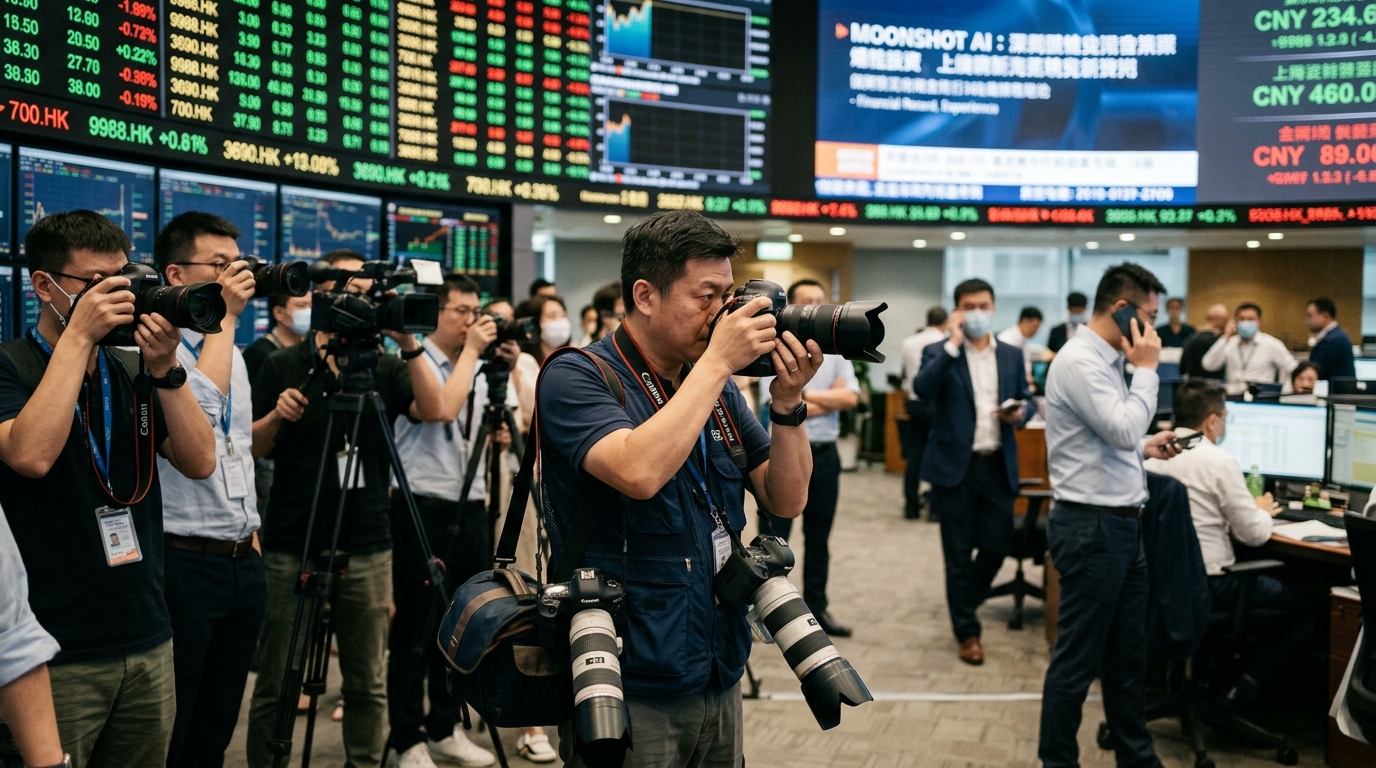
In the high-stakes geopolitical chess match of artificial intelligence, China has just made a move that resonates across the globe. Moonshot AI PTE. LTD., the rising power behind the popular Kimi chatbot, has announced the completion of a massive funding round totaling 7.62 billion yuan (approximately $1.05 billion). This investment, featuring heavyweights such as Meituan Long-Z Investments, China Mobile Limited, and CPE Funds Management, is not merely a liquidity injection; it is a definitive statement of intent regarding the technological sovereignty of the world's second-largest economy.
The Long Context Strategy
Moonshot AI, led by the charismatic Yang Zhilin—a veteran of Google and Meta—has successfully differentiated itself in a saturated market through a specific technical edge: the massive "context window." While most models struggle to maintain coherence over long texts, Moonshot’s Kimi can process hundreds of thousands, and now millions, of Chinese characters in a single prompt. This capability makes the model indispensable for legal analysis, academic research, and complex programming—fields where precision across vast volumes of data is paramount.
The participation of China Mobile in this funding round is particularly telling. As the world's largest mobile carrier, China Mobile possesses the infrastructure and data necessary for the widespread deployment of AI to the masses. The synergy between an agile startup and a state-owned telecommunications giant highlights the Chinese development model: the fusion of private innovation with state power.
Western Competition and the Domestic Chessboard
This funding comes at a time when the U.S. is intensifying restrictions on the export of advanced semiconductor chips to China. Moonshot AI is tasked with proving it can train world-class models using either older hardware or domestic alternatives. The Chinese market is no longer a "copycat" of Silicon Valley. With players like Baidu (Ernie Bot), Alibaba (Tongyi Qianwen), and Zhipu AI, the competition is cutthroat. However, Moonshot is now considered one of the "Six Little Dragons" of Chinese AI, a group of companies with the financial and technical muscle to challenge the dominance of OpenAI and Google.
"Artificial intelligence is no longer just a matter of code, but a matter of national power and economic survival in the new digital paradigm," say market analysts in Beijing.
Economic Implications and the Road Ahead
For investors, Moonshot AI represents a high-risk, high-reward opportunity. Meituan, a leader in delivery services and local commerce, sees in Kimi a tool for automating customer service and optimizing logistics on a scale previously unimaginable. The company's valuation following this round places it among the elite of global unicorns.
However, challenges remain. Beijing's censorship and strict regulations on AI-generated content represent a constant hurdle. Moonshot must balance the model's creative output with compliance with Chinese government guidelines. Whether it can expand beyond China's borders remains the big question, as Western distrust of Chinese technology remains at an all-time high.
- Focus on large context windows for specialized professional use cases.
- Strategic alliance with state entities for infrastructure access.
- Resilience against U.S. sanctions through algorithmic optimization.
In conclusion, Moonshot AI is not just a software company; it is a symbol of a China that refuses to be left behind in the race of our generation. With 7.62 billion yuan in its coffers, Yang Zhilin's "rocket" has the fuel it needs to reach the moon—or at least the summit of the global AI hierarchy.





