

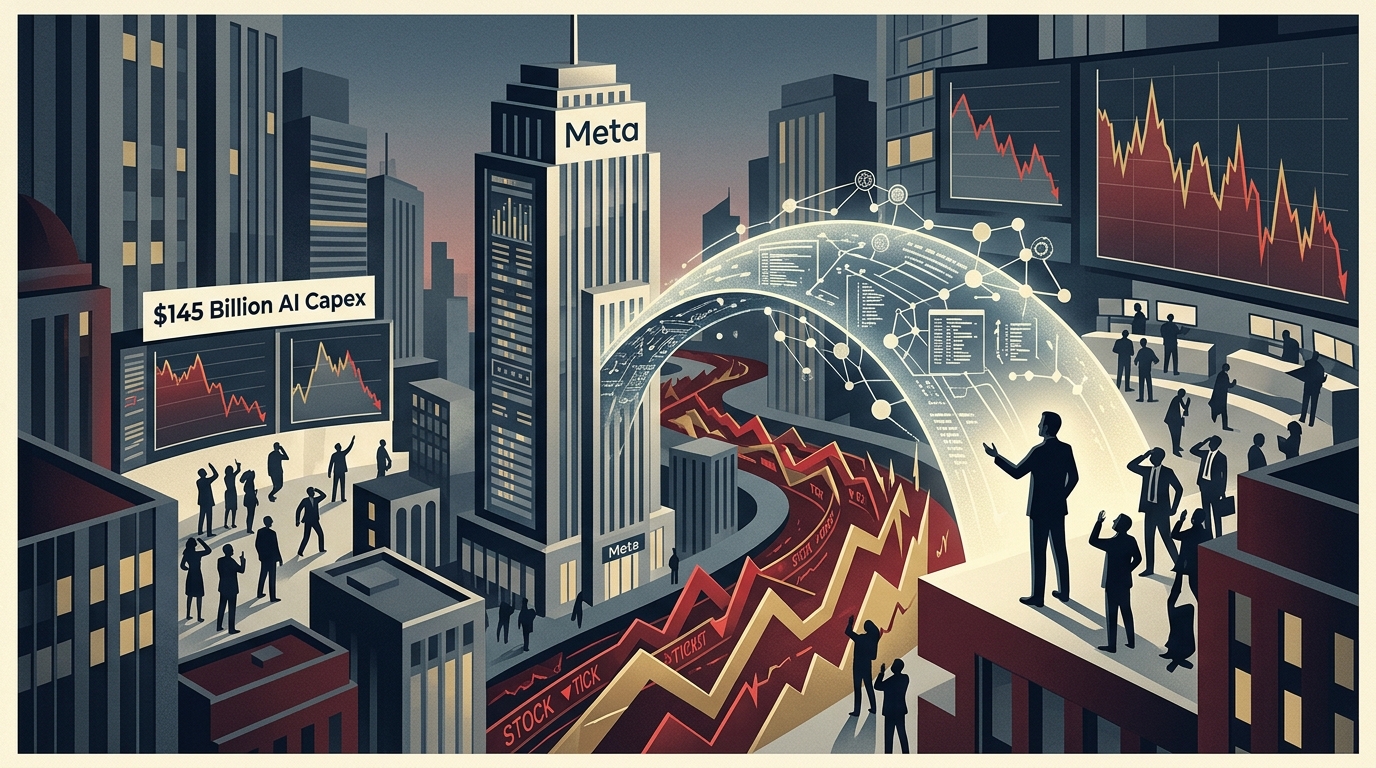
In the chronicles of technological evolution, there are moments when the leaders of global titans decide to burn their bridges, tethering their companies' destinies to a single, uncompromising vision. For Mark Zuckerberg, that moment arrived on April 29, 2026. Meta’s announcement that its capital expenditure (Capex) for 2026 could reach a staggering $145 billion is not merely a corporate update; it is a declaration of intent that reshapes the global economic landscape. Yet, investors—who typically crave growth but loathe uncertainty—responded with a sharp 6% decline in the company’s stock price.
The Transformation into an Infrastructure Giant
For decades, Meta (formerly Facebook) was viewed as a software and advertising firm with high margins and relatively low physical asset requirements. That model is now officially a relic of the past. The new forecast for 2026 reveals that Zuckerberg is transforming his empire into an infrastructure behemoth, directly challenging the likes of Amazon Web Services and Google, not just in content, but in the very hardware substrate of the digital age. The $145 billion is earmarked for the procurement of hundreds of thousands of next-generation Nvidia chips, the construction of proprietary data centers powered by modular nuclear reactors, and the development of Llama 5—the model Meta hopes will serve as the world’s operating system for intelligence.
The scale of these figures is dizzying. This sum is larger than the GDP of several European nations and exceeds Meta’s total spending for 2024 and 2025 combined. Zuckerberg appears to believe that in the AI arms race, there is no prize for second place. “The risk of being late is infinitely greater than the risk of over-investing,” he told analysts during the earnings call, echoing the “move fast and break things” mantra of his youth, but with significantly higher financial stakes.
Wall Street’s Skepticism and the Ghost of the Metaverse
Why are investors flinching? The answer lies in the scars of the recent past. Many analysts remember the billions lost in Reality Labs for the Metaverse—a bet that has yet to yield a meaningful return. Wall Street fears that Meta is entering a new cycle of unbridled spending without a clear horizon for return on investment (ROI). While the company’s core advertising business remains robust, profit margins will inevitably be squeezed under the weight of this massive capital deployment.
- The 40% hike in spending compared to previous forecasts caught analysts off guard.
- The lack of granular detail on how AI Agents will directly monetize remains a point of friction.
- Energy constraints and the cost of transitioning data centers to sustainable power add layers of complexity.
Despite the stock market’s immediate allergic reaction, Meta possesses an advantage its competitors envy: direct access to billions of users via Instagram, WhatsApp, and Facebook. If AI is successfully woven into these platforms, Meta won’t just be selling technology; it will own the daily interface between humanity and machine intelligence.
Conclusion: An Existential Choice
Zuckerberg is no longer playing a game of optics. He is playing a game of survival. In a world where computational power translates directly into geopolitical and economic leverage, Meta is choosing to become the “railroad” of the new era. The question is no longer whether AI is the future—that is now a consensus—but whether shareholders have the fortitude to wait for Zuckerberg to complete the most expensive infrastructure project in the history of capitalism. April 30, 2026, will be remembered as the day Silicon Valley stopped measuring success in lines of code and started measuring it in gigawatts and billions.





