

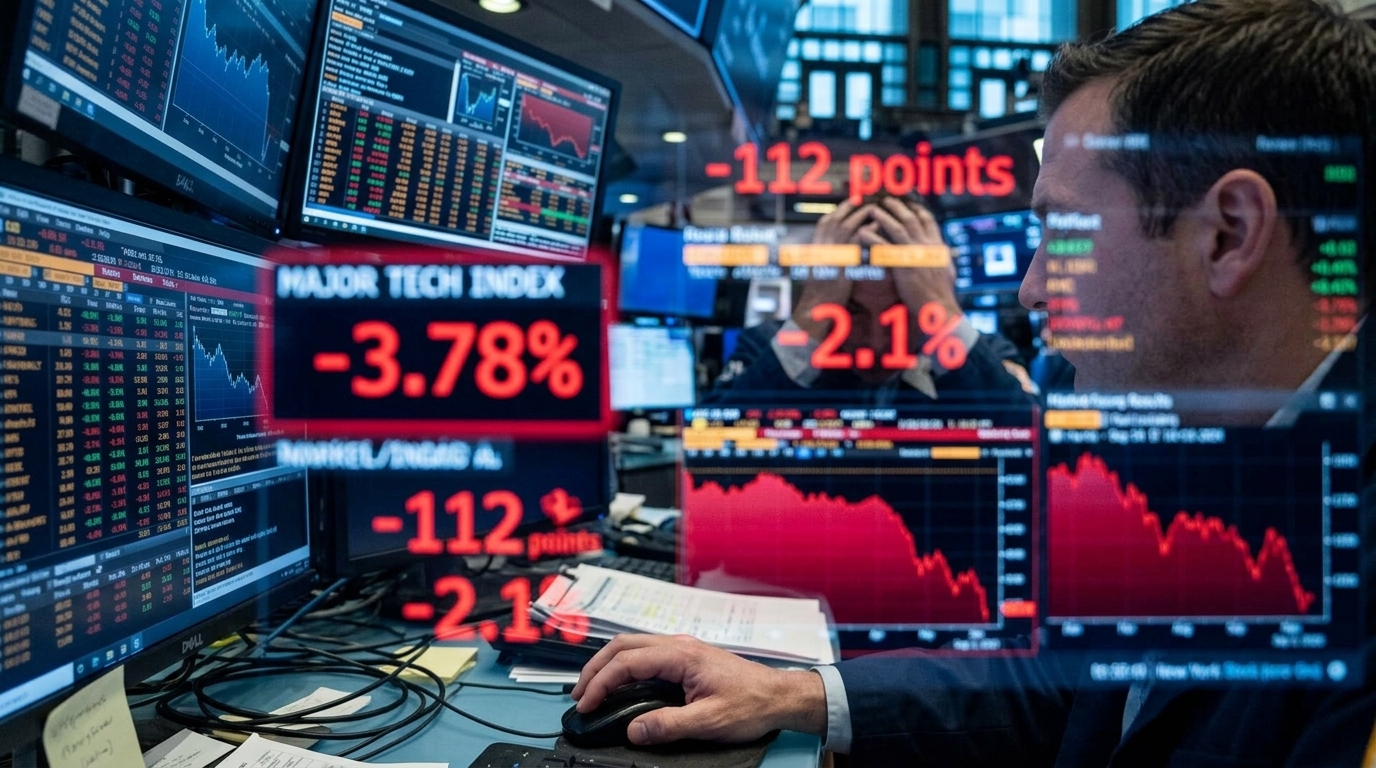
The stock market euphoria fueled by Artificial Intelligence (AI) is at a critical crossroads. As we move through the summer of 2026, the market seems to be balancing between the promise of a new industrial revolution and the fear of a violent 'momentum crash.' Wall Street and City of London strategists are flashing warning signs, noting that capital concentration in a handful of tech giants has reached levels that historically precede major corrections.
The Concentration Trap and the Dominance of the 'Few'
The primary argument of those concerned is the extreme concentration of the S&P 500. A small group of companies—Nvidia, Microsoft, Alphabet, and Amazon—account for the lion's share of the index's gains over the past two years. This phenomenon creates an illusion of stability in the broader market, while in reality, the system's health depends on the performance of very few players. When the 'momentum' of these stocks begins to fade, the fallout can be cascading.
According to a recent Reuters analysis, Relative Strength Indexes (RSI) for semiconductor stocks have been in 'overbought' territory for months. History teaches us that when the market becomes so one-sided, the slightest disappointment in corporate earnings or a shift in Fed interest rate policy can trigger mass liquidations. The question is no longer whether AI is the future, but whether current valuations have priced in gains that will take decades to materialize.
The Gap Between Capital Expenditure (CapEx) and Revenue
One of the most alarming points raised by market bears is the massive gap between capital expenditures (CapEx) and actual revenue from AI services. Big Tech companies are spending hundreds of billions of dollars on chips and data centers. However, the adoption of Generative AI by enterprises and consumers has not yet translated into corresponding profitability for software providers.
"We are in the phase of building the railroads, but we don't see the trains carrying goods profitably yet," a Goldman Sachs analyst noted.
This imbalance strongly echoes the 1999-2000 period, when telecommunications companies spent billions on fiber optics that remained 'dark' (unused) for years. If investors begin to question the Return on Investment (ROI) of these expenditures, the divestment from the sector will be sharp, causing what economists call a 'momentum crash': a situation where the best-performing stocks collapse faster than the rest of the market.
The Inflation Factor and Interest Rates
The macroeconomic picture further complicates matters. Despite expectations for rate cuts, persistent inflation in certain sectors is forcing central banks to keep borrowing costs high. Growth stocks, such as those in technology, are particularly sensitive to interest rates. As long as the cost of money remains high, the future cash flows of AI companies are valued lower in the present.
Furthermore, geopolitical instability and restrictions on technology exports to China are creating bottlenecks in the semiconductor supply chain. If Nvidia or ASML face production or distribution issues due to political pressure, the edifice of the AI trade will take a heavy hit. Markets have already begun pricing in this risk, with volatility (VIX) showing upward trends.
Conclusion: Correction or Collapse?
Despite the warnings, many argue that the current situation differs from the dot-com bubble. Today's tech leaders possess massive cash reserves and real profits, unlike the companies of 2000 that relied on 'clicks' and hopes. However, even the best companies can become overvalued. A 'momentum crash' does not necessarily mean the end of AI, but a violent rationalization of expectations. Investors are now called to be extremely selective, as the period where 'anything AI-related goes up' seems to be coming to an end.





