

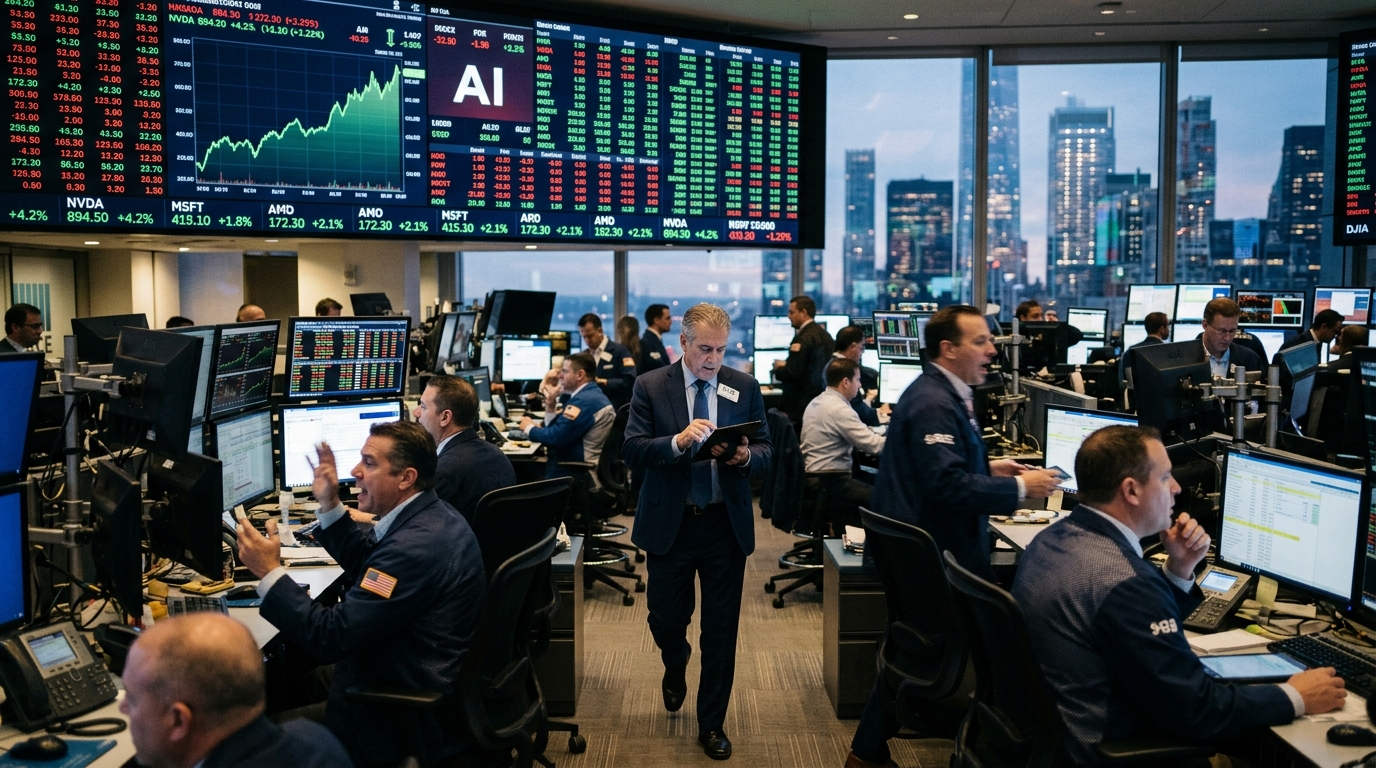
The history of financial markets is, to a large extent, a history of identifying and exploiting scarcity. Today, as the Artificial Intelligence (AI) revolution enters its most mature and capital-intensive phase, Wall Street has found a new mantra: 'chase the bottlenecks.' It is no longer just about who has the best large language model, but about who controls the physical constraints that prevent the technology from scaling.
The Bottleneck Strategy
In early 2026, the investment community seems to have internalized a lesson from the Gold Rush era: in the search for gold, the shovel sellers make the most reliable profits. However, in the case of AI, the 'shovels' have become extraordinarily complex. Bottlenecks have shifted from Nvidia’s semiconductors to a broader ecosystem of infrastructure. Wall Street analysts note that investors 'love chasing bottlenecks' because they offer pricing power and high margins.
When demand for a service far exceeds supply, the companies that hold the 'key' to production can dictate terms. Currently, the congestion is concentrated in three main pillars: electrical power, data center cooling systems, and fiber optic network capacity. The stocks of companies operating in these sectors have seen a surge reminiscent of the dot-com glory days, but with a crucial difference: there are real revenues and multi-billion dollar contracts backing them up.
From Chips to Power: The Great Shift
While Nvidia remains the undisputed leader in processors, focus is now shifting to energy. AI data centers consume vast amounts of electricity, driving utilities and renewable energy providers into a new era of growth. Wall Street is betting that the lack of available power will be the next major hurdle to skyrocket the valuations of companies that can provide it.
- The Electrical Grid: Companies modernizing transformers and transmission networks are seeing their order books filled for the next decade.
- Liquid Cooling: As GPUs become more powerful, traditional air cooling is no longer sufficient. Leaders in liquid cooling technology are now 'must-haves' in Wall Street portfolios.
- Nuclear Energy: The revival of SMRs (Small Modular Reactors) is being fueled almost exclusively by Big Tech’s (Microsoft, Amazon, Google) need for stable, zero-emission power.
This shift reflects a deeper market understanding: AI is not an intangible technology living in the 'cloud,' but a heavy industry that requires concrete, copper, and inexhaustible amounts of electrons.
Valuations and the Bubble Fear
Despite the excitement, voices of skepticism are not absent. Earnings multiples on some of these 'ancillary' stocks have reached levels that historically precede corrections. The question haunting strategists is whether AI demand will ultimately justify these massive infrastructure investments (Capex). If software companies fail to turn AI into profitable products for the end consumer, then demand for new data centers could collapse abruptly.
'Markets have a tendency to discount the future with excessive optimism. Chasing bottlenecks is profitable until the moment technology finds an alternative path or the constraint is lifted through oversupply,' notes a senior executive at a major investment bank.
However, proponents of the rally argue that this time is different. The need for computing power is now considered as fundamental as the need for oil was in the 20th century. In this context, 'bottlenecking' is not a transient problem, but the new normal of an economy digitizing at a geometric rate.
Conclusion: The Geopolitics of Scarcity
In closing, it must be noted that chasing bottlenecks has a strong geopolitical dimension. Access to advanced chips, securing energy resources, and controlling telecommunications hubs are now matters of national security. Wall Street is not just investing in companies, but in strategic advantages that will define the power of nations in the coming decades. The AI stock rally may be 'epic,' but its roots are buried deep in the material reality of the global economy.





