

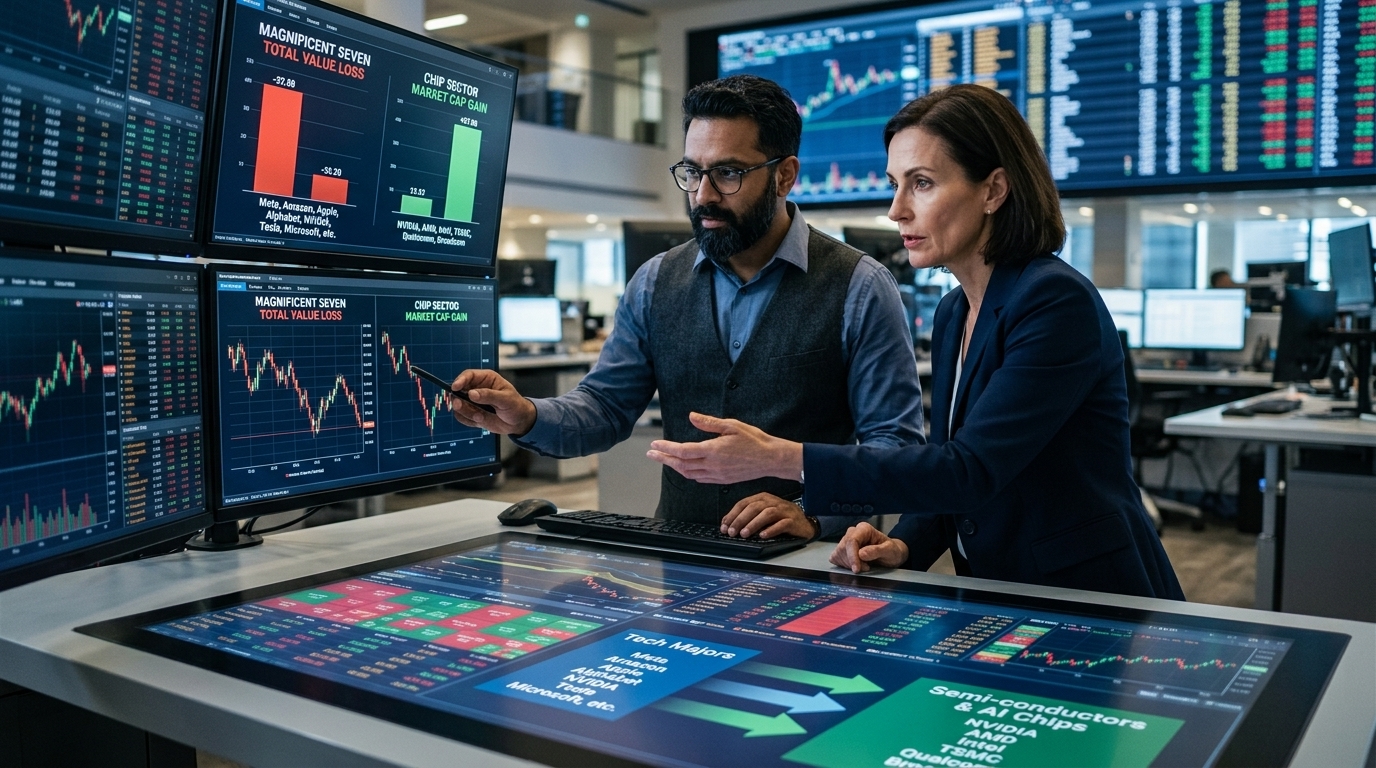
In the ever-shifting landscape of the global economy, June 30, 2026, will likely be recorded as the moment when 'blind faith' in the tech titans gave way to a more strategic, tangible approach. The 'Magnificent Seven' (Apple, Microsoft, Alphabet, Amazon, Nvidia, Meta, and Tesla), which for years served as the safe haven and engine of the S&P 500, saw their market capitalization shrink by an astronomical $2.3 trillion in just one month. This massive exodus of capital is not merely a correction but a structural realignment of the investment map.
The Shift from Platforms to Infrastructure
Why are investors deserting Wall Street's 'golden children'? The answer lies in the maturation of the Artificial Intelligence cycle. While 2024 and 2025 were the years of promise and Large Language Models (LLMs), 2026 is the year of implementation and scaling. Investors are realizing that for the software applications of Microsoft and Google to deliver, an unprecedented level of computing power is required—one that only semiconductor manufacturers can provide.
The pivot toward chip companies like TSMC, ASML, Broadcom, and ARM reflects a 'picks and shovels' strategy. Much like the Gold Rush era, those who made the most money weren't the miners, but those who sold the equipment. Today, 'gold' is data and its processing, and the 'picks' are next-generation semiconductors.
The Weight of Valuations and Revenue Fatigue
An additional factor behind the $2.3 trillion loss is the astronomical valuations the Magnificent Seven had reached. With P/E (price-to-earnings) ratios often exceeding 40 or 50, earnings expectations had become nearly impossible to satisfy. Despite these companies continuing to show strong profitability, the slightest slowdown in the growth rate of cloud or advertising revenue triggers waves of liquidations.
In contrast, the semiconductor sector offers a clearer growth narrative. Orders for specialized AI chips are booked two years in advance, providing revenue visibility that consumer software companies struggle to guarantee in an environment where competition in generative AI has become cannibalistic.
Geopolitics and the Supply Chain
We cannot ignore the geopolitical context of 2026. Increasing pressure for 'technological sovereignty' between the US and China has made semiconductors the most valuable commodity in the world. The shift of capital toward companies that control manufacturing (foundries) and chip design is also a move to insulate portfolios. Investors are betting on companies that are 'too big to fail' within the framework of major powers' national security.
- Apple faces saturation in the smartphone market despite AI integrations.
- Microsoft is pressured by the high maintenance costs of data centers.
- Tesla sees competition from China squeezing its profit margins.
- Semiconductors remain the bottleneck through which the entire digital economy must pass.
"The market is not punishing innovation, but rather excessive optimism that isn't accompanied by immediately measurable results in infrastructure," Wall Street analysts note.
In conclusion, the $2.3 trillion loss marks the end of an era where technology was treated as a monolithic block. Now, the distinction between 'service providers' and 'infrastructure providers' is clear, with the latter holding the keys to future growth. The remaining question is whether this pivot toward chips will create a new bubble or if it represents the foundation of a healthier, more realistic digital economy.





