

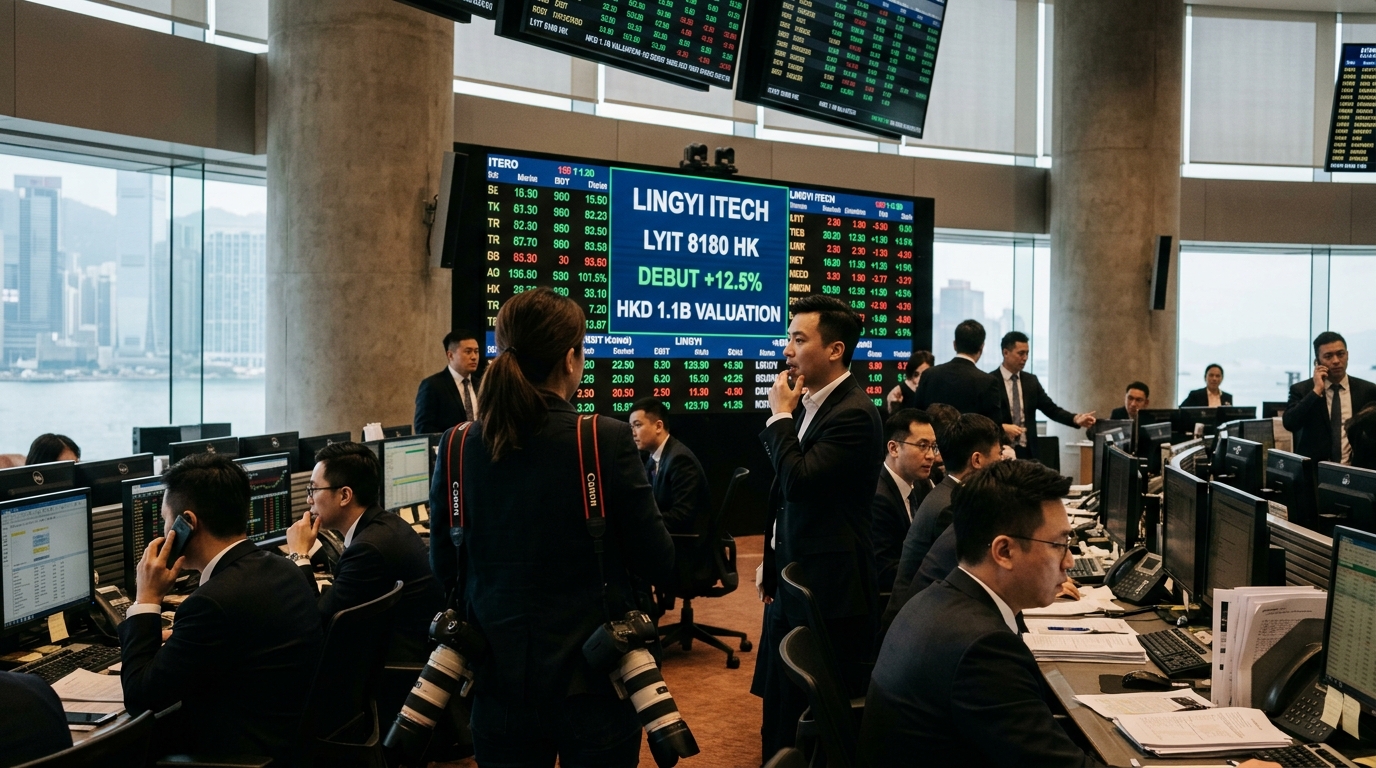
The listing of Lingyi iTech Guangdong Co. on the Hong Kong Stock Exchange (HKEX) is more than just another corporate headline; it is a significant barometer for the trajectory of the global tech market in 2026. As a pivotal link in Apple’s intricate supply chain, Lingyi managed to raise HK$8.3 billion (approximately $1.06 billion), marking one of the city's most substantial initial public offerings this year.
The Strategic Weight of a Dual Listing
Already a staple on the Shenzhen Stock Exchange, Lingyi iTech’s move to Hong Kong reflects a broader trend among Chinese tech titans seeking international capital in a geopolitically charged environment. The success of the IPO, which saw heavy oversubscription from institutional investors, demonstrates that despite persistent rhetoric regarding 'decoupling' between the U.S. and China, investor appetite for the companies powering Apple’s ecosystem remains voracious.
Lingyi is far from a generic manufacturer. It specializes in high-precision components, including thermal management modules, adapters, and internal structural parts for iPhones, iPads, and Macs. In an era where Artificial Intelligence (AI) demands increasingly robust hardware with sophisticated heat dissipation capabilities, Lingyi finds itself at the very heart of technological evolution.
The 'China Plus One' Strategy and Global Expansion
A primary driver behind this capital raise is the financing of the company's international expansion. Lingyi iTech is strictly adhering to the 'China Plus One' strategy, establishing manufacturing hubs in Vietnam, India, and Brazil. This shift is essential to meet Apple’s demands for supply chain diversification and a reduced reliance on mainland China.
- Expansion of facilities in Vietnam to produce next-generation components.
- Strengthening presence in India, which is rapidly becoming the second-largest hub for iPhone assembly.
- Significant R&D investment into materials for upcoming Augmented Reality (AR) and wearable devices.
The company’s ability to maintain profitability while migrating portions of its production outside China is a high-stakes gamble that investors seem to be backing. The stock’s upward trajectory immediately following the opening bell provided a much-needed boost to the HKEX, which is striving to reclaim its status as Asia’s premier financial hub.
Challenges and Geopolitical Headwinds
Despite the initial triumph, the path forward is fraught with complexity. Lingyi iTech operates on a razor's edge. On one hand, it is heavily dependent on Apple’s procurement cycles—a customer concentration risk that consistently concerns analysts. On the other, the ongoing trade friction between Washington and Beijing could, at any moment, disrupt access to advanced manufacturing equipment or trigger new tariffs.
“Lingyi’s success in Hong Kong is a vote of confidence in the resilience of Chinese manufacturing prowess, even as it is forced to transmute into a truly global entity,” notes a senior tech market analyst.
In conclusion, Lingyi iTech’s IPO is a landmark event for 2026. It proves that capital continues to flow toward efficiency and innovation, irrespective of political boundaries. The company must now demonstrate that it can utilize this $1.1 billion windfall to evolve from a Chinese supplier into a global technological powerhouse that dictates the future of the supply chain.





