In the traditional world of insurance, where decisions are often made in wood-paneled offices amidst decades of archived files, Lemonade Inc. emerged as the digital insurgent promising to topple the status quo. Today, as 2026 finds artificial intelligence at its peak maturity, the company is no longer satisfied with simple chatbots. It is betting its very survival on a model based entirely on algorithms, forcing investors to ask: Is this the future of risk management, or a dangerous tech bubble?
The Rise of Synthetic Agents: Automating Trust
Lemonade is not just an insurance company with a slick app. At its core, it is a data company that happens to sell insurance. Its recent pivot toward "Synthetic Agents" represents its most ambitious undertaking to date. These agents are nothing less than sophisticated machine learning models that handle the entire lifecycle of a policy: from initial pricing and underwriting to claims management.
This strategy aims to eliminate human error and, more importantly, human cost. In an industry where operating expenses can consume 20-30% of revenue, Lemonade claims it can operate at a fraction of that cost. Synthetic Agents allow the company to scale its operations without hiring thousands of employees, effectively turning fixed costs into variable ones. This "capital-light" model is what excites tech analysts but deeply concerns traditional actuaries.
The Loss Ratio Enigma: Can AI Predict the Unpredictable?
The most critical metric for any insurer is the loss ratio—the percentage of premiums paid out in claims. For years, Lemonade struggled with high ratios that spooked the market. The company’s promise has always been that as its AI collects more data, it will better predict risk, thereby lowering losses. According to recent data, this promise is beginning to bear fruit, with the loss ratio showing steady improvement.
"We are not building an insurance company on top of AI; we are building an AI model that issues insurance," company executives frequently state.
However, the challenge remains: climate change and unpredictable natural disasters represent "black swans" that often escape the historical data on which AI is trained. If Lemonade's model fails to predict a series of extreme weather events, its technological edge could turn into a financial trap. Wall Street remains divided, with some seeing a future "Apple of Insurance" and others an overpriced software firm masquerading as an underwriter.
Investor Psychology and the Battle with Giants
While Lemonade innovates, traditional giants like State Farm and Geico are not standing still. They are investing billions into their own digital transformations. Lemonade’s advantage is the absence of legacy systems—it doesn't need to modernize old databases because it was born in the cloud. But its disadvantage is scale. In insurance, size provides statistical safety and the ability to absorb shocks.
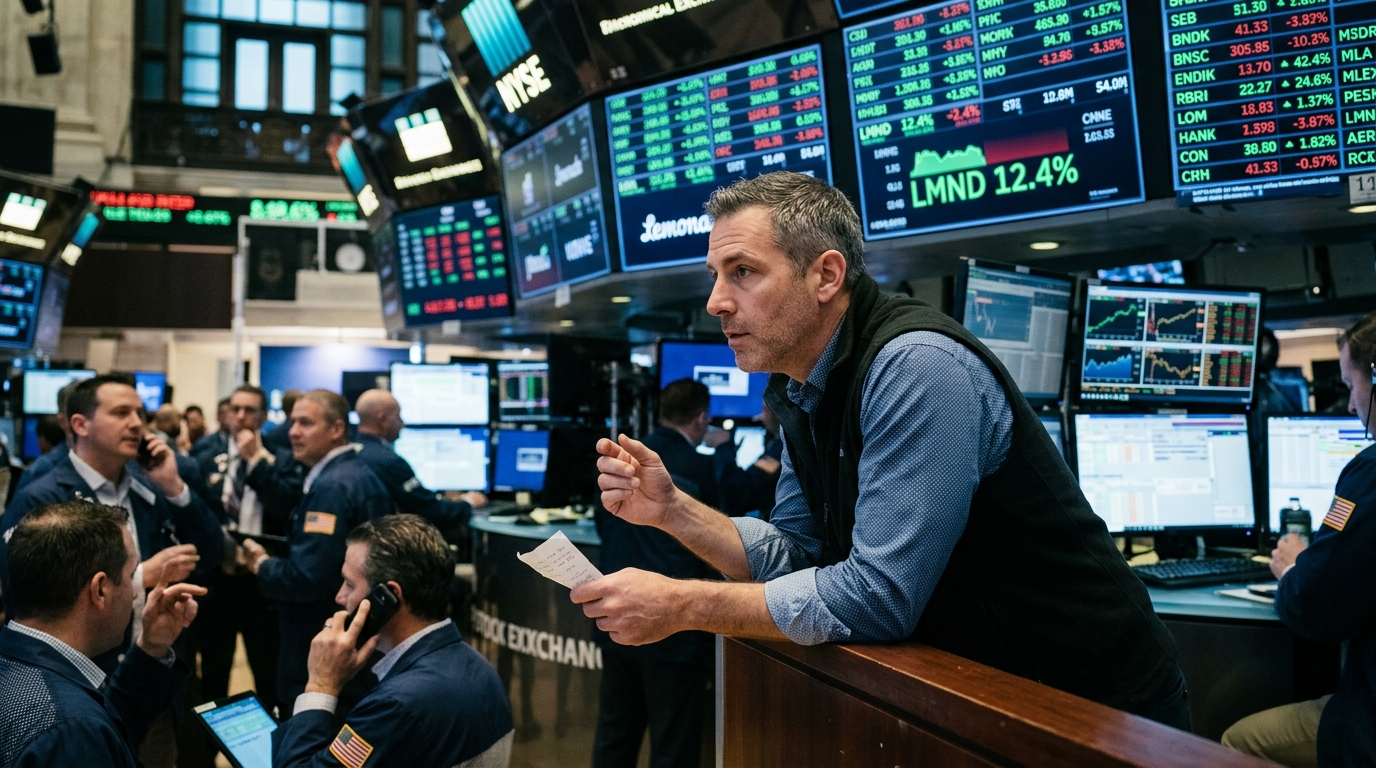
Investors eyeing Lemonade stock must weigh two factors: exponential customer growth (driven by transparency and speed) and long-term profitability. The use of AI to create Synthetic Agents is a real-time experiment in whether technology can replace decades of underwriting experience. If Lemonade can prove its algorithm is more accurate than a seasoned actuary, then its current valuation might actually be a bargain.
Conclusion: A New Era for Risk
The case of Lemonade is a textbook example of the "creative destruction" brought about by AI. It isn't just about improving a process; it’s about completely restructuring the concept of insurance. For the average consumer, this means lower premiums and faster payouts. For the investor, it means participating in a high-stakes bet with the hope of a massive payoff. One thing is certain: the insurance industry will never be the same, and Lemonade is the hare leading the race.