

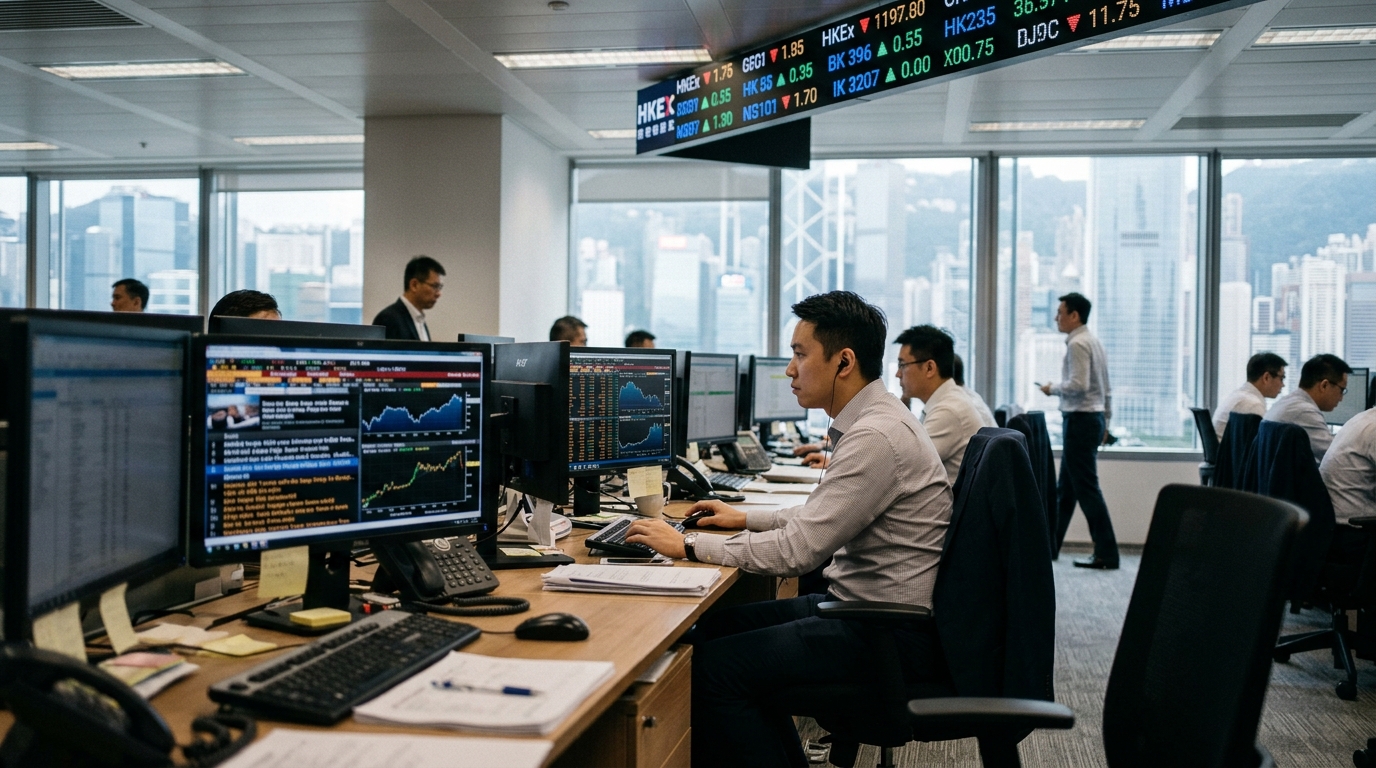
In the heart of Hong Kong’s financial district, a company once viewed as a traditional manufacturer of industrial components has emerged as the ultimate stock market protagonist of 2026. Kingboard Laminates Holdings Ltd., the world’s largest producer of copper-clad laminates (CCL), has seen its market capitalization soar by 550% since the beginning of the year. What is unfolding is not merely a speculative bubble, but a fundamental 're-rating' of the company’s value within the context of the global Artificial Intelligence explosion.
The Transformation from Commodity to AI Play
For decades, Kingboard Laminates was considered a cyclical stock, inextricably linked to the fortunes of consumer electronics such as smartphones and personal computers. Its products—the copper sheets that form the base of printed circuit boards (PCBs)—were essential but regarded as low-margin commodities. However, the advent of Generative AI changed the calculus. AI servers require boards of significantly higher quality, featuring exceptional heat resistance and minimal signal loss.
Kingboard successfully upgraded its production lines, offering high-tech materials indispensable for the accelerators produced by Nvidia and other industry titans. This shift allowed analysts to stop viewing the company as a simple industrial supplier and begin valuing it as a critical link in the AI supply chain, akin to semiconductor firms.
The Geopolitical Chessboard and Chinese Dominance
The rise of Kingboard cannot be examined independently of the geopolitical context. While the U.S. imposes restrictions on the export of advanced chips to China, the supply chain for the materials used to build these systems remains largely centered in Asia. Kingboard, headquartered in Hong Kong with a production base in mainland China, benefits from Beijing’s push for technological self-reliance.
- Vertical Integration: The company produces its own raw materials (glass fiber, epoxy resin), giving it a massive cost advantage.
- Scale: The ability to mass-produce materials to AI specifications is something few competitors can match.
- Strategic Location: Proximity to assembly hubs in Shenzhen and Dongguan reduces logistics costs.
Western investors, initially wary of Chinese tech stocks due to regulatory risks, seem to be setting aside their fears in the face of impressive fundamentals. Kingboard is no longer a 'cheap' Chinese stock; it is a global leader setting prices in the high-performance materials market.
Financial Analysis and Outlook
The explosive rise in the share price has been accompanied by a dramatic improvement in financial metrics. The company’s profit margins doubled within 18 months as demand for high-speed CCL surpassed all expectations. Analysts at Goldman Sachs and Morgan Stanley revised their price targets multiple times during the first half of 2026, noting that Kingboard is in the market's 'sweet spot.'
“This is not a simple recovery of the electronics sector. It is a structural shift where AI infrastructure becomes the primary driver of demand for advanced materials, and Kingboard holds a monopoly on scale,” a recent Bloomberg Intelligence report states.
However, there are voices of skepticism. Some warn that the 550% rally already incorporates the most optimistic forecasts for the next five years. If global demand for AI data centers slows down or if there is an oversupply of materials from new players, the correction could be as violent as the ascent.
The Future of Industrial AI
The case of Kingboard Laminates serves as a lesson in how AI is transforming not just software, but heavy industry. A company’s ability to adapt its physical infrastructure to the needs of the digital future is the key to survival and success in the 21st century. As the world moves toward even more complex AI models, the need for even more sophisticated materials will continue to grow, placing companies like Kingboard at the heart of the new industrial revolution.
In conclusion, Kingboard’s rally is a reminder that AI is not just about code and algorithms. It is about the copper, glass, and chemistry that allow those algorithms to run. For Hong Kong, this success provides a much-needed injection of optimism, proving that the city remains a vital hub for financing the technology of the future.





