

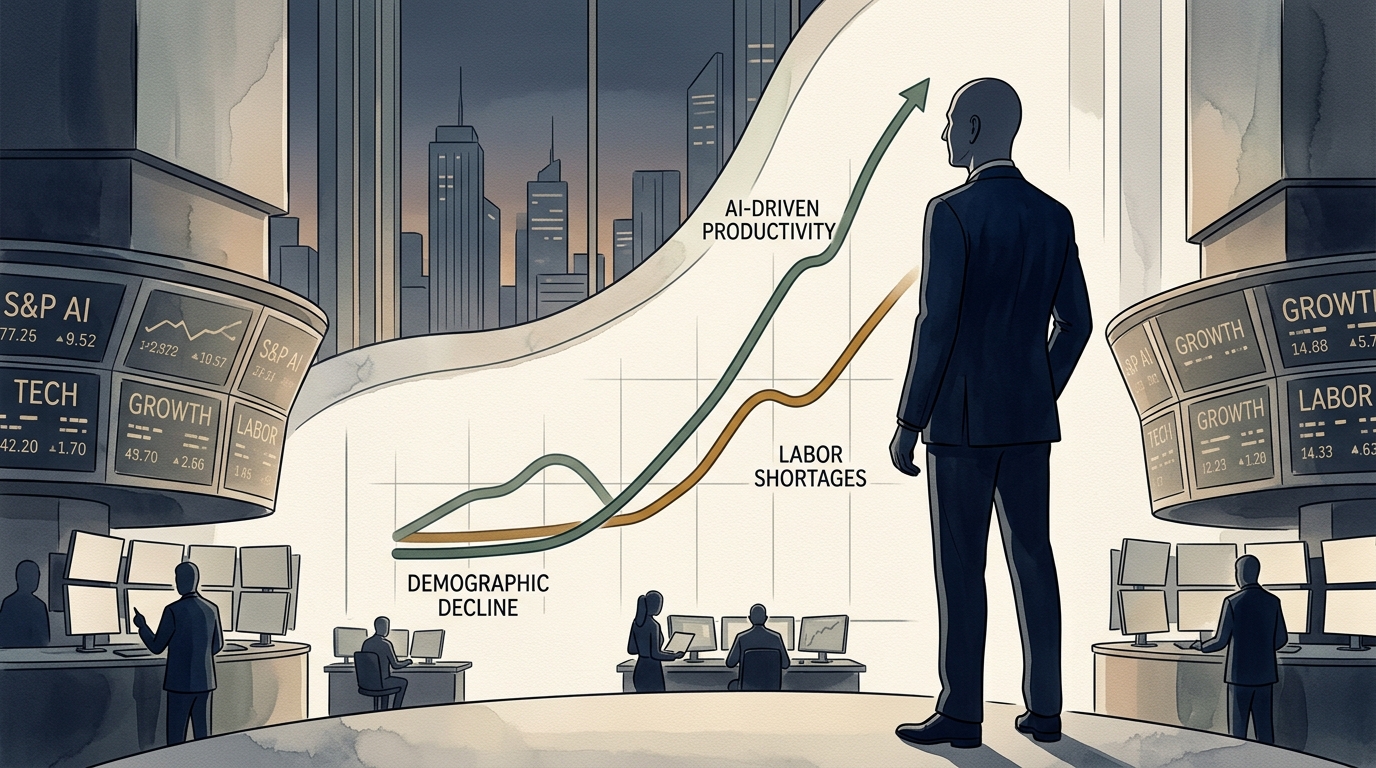
In an era where public discourse on Artificial Intelligence (AI) is dominated by dystopian scenarios of mass unemployment and social destabilization, Jeff Bezos chooses to follow a diametrically opposite path. The founder of Amazon and one of the world's wealthiest individuals argues that the real problem of the future will not be a lack of jobs, but a lack of people to fill them. Bezos's position, which aligns with current demographic trends in developed economies, suggests that AI is not a competitor to be feared, but a necessary ally for maintaining global prosperity.
The Luddite Fallacy and the New Reality
Historically, every major wave of technological innovation has been accompanied by the fear of "technological unemployment." From the 19th-century Luddites to the introduction of personal computers in offices, the concern has remained the same: machines will replace human hands. However, Bezos points out that history has proven the opposite. Technology increases productivity, which leads to lower costs for products and services, ultimately increasing demand and creating new, often unpredictable, categories of professions.
According to Bezos's analysis, AI will act as a power multiplier. Instead of eliminating jobs, it will allow smaller groups of people to achieve much more. Within the context of Amazon, for example, the introduction of thousands of robots in warehouses did not lead to layoffs but to an unprecedented increase in the company's global workforce, as increased efficiency allowed for faster expansion into new markets.
The Demographic Time Bomb and AI's Role
Bezos's strongest argument is rooted in demographics. The West, Japan, and now China are facing an unprecedented decline in the working-age population. With fertility rates falling below replacement levels, the economies of these countries risk stagnation due to a shortage of labor. "We don't have enough people," is the central message.
In this scenario, Artificial Intelligence and automation do not come to steal jobs but to fill the gaps left by an aging population. Without AI, elderly care, infrastructure maintenance, and goods production would become prohibitively expensive due to labor scarcity. Automation thus becomes an existential necessity for maintaining the standard of living.
- AI will take over repetitive and dangerous tasks, freeing human capital for more creative roles.
- Labor shortages will lead to wage increases for positions requiring human judgment and empathy.
- Businesses that fail to adopt AI will find themselves uncompetitive, not because of cost, but due to an inability to find staff.
The Challenge of Transition
Despite his optimism, Bezos does not ignore the difficulties of the transition. The issue is not the total number of jobs, but the matching of skills. The labor market will undergo a violent restructuring where the ability to collaborate with AI will be the primary qualification.
"The question is not whether there will be work, but whether workers will be prepared for the work that will exist,"he notes emphatically.
Education and lifelong learning are becoming the most critical tools of social policy. The state and businesses must invest heavily in reskilling the population. Bezos's optimistic outlook assumes a society that is flexible and ready to embrace change, rather than trying to block it with regulatory hurdles that may ultimately harm economic growth.
Conclusions for the Future
Bezos's approach offers a necessary dose of realism to the debate over the future of work. By focusing on demographic reality, he shifts the emphasis from the fear of technology to the need for strategic planning. If AI is indeed the tool that will allow us to prosper in a world with fewer workers, then the challenge of our time is not to restrict it, but to integrate it rapidly and fairly into the production process. The future Bezos describes is not a world without work, but a world where work will be more valuable, more efficient, and, ultimately, more human.





