

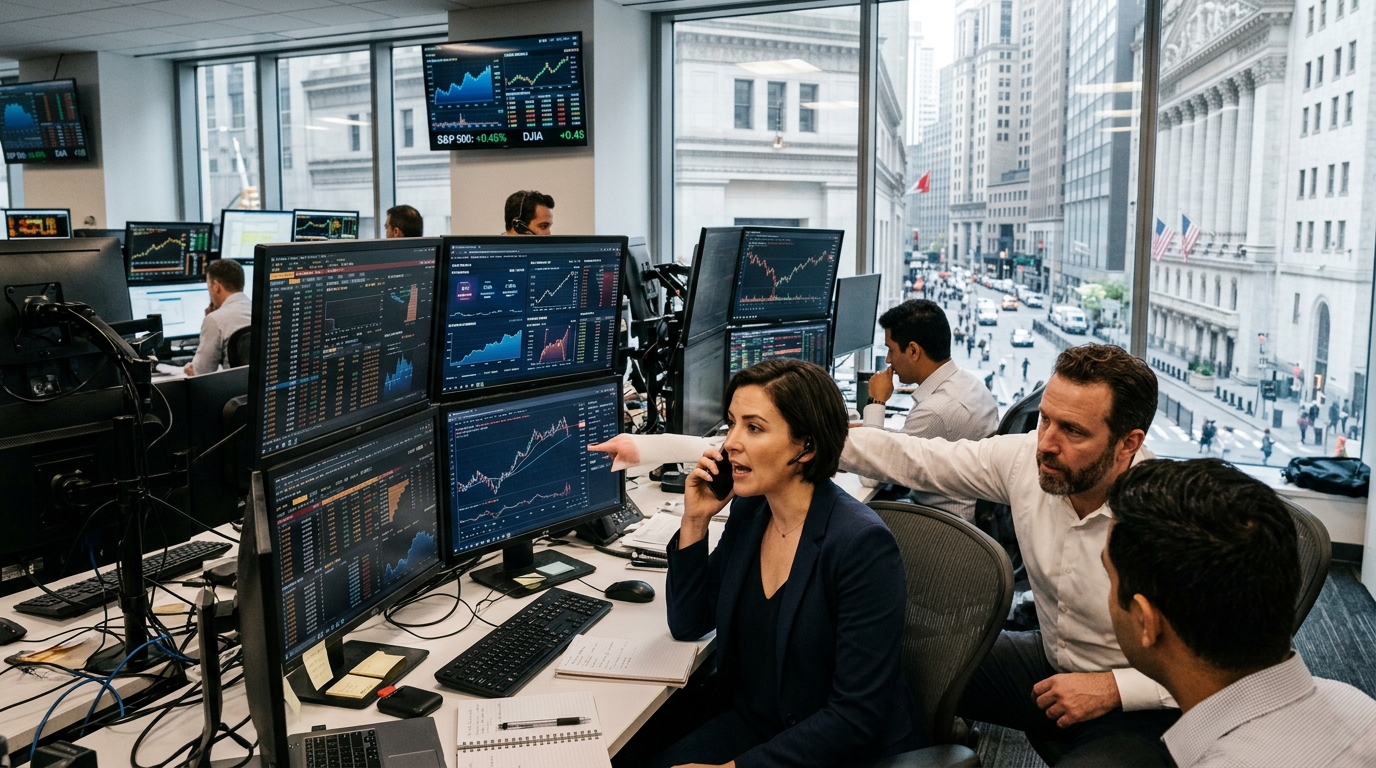
The traditional image of Wall Street, with legions of analysts in expensive Manhattan offices poring over balance sheets, is fast becoming a relic of the past. Today, the battle for alpha is fought within lines of code and across cloud servers. A new breed of hedge funds, often consisting of small, lean teams of data scientists, is leveraging Artificial Intelligence to assault the market share once held exclusively by titans like BlackRock, Citadel, and Renaissance Technologies.
The Democratization of Data and the Fall of Entry Barriers
For decades, the advantage of large hedge funds rested on privileged access to data and the financial muscle to employ hundreds of PhDs to analyze it. The advent of Large Language Models (LLMs) and Generative AI has fundamentally shifted this equation. Today, a fund with a headcount of just five can utilize AI tools to process millions of pages of unstructured data—ranging from earnings call transcripts and social media sentiment to satellite imagery of retail parking lots—in mere minutes.
These boutique funds are not merely mimicking the giants. Instead, they are developing specialized algorithms that detect micro-correlations that the human eye, or even older quantitative models, are incapable of perceiving. The use of AI allows for the creation of 'synthetic analysts' that work 24/7, assessing global economic sentiment in real-time, free from the cognitive biases or fatigue that plague human operators.
From Passive Analysis to Predictive Action
The true power of these new hedge funds lies in their ability to translate information into action at the speed of light. While traditional asset managers might take days to evaluate a shift in Federal Reserve policy, AI-driven funds have often executed thousands of trades before the central banker has even finished their press conference.
- Sentiment Analysis: Algorithms no longer just read words; they interpret the tone of a CEO’s voice and the subtle hesitations in their answers during investor Q&A sessions.
- Alternative Data: Monitoring container ship movements or industrial energy consumption via AI provides a granular view of the economy long before official statistics are released.
- Automated Risk Management: AI can simulate millions of stress-test scenarios per second, dynamically adjusting portfolios to hedge against tail-risk events.
"Artificial Intelligence isn't just a tool in our shed; it is the very core of our strategy. It allows us to compete on a playing field that was, until now, behind locked doors," says a manager of a new boutique fund based in London.
The 'Black Box' Risk and the Regulatory Challenge
However, this technological revolution is not without its perils. The 'black box' phenomenon—where even the creators of an algorithm cannot fully explain why the AI made a specific decision—is causing significant concern for regulators like the SEC. There is a growing fear that if multiple hedge funds utilize similar AI models, it could lead to 'herding' behavior, potentially triggering sudden market collapses or flash crashes.
Furthermore, the reliance on AI raises ethical questions regarding market fairness. When information is processed so rapidly by machines, the average retail investor finds themselves at an even greater disadvantage. Wall Street is transforming into a battlefield of supercomputers, where human intuition seems to be losing its currency. Nevertheless, for the new wave of hedge funds, AI remains their only hope of survival and success in an environment that has traditionally favored massive capital concentration.
The Future of Asset Management
As we move toward 2027, the distinction between a 'tech company' and a 'hedge fund' will continue to blur. Success will no longer be measured solely by Assets Under Management (AUM), but by the quality of data pipelines and the sophistication of neural networks. These new hedge funds are proving that in the age of AI, agility and innovation can overcome raw financial might. The question remains whether the giants of Wall Street will adapt quickly enough, or if they will watch their dominance eroded by the very machines they once viewed as mere assistants.





