

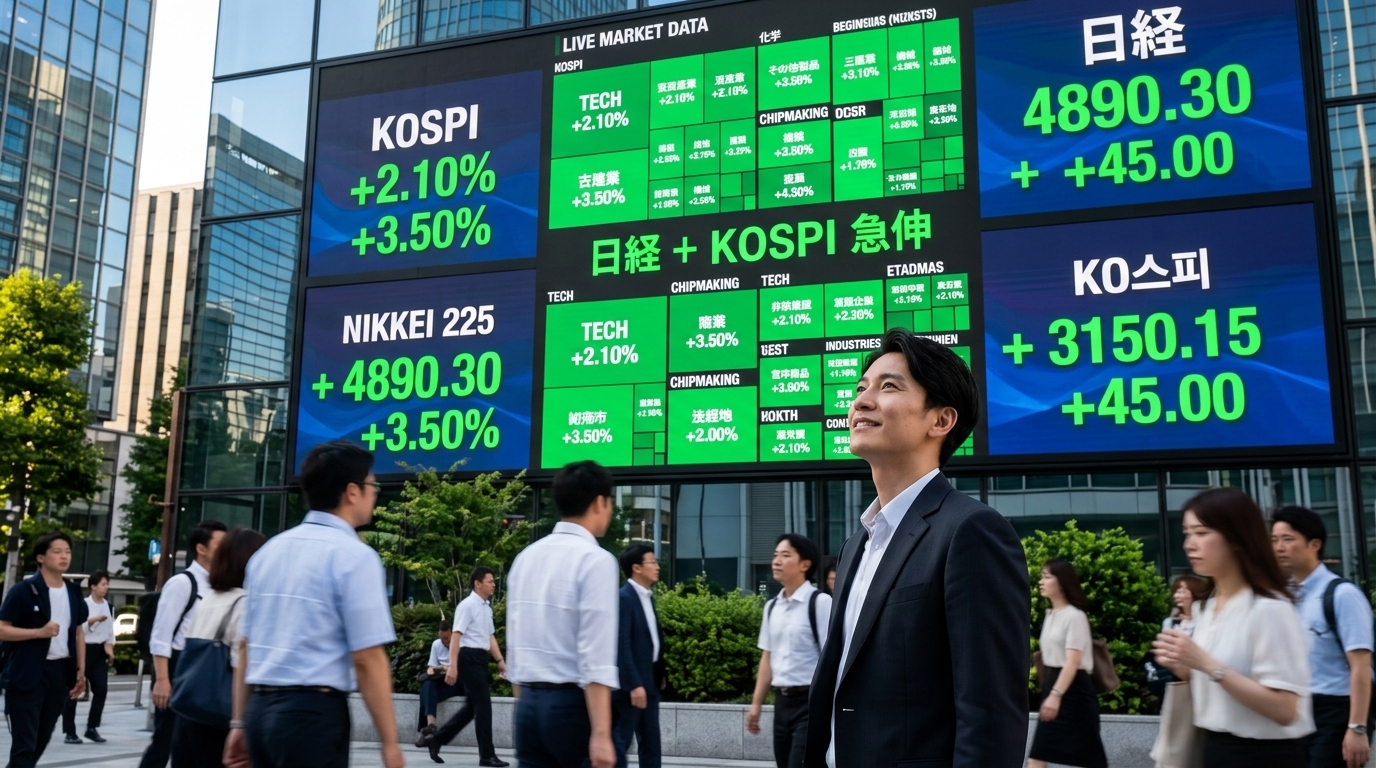
June 18, 2026, will be remembered in market history as the day Asia confirmed its dominance in the new economic cycle. The Nikkei 225 in Tokyo and the KOSPI in Seoul surged beyond all expectations, fueled by a rare combination of factors: the explosive demand for Artificial Intelligence infrastructure and the unexpected diplomatic breakthrough in the Middle East with the US-Iran peace deal. This "double-shot" of optimism triggered a wave of liquidity moving from West to East, seeking higher returns in a reduced-risk environment.
The Peace Dividend and Energy Decompression
The news regarding the finalization of the agreement between Washington and Tehran acted as a catalyst for energy-dependent markets like Japan and South Korea. The prospect of stabilizing oil prices and the lifting of sanctions that hindered capital flow in the Gulf region reduced production costs for Asia's industrial giants. Analysts are speaking of a "peace dividend," which allows central banks to reconsider their monetary policies without the fear of imported inflation.
"We are not just seeing a reaction to news, but a structural realignment of risk. The Middle East is ceasing, for now, to be the black hole of global uncertainty," says a senior investment banking executive in Tokyo.
For Japan, this development bolsters the attractiveness of Japanese companies with strong balance sheets and an export-oriented focus. The Nikkei, already benefiting from corporate governance reforms, now finds new support in geopolitical calm, allowing the Yen to stabilize at levels that favor exports without crushing consumer purchasing power.
Semiconductor Dominance and the AI Supercycle
Parallel to diplomatic developments, the Artificial Intelligence sector continues to serve as the engine of growth. South Korea, through Samsung Electronics and SK Hynix, sits at the heart of the global supply chain for High Bandwidth Memory (HBM), essential for processors from Nvidia and other titans. The KOSPI rally reflects investor conviction that the AI cycle is not a bubble, but a multi-year phase of infrastructure investment.
- Samsung announced record profits from its semiconductor division, beating analyst forecasts by 15%.
- SK Hynix confirmed the expansion of its facilities for next-generation chip production, with advance orders covering all of 2027.
- In Japan, companies like Tokyo Electron and Advantest are seeing their stocks soar, as chip-making equipment becomes the most sought-after commodity on the planet.
The convergence of these two forces—technological progress and geopolitical stability—creates a unique environment. While Silicon Valley produces the software and algorithms, East Asia is the one manufacturing the "body" of AI. Without the factories of Seoul and Tokyo, the intelligence revolution would remain theoretical.
Toward a New Global Balance
The rise of Asian markets is not just an economic event; it is a message to the West. As the US and Europe grapple with internal political polarization and fiscal challenges, Asia is seizing the moment to establish itself as a safe haven for capital. The US-Iran deal, though achieved through Washington's initiative, seems to benefit those on the other side of the Pacific the most, by lowering the cost of energy that fuels energy-intensive semiconductor industries.
In conclusion, the historic rally in the Nikkei and KOSPI is proof that the 2026 economy no longer operates in silos. Peace in one corner of the world translates into liquidity in another, and technological superiority transforms into political power. For investors, the message is clear: the heart of global growth is now beating strongly beating in Asia, and old certainties about Western market dominance are being called into question.





