

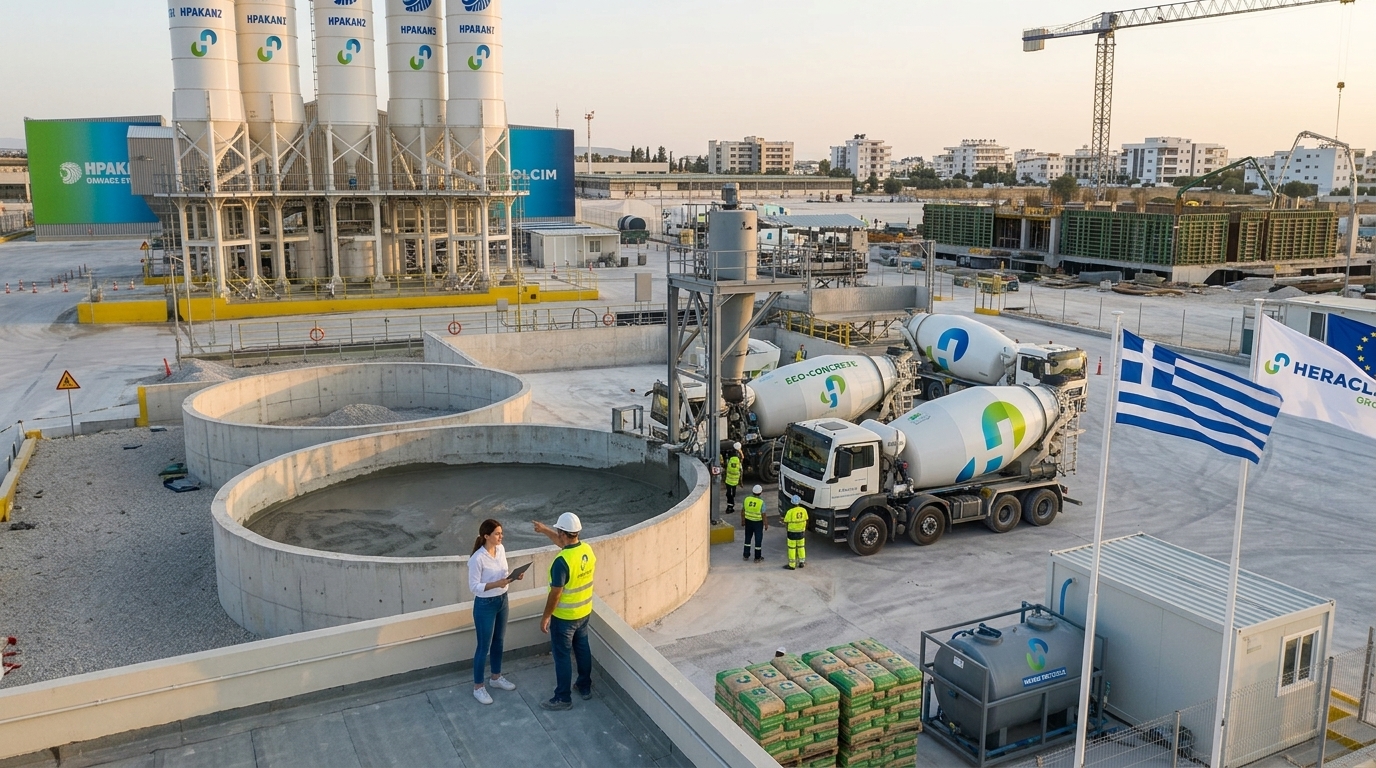
In an era where the climate crisis is no longer a distant threat but a daily reality, heavy industry finds itself at the center of a historic transition. HERACLES Group, a member of the global giant Holcim, has announced a sweeping investment program of 600 million euros through 2030. This is not merely a capital injection; it is a strategic roadmap for survival and dominance in a world that increasingly demands "green" building materials. The Greek cement industry, with a history spanning over a century, is now called upon to prove it can lead the charge toward net-zero carbon emissions, intertwining profitability with environmental stewardship.
The 2030 Strategic Roadmap: Investments and Technology
The HERACLES Group investment plan is structured around three central pillars: production decarbonization, process digitalization, and the reinforcement of the circular economy. Out of the €600 million, a significant portion is allocated to the modernization of the plants in Milaki (Evia) and Volos. The Group's management aims for a drastic reduction in CO2 emissions by adopting cutting-edge technologies that will allow the production of cement with a significantly lower environmental cost. According to forecasts, the demand for "green" concrete is expected to skyrocket in the coming years, as major infrastructure projects and private investments now require sustainability certifications (such as LEED or BREEAM).
Particular emphasis is placed on the "Olympus" project, a flagship investment for Carbon Capture and Storage (CCS) at the Milaki plant. This project, which has received substantial support from the EU Innovation Fund, represents the spearhead of the company's transformation. The ability to capture over 1 million tons of CO2 annually will make the plant one of the most advanced globally, offering the Group a massive competitive advantage in the European market, where the cost of carbon emissions is becoming increasingly prohibitive for traditional industries.
Circular Economy and Alternative Fuels
The shift toward "green" development is not limited to emission management; it extends to the source of energy. HERACLES is systematically investing in the use of alternative fuels, replacing fossil fuels with processed residues from municipal and industrial waste. This approach offers a dual benefit: it reduces energy costs while simultaneously providing a solution to the waste management problem in Greece. The circular economy is fully integrated into the production process, with the use of recycled demolition materials in the production of new concrete, thus closing the life cycle of building materials.
"Sustainable development is not an option; it is the only path for the industry of the future," Group executives state, emphasizing that investment in innovation is what will secure jobs and national added value.
The Construction Spring and The Ellinikon
The timing of these investments is no coincidence. Greece is in the midst of a new construction cycle, with mega-projects like The Ellinikon, Athens Metro Line 4, and major highway axes creating steady and increased demand for concrete. HERACLES has already taken a pivotal role in supplying materials for The Ellinikon, the largest urban regeneration project in Europe. The need for low-carbon materials in projects of such scale acts as a catalyst for accelerating the company's investment plan. Meanwhile, the recovery of private building activity, despite the challenges of inflation and interest rates, provides a favorable backdrop for the absorption of new "green" products.
Challenges and Outlook
Despite the optimism, the road to 2030 is not without obstacles. High energy costs remain a volatile factor, while bureaucracy in licensing new alternative fuel units and CCS infrastructure can cause delays. Furthermore, competition from imported products from countries with lower environmental standards poses a permanent risk to the European cement industry. However, support from the parent group Holcim and access to European funds provide HERACLES with the necessary tools to complete its transformation. The success of this venture will serve as a litmus test for whether Greek industry can remain competitive in the era of the Green Deal, turning environmental challenges into business opportunities.





