

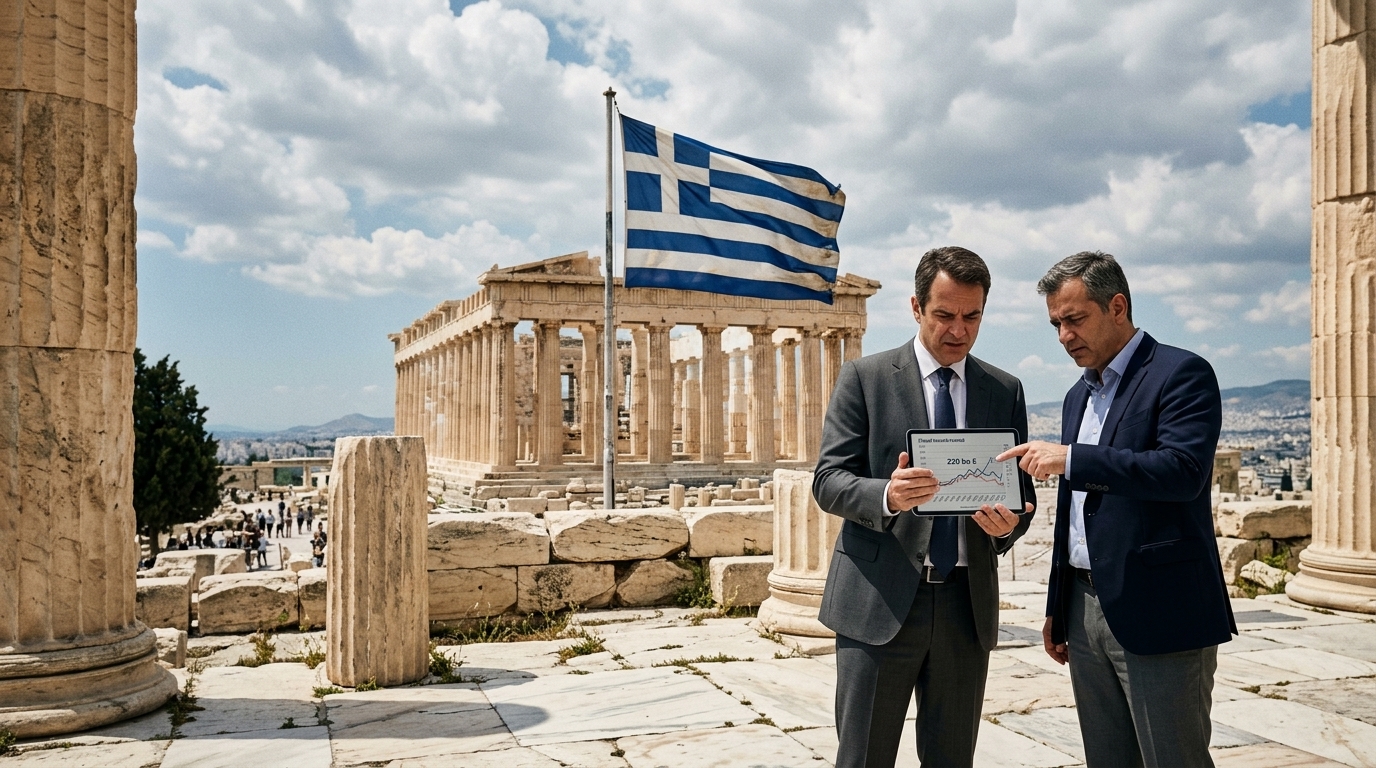
As of July 2026, the Greek economy stands at a pivotal crossroads. While international headlines often focus on the regaining of investment-grade status and growth rates that outpace the Eurozone average, the shadow of debt remains long and heavy. The total amount owed to European institutions — the European Financial Stability Facility (EFSF), the European Stability Mechanism (ESM), and the bilateral loans of the first memorandum (GLF) — stands at approximately €220 billion. This legacy of the crisis is not merely an accounting entry but a fiscal roadmap that will dictate Greek policy until 2070.
The Anatomy of Institutional Debt
The lion's share of Greek debt is held by the official sector. This is both a blessing and a curse. On one hand, these loans feature exceptionally favorable terms, with low interest rates and very long maturities, thanks to successive restructurings and relief measures agreed upon by the Eurogroup. On the other hand, reliance on institutional creditors entails continuous, strict supervision and the necessity for the persistent generation of primary surpluses.
- Bilateral Loans (GLF): The initial loans received by Greece in 2010, with repayments already underway and set to continue for years.
- EFSF: The fund that supported the second program, holding the largest volume of debt.
- ESM: The permanent mechanism that provided financing for the third memorandum in 2015.
The strategy of the Public Debt Management Agency (PDMA) in recent years has focused on the early repayment of the most expensive segments of this debt, such as IMF loans and parts of the bilateral loans to Eurozone countries. However, the core volume remains immovable, with the schedule indicating that the final installments will be paid when the generation being born today approaches retirement.
The 2070 Milestone and Sustainability
Why 2070? This date is not arbitrary. It is the result of extensions granted so that the annual cost of servicing the debt remains below 15% of GDP (and later below 20%). This safety cushion allows Greece to avoid being suffocated by annual installments but obliges it to long-term fiscal discipline. The challenge is twofold: maintaining growth at levels higher than the borrowing cost and avoiding new deficits that could derail the downward trajectory of the debt-to-GDP ratio.
"Greece does not have a liquidity problem, but a duration problem. Managing a debt that spans half a century requires a political consensus rarely seen in Greek history," notes a financial analyst familiar with the inner workings of Brussels.
Risks on the Horizon: Interest Rates and Demographics
Despite the stability offered by the fixed interest rates of European loans, there are unpredictable factors. The rise in interest rates by the ECB in previous years affects the cost of new market borrowing, which is necessary to refinance maturing bonds. Furthermore, Greece faces a severe demographic crisis. With an aging and shrinking population, the debt burden per worker increases, making the need for structural reforms and investments in technology and AI imperative.
In conclusion, the €220 billion owed to Europeans is the "elephant in the room." The country has managed to transform an existential crisis into a manageable economic obligation, but the road to 2070 is fraught with traps. Maintaining credibility with markets and partners is the only way to ensure that Greece does not find itself on the brink again, but continues its slow, steady return to European normalcy.





