

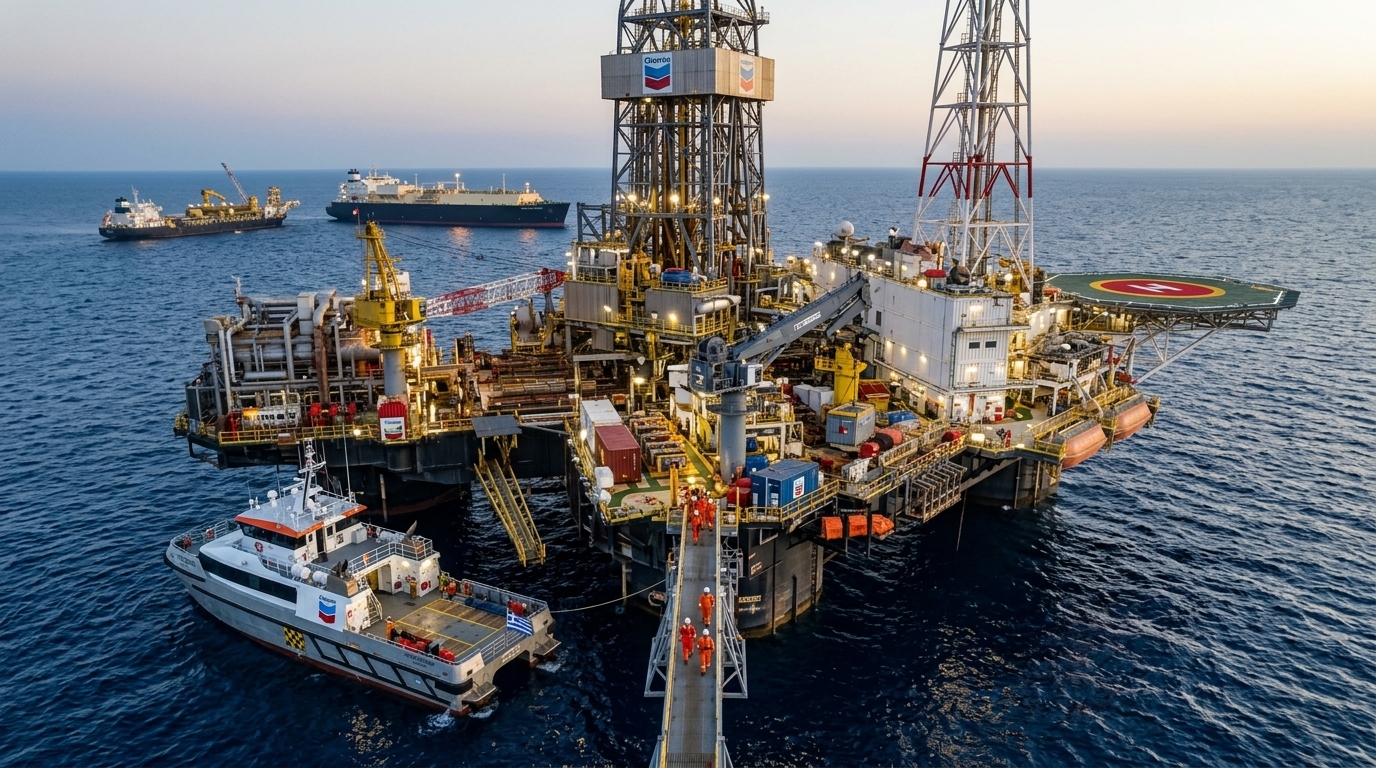
In a decisive turn for Southeast Europe's energy landscape, Greece is solidifying its position as a potential hydrocarbon producer through a landmark agreement with American energy giant Chevron. Chevron’s decision to assume the role of Operator in 'Block 10' of the Kyparissiakos Gulf is more than a corporate transaction; it is a geopolitical statement of intent that inextricably links Greek sovereign rights with the interests of the world’s most powerful energy players.
The agreement, which sets the stage for the first exploratory drilling in February 2027, is estimated to generate revenues of up to €10 billion over time, provided the deposits prove commercially viable. Stavros Papastavrou, in recent statements, emphasized that Greece does not merely aim for extraction but for the creation of a holistic energy ecosystem that harmonizes natural gas with Renewable Energy Sources (RES) and energy storage solutions.
The Strategic Significance of Block 10
Block 10, stretching across the Kyparissiakos Gulf, is considered one of the most promising areas within the Greek Exclusive Economic Zone (EEZ). The involvement of Chevron, succeeding or collaborating closely with HELLENiQ ENERGY, provides the necessary technical expertise and capital depth required for complex deep-sea drilling operations. Preliminary seismic surveys have revealed geological structures mirroring those found in the Eastern Mediterranean (such as Egypt’s Zohr field), significantly raising expectations for substantial natural gas reserves.
The selection of February 2027 as the target date for drilling allows for a necessary window to complete comprehensive environmental impact assessments and ensure the implementation of the strictest safety protocols. In an era where climate change demands a rapid transition, the Greek government is performing a delicate balancing act: leveraging fossil wealth as a 'bridge fuel' while simultaneously investing billions in green energy infrastructure.
Geopolitics and Energy Security
The presence of a US major like Chevron in Greek waters serves as a strategic deterrent against regional challenges. Washington has repeatedly voiced support for Greece’s emergence as an energy hub capable of diversifying Europe away from Russian gas. Alongside the IGB and TAP pipelines and the Alexandroupoli FSRU, Block 10 adds domestic production to the puzzle of energy autonomy.
- Strengthening the Greece-US strategic relationship through high-stakes energy investments.
- Creation of thousands of jobs within the extraction and logistics supply chain.
- Long-term reduction of energy costs for domestic industry and households.
"Greece is transforming from an energy importer into a critical production and transit hub, ensuring stability across Southeastern Europe," industry analysts note.
Challenges and the Environmental Footprint
Despite the optimism, significant challenges remain. Environmental organizations have raised concerns regarding the Ionian Sea’s marine ecosystem, which hosts rare cetacean species. Chevron and the Greek government have pledged to utilize cutting-edge technologies to minimize environmental risks; however, securing social license from local communities in the Peloponnese will be vital. Furthermore, the projected €10 billion windfall is contingent upon global natural gas prices in the 2030s, when full-scale production is expected to commence.
In conclusion, the Chevron agreement represents Greece’s most serious step in the hydrocarbon sector in decades. If successful, the project will not only alter the country’s economic profile but will also catalyze its role on the European chessboard, turning the Kyparissiakos Gulf into a new energy lung for the continent. The road to 2027 is paved with high expectations and the promise of a more secure energy future.





