

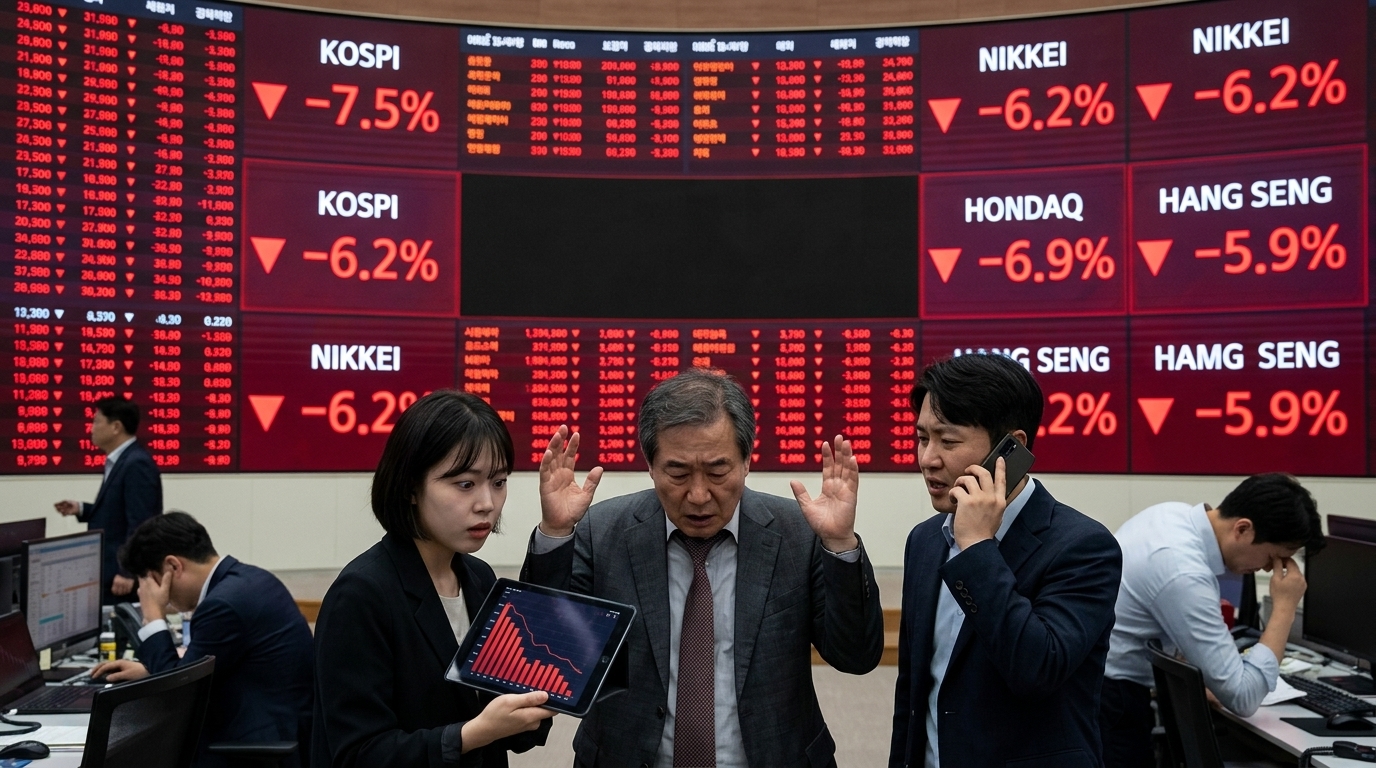
The global investment community faced one of the most violent turbulences in recent years as the 'bubble' of expectations surrounding Artificial Intelligence (AI) began to show its first serious cracks. Asia became the epicenter of an unprecedented sell-off, with South Korea's Kospi index recording a free fall of 8%, triggering automatic circuit breakers—a move not seen since the dark days of the pandemic.
The End of the AI Honeymoon
For nearly two years, the market moved in a rhythm of euphoria, fueled by the belief that generative AI would immediately transform the global economy. However, recent earnings reports from Silicon Valley giants have begun to shift the narrative. Investors are no longer satisfied with promises of the future; they demand tangible proof of profitability from the massive capital expenditures (CapEx) being undertaken.
Microsoft, Alphabet, and Amazon announced billions in spending on AI infrastructure, but revenue directly derived from these technologies remains disproportionately low. This 'yield gap' created a climate of nervousness that transmitted instantly to Asia, home to the key hardware suppliers of the global technology supply chain.
The Asian Collapse: Samsung, SK Hynix, and SoftBank
In South Korea, Samsung Electronics and SK Hynix, the world's two largest memory makers, saw their shares crushed. SK Hynix, a key Nvidia supplier, found itself in the crosshairs of liquidations as fears of delays in Nvidia's next-generation 'Blackwell' chips intensified uncertainty. The Kospi's 8.77% drop was not just a correction; it was a manifestation of panic reflecting the country's dependence on the tech cycle.
In Japan, the situation was equally dramatic. The Nikkei 225 suffered its largest daily drop since the 'Crash' of 1987. SoftBank Group, Masayoshi Son's investment giant that has bet everything on AI, saw its value evaporate as its portfolio of tech startups took a heavy hit. The rising Yen, a result of policy shifts by the Bank of Japan, exacerbated the situation by closing the so-called 'yen carry trade,' forcing investors to liquidate stock positions to cover their obligations.
The US Recession Factor
The sell-off in Asia was not an isolated event but a reflection of fears regarding the health of the US economy. Recent US employment data was disappointing, triggering the 'Sahm Rule,' a metric that historically foreshadows the onset of a recession. When the world's largest economy 'sneezes,' Asia, as the global manufacturing hub, 'catches pneumonia.'
- Risk Re-assessment: Markets are re-evaluating whether current tech valuations are justified by actual growth.
- Currency Volatility: The strengthening Yen is upending global arbitrage strategies.
- Geopolitical Uncertainty: Restrictions on chip exports to China continue to weigh on the semiconductor sector's sentiment.
"We are not just seeing a price correction, but a correction of expectations. The market is realizing that the AI revolution will require more time and much more money than initially estimated," notes a market analyst in Seoul.
Conclusion: A New Reality
The plunge of the Kospi and the general turmoil in Asia serve as a reminder that technology does not move in a vacuum. The laws of economics, the importance of cash flows, and macroeconomic balances are returning to the forefront. While the long-term prospect of AI remains strong, the current period represents a necessary, albeit painful, purging of the excesses of the recent past. Investors are now called to distinguish between companies that merely 'promise' AI and those that can turn it into a profitable reality.





