

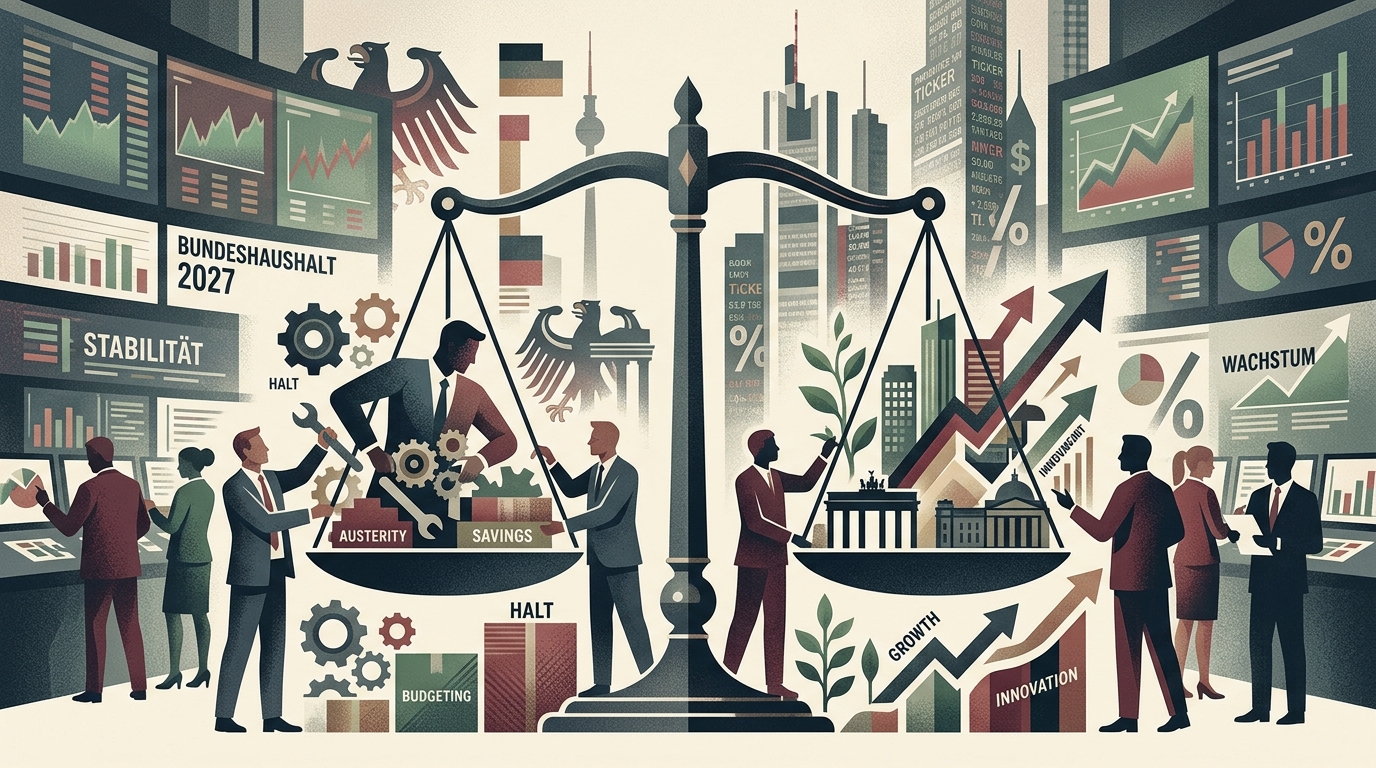
In a decisive moment for Europe’s economic powerhouse, the draft for Germany’s 2027 federal budget has been finalized. According to exclusive reporting by Handelsblatt, Finance Minister Lars Klingbeil has concluded negotiations, setting the fiscal trajectory for the coming years. This document is far more than a simple ledger of revenues and expenditures; it serves as a political manifesto attempting to square the circle: maintaining strict fiscal discipline (the "Schuldenbremse") while simultaneously funding massive investments in national defense and the green energy transition.
The Persistence of the Debt Brake
The central point of contention remains the constitutionally mandated debt brake. Despite intense pressure from factions within the Social Democrats (SPD) and the Greens to relax these rules to fund crumbling infrastructure, Klingbeil appears to have held the line on fiscal orthodoxy. This decision reflects Germany’s strategic need to remain the Eurozone’s anchor of stability, particularly as neighbors like France and Italy struggle with ballooning deficits. However, critics argue that this obsession with outdated fiscal rules is starving German industry of the capital necessary for its digital and ecological transformation.
Defense vs. Social Cohesion
A significant portion of the 2027 budget is earmarked for the reinforcement of the Bundeswehr. Following the "Zeitenwende" (historic turning point) announced in 2022, Germany is committed to keeping defense spending above the 2% GDP threshold, even after the initial 100-billion-euro special fund is depleted. This commitment necessitates cuts in other areas, creating friction in social policy. Klingbeil must navigate between NATO’s demands and the necessity of supporting low-income households in an era where inflation, though cooling, has left a permanent mark on purchasing power.
- Adherence to the borrowing limit of 0.35% of GDP.
- Increased funding for cybersecurity and artificial intelligence.
- Targeted tax relief for small and medium-sized enterprises (the Mittelstand).
- Restructuring of heating and energy subsidies.
The Shadow of Elections and Industrial Future
2027 is viewed as a pivotal year, as the consequences of today's fiscal choices will be fully realized. The German automotive industry, the backbone of the nation's economy, is currently undergoing a painful transition to electromobility. While the budget provides incentives for R&D, many experts question whether these measures are sufficient to counter the aggressive industrial policies of China and the United States. Furthermore, the political stakes are high. With federal elections on the horizon, the governing coalition is desperate to project an image of competence and stability, moving away from the public infighting that plagued previous cycles.
"The budget is not just numbers; it is proof of our ability to adapt without losing our fundamental identity," a source close to the Ministry stated.
In conclusion, the 2027 draft represents an attempt at controlled adaptation. Germany refuses to abandon its model of fiscal prudence, yet it recognizes that without investment in security and technology, such stability will eventually become hollow. The gamble for Lars Klingbeil is immense: to convince global markets of Berlin’s credibility while convincing German citizens of their continued prosperity.





