

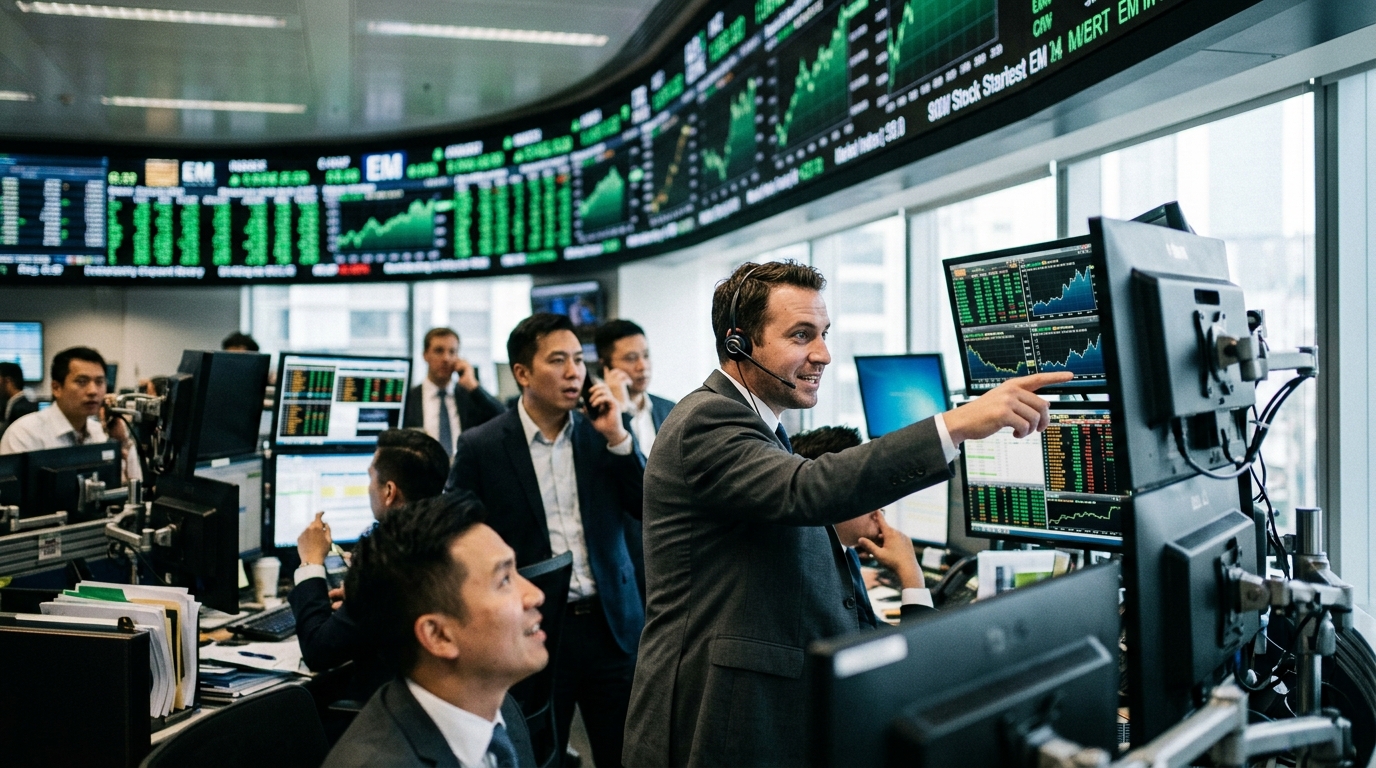
In a stunning display of market resilience, Emerging Market (EM) stock indices surged to record highs on June 1, 2026, defying the grim forecasts that typically accompany escalating regional conflicts. The primary engine behind this ascent is Artificial Intelligence, which has evolved from a promising niche into a formidable economic powerhouse reshaping global capital flows. While oil prices climb due to supply disruptions stemming from the conflict in Iran and national currencies face downward pressure, investors appear willing to overlook traditional macroeconomic risks in favor of the "digital golden age."
Asia's Dominance in the AI Landscape
The rally in emerging markets is heavily concentrated in Asia, with Taiwan and South Korea leading the charge. Semiconductor titans such as TSMC and Samsung Electronics have seen their valuations skyrocket as the world demands increasingly powerful chips to support third-generation Generative AI models. The market seems to have priced in AI as a "permanent infrastructure" of the global economy, akin to electricity in the 20th century.
Market analysts suggest that the current surge differs from previous speculative bubbles. "We aren't just seeing speculation based on hype; we are seeing tangible earnings derived from multi-billion dollar contracts," notes a Bloomberg Tech report. India is also a key participant in this rally, as its IT services firms rapidly transform into AI implementation hubs, offering automation solutions to Western enterprises struggling to mitigate operational costs amidst persistent inflationary pressures.
The Paradox of Oil and Currencies
However, the picture is not uniformly positive. The simultaneous rise in oil prices, triggered by the hostilities in Iran, is creating a sharp dichotomy within emerging economies. On one hand, tech stocks are flourishing; on the other, the currencies of net energy importers—such as India and various Southeast Asian nations—are faltering against the US dollar. High energy costs threaten to reignite inflation, forcing central banks to maintain elevated interest rates for longer periods.
This "currency bleeding" represents the dark side of the current economic environment. While foreign institutional investors pour capital into tech equities, local economies are grappling with the rising cost of living. The decoupling between stock market performance and the real economy in emerging markets is more pronounced than ever. The critical question remains: how long can "AI euphoria" shield markets from the reality of a prolonged conflict in the Middle East?
Geopolitical Instability and the Iran Factor
The crisis in Iran has fundamentally altered the energy map. With the Strait of Hormuz facing unprecedented uncertainty, the global oil supply chain is at a breaking point. Traditionally, such a crisis would trigger a massive flight to safety, with capital moving toward gold or US Treasuries. However, in 2026, the "safe haven" seems to have shifted toward the companies that control the future of computational power.
"AI is the new oil, but with a fundamental difference: its value increases the more we use it, unlike fossil resources which are finite and depletable," remarks a leading global strategist.
This conviction has created a protective buffer around Asian markets. Investors are betting that the productivity gains delivered by AI will more than offset the losses incurred from higher energy costs. Nevertheless, analysts warn that if oil prices breach a critical threshold—such as $120 per barrel—the production costs of semiconductors and the operation of massive data centers could be severely impacted, potentially halting the rally.
Outlook and Investor Sentiment
As we move into the second half of 2026, the trajectory of emerging markets will depend on the delicate balance between technological innovation and geopolitical stability. AI has proven to be a powerful growth catalyst, but it is not immune to the laws of macroeconomic gravity. Investors must remain vigilant, as currency volatility can quickly erode equity gains for those without robust hedging strategies.
The narrative of June 2026 is a tale of two worlds: a digital world racing toward the future and a physical world still bound by ancient conflicts over resources. The ultimate success of emerging markets will be determined by which of these worlds maintains its grip on investor sentiment.





