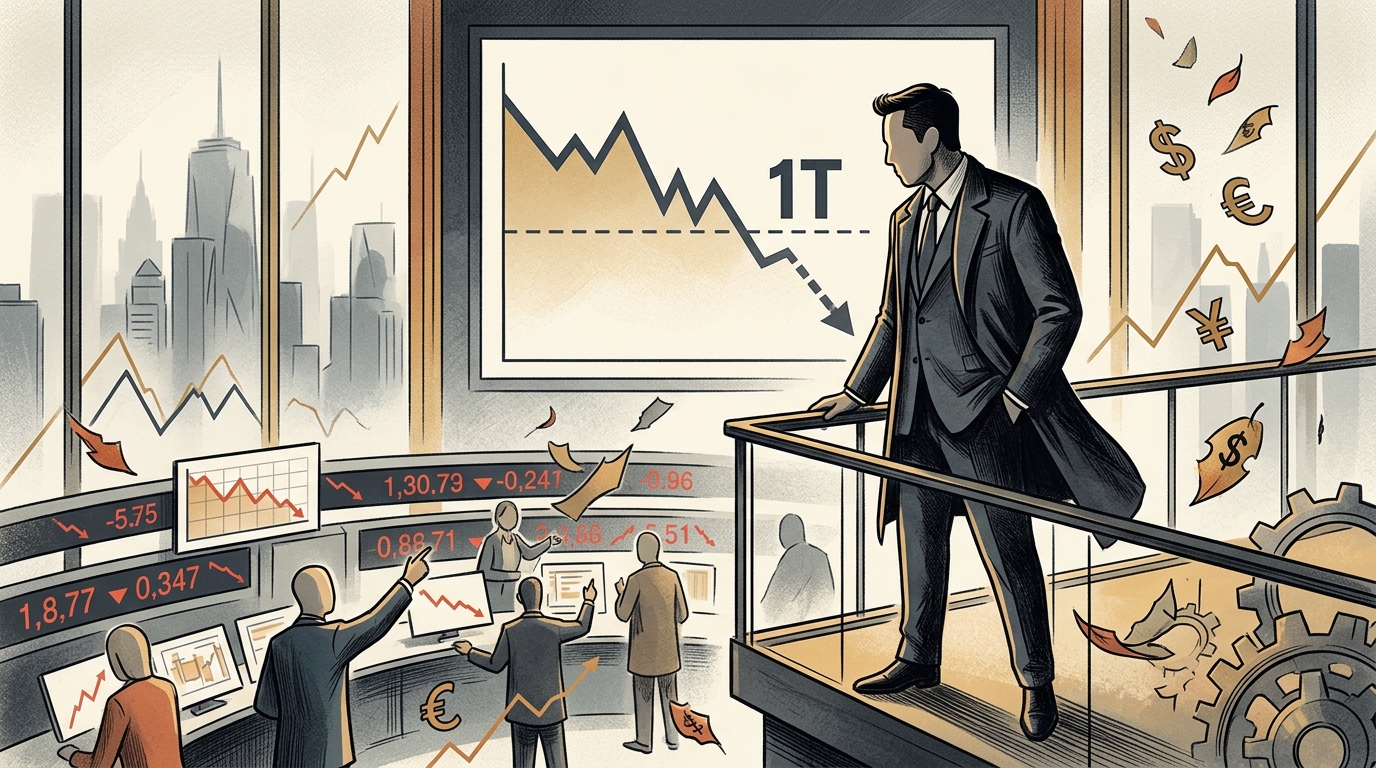
The chronicles of global wealth are punctuated by meteoric rises and equally spectacular corrections, but few narratives have captivated the public imagination quite like the financial trajectory of Elon Musk. In mid-2026, the news that the founder of Tesla and SpaceX no longer holds the title of a trillionaire is more than just a statistical blip on stock tickers. It is a symptom of a fundamental shift in the global economic zeitgeist, where the unbridled euphoria surrounding AI and space exploration is finally meeting the cold reality of high interest rates and consumer saturation.
The Market Hemorrhage of Tesla
The primary catalyst for Musk’s retreat from the 13-figure club lies within Tesla. The EV pioneer, which once commanded a valuation exceeding that of all its major competitors combined, is currently navigating a period of intense scrutiny. Investors, who previously viewed Tesla as a high-growth software company on wheels, are now applying the rigorous metrics of traditional manufacturing. Mounting pressure from Chinese giants like BYD and Xiaomi has forced Tesla into a cycle of price cuts, eroding profit margins to levels that no longer justify the astronomical P/E ratios of yesteryear.
Furthermore, the global market sell-off observed in recent weeks has been particularly unkind to growth stocks. With inflation proving stubborn in key regions and central banks hesitating to implement aggressive rate cuts, capital is fleeing toward safer havens. For Musk, whose net worth is inextricably linked to Tesla’s equity, this shift has translated into the evaporation of hundreds of billions of dollars in theoretical wealth within a remarkably short timeframe.
SpaceX: From Liftoff to Revaluation
While Tesla serves as the public-facing pillar of his empire, SpaceX has long been considered the private-sector powerhouse. However, even this frontier is not immune to economic gravity. Despite the technical milestones achieved by the Starship program, the market has begun to recalibrate the value of private space ventures. Delays in key NASA contracts and intensifying competition in the satellite internet sector via Starlink have led to more conservative valuations in secondary markets.
Because SpaceX is privately held, its valuation is inherently less volatile than Tesla's, yet it remains sensitive to the broader venture capital climate. Recent share sales by employees and early-stage investors have occurred at prices below previous peaks, reflecting a general liquidity crunch in the tech sector. This downward revision of Musk’s private assets provided the final push that relegated him back to the billionaire ranks, albeit still at the very top of that list.
The Psychology of the Trillion and Social Backlash
There is something inherently mythic about the number 'one trillion.' In a world grappling with a cost-of-living crisis and widening wealth inequality, the concentration of such vast resources in a single individual’s hands invites intense scrutiny. Musk’s fall below this threshold is viewed by many analysts as both a financial event and a social milestone. Critics argue that his wealth was largely built on 'paper' valuations and government subsidies, while supporters see a visionary being unfairly punished by the short-termism of the markets.
Musk’s increasing involvement in U.S. political discourse and his controversial stewardship of the X platform (formerly Twitter) have also played a role. The polarization surrounding his persona has caused some institutional investors to maintain a distance, fearing 'reputation risk.' In an era where ESG (Environmental, Social, and Governance) standards are a primary concern for fund managers, Musk’s eccentric public behavior and political broadsides often act as a drag on his companies' stock performance.
Conclusion: A New Economic Reality
Elon Musk remains, by any objective measure, one of the wealthiest and most influential individuals on Earth. Losing the 'trillionaire' status does not diminish his capacity to disrupt industries or shape political narratives. However, this correction serves as a potent reminder that no empire is invincible to market forces. As we move through 2026, the pertinent question is not whether Musk will reclaim his trillionaire title, but whether the brand of capitalism he represents—characterized by extreme leverage and cults of personality—can thrive in an environment demanding greater fiscal discipline and corporate accountability.