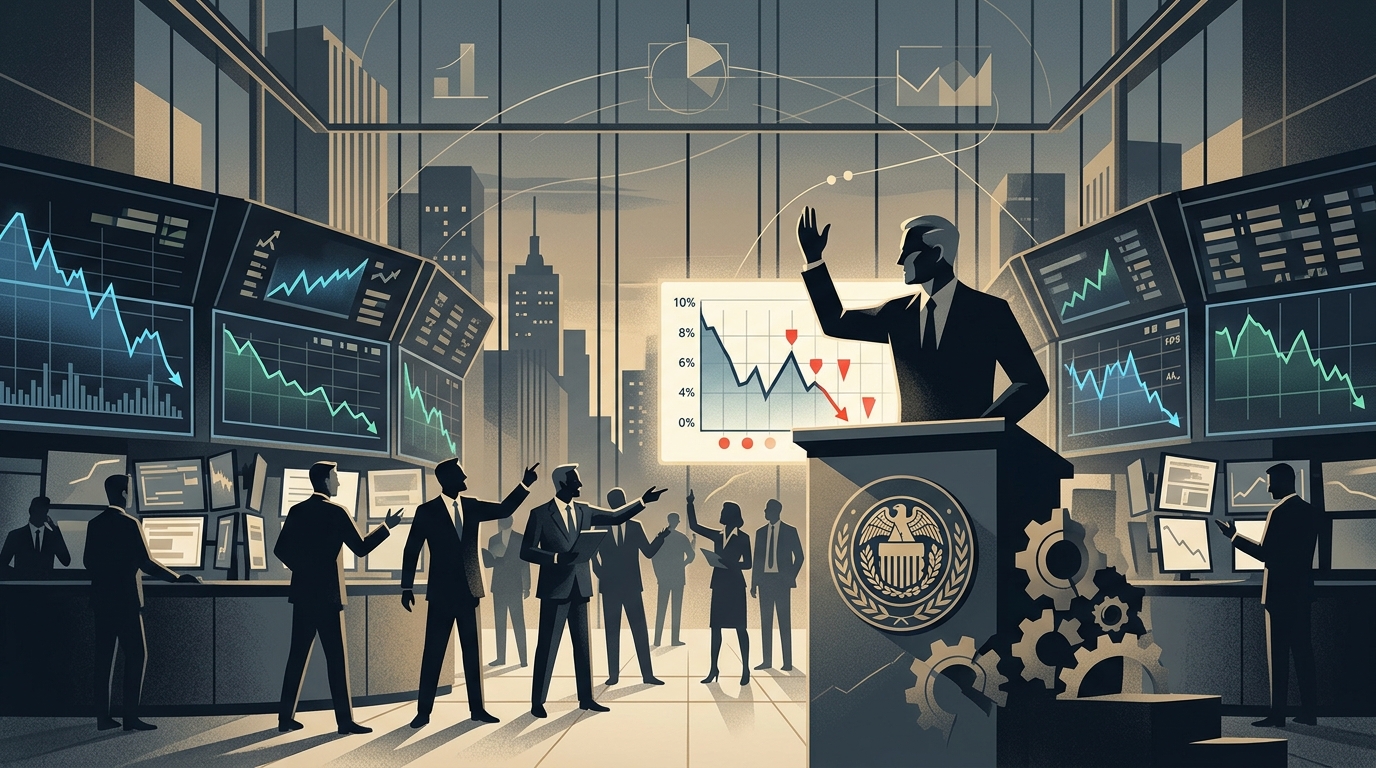
As we navigate the summer of 2026, the United States economic landscape finds itself at a paradoxical crossroads. While headline indicators suggest a surface-level resilience, a growing cohort of contrarian analysts argues that the Federal Reserve (Fed) is on the precipice of a forced and rapid rate-cutting cycle. The central thesis of this analysis is that the labor market is not merely 'cooling' but is on the verge of a significant downturn, while inflation, the once-invincible foe, is preparing for a spectacular plunge.
The Illusion of Robust Payrolls
For months, payroll data has painted a picture of unceasing growth. However, a deeper dive into the numbers reveals a different reality. Job growth over the past year has relied disproportionately on part-time positions and the government sector, while full-time private-sector roles have stagnated or declined. Downward revisions to data have become the norm rather than the exception, suggesting that the 'birth-death' model used by the Bureau of Labor Statistics is failing to capture the rate of small business closures in a high-interest-rate environment.
Unemployment, while still at historically low levels, has begun to show a worrying upward trend that triggers the 'Sahm Rule.' Historically, when the three-month moving average of the unemployment rate rises by 0.5% relative to its low during the previous 12 months, the economy is already in a recession. Contrarian analysts warn that the Fed risks repeating its 2021 mistake—when it labeled inflation 'transitory'—only this time, the error will be a delay in recognizing the economic slowdown.
The Disinflationary Tsunami and Oil Prices
Inflation, which plagued the global economy for years, appears to be losing momentum faster than most economists predicted. The decline in commodity prices, particularly oil, is acting as a massive disinflationary mechanism. With global demand softening—especially from China—and non-OPEC production hitting record levels, energy costs are no longer a source of pressure but a source of relief.
Furthermore, the shelter component, which makes up the largest portion of the Consumer Price Index (CPI), is finally starting to reflect the drop in new lease prices observed a year ago. This lag means that official inflation is likely to dip below the Fed's 2% target in the coming months, creating the environment for aggressive rate cuts to avoid the risk of deflation.
Kevin Warsh: Political Strategy or Economic Conviction?
One of the most intriguing points of the current debate is the stance of Kevin Warsh, a former member of the Fed Board of Governors and frequent candidate for the chairmanship. Warsh's recent hawkish rhetoric, calling for sustained high rates, is now drawing criticism for being 'performative.' Analysts argue that Warsh had to sound tough to draw a clear line between himself and the White House, protecting his reputation as an independent technocrat during a period of intense politicization of monetary policy.
"Warsh’s stance was never about the actual economic data, but about shielding his credibility against pressures for cheap money ahead of the election cycle,"
noted a Wall Street source. This interpretation suggests that even the most ardent supporters of high rates know the economy needs loosening, but they hesitate to admit it publicly for reasons of political tactics and institutional independence.
Implications for Markets and Global Stability
If this contrarian prediction proves correct, bond markets will experience a historic rally as yields collapse. For the global economy, a Fed pivot would provide much-needed 'cover' for other central banks, such as the ECB, to proceed with their own cuts without risking excessive currency volatility. However, the risk remains: if the Fed waits too long to act, the 'soft landing' everyone promised could turn into a hard crash with unpredictable social and political consequences. The lag effect of monetary policy is a blunt instrument, and the 2026 data suggests the blow may have already been struck.