

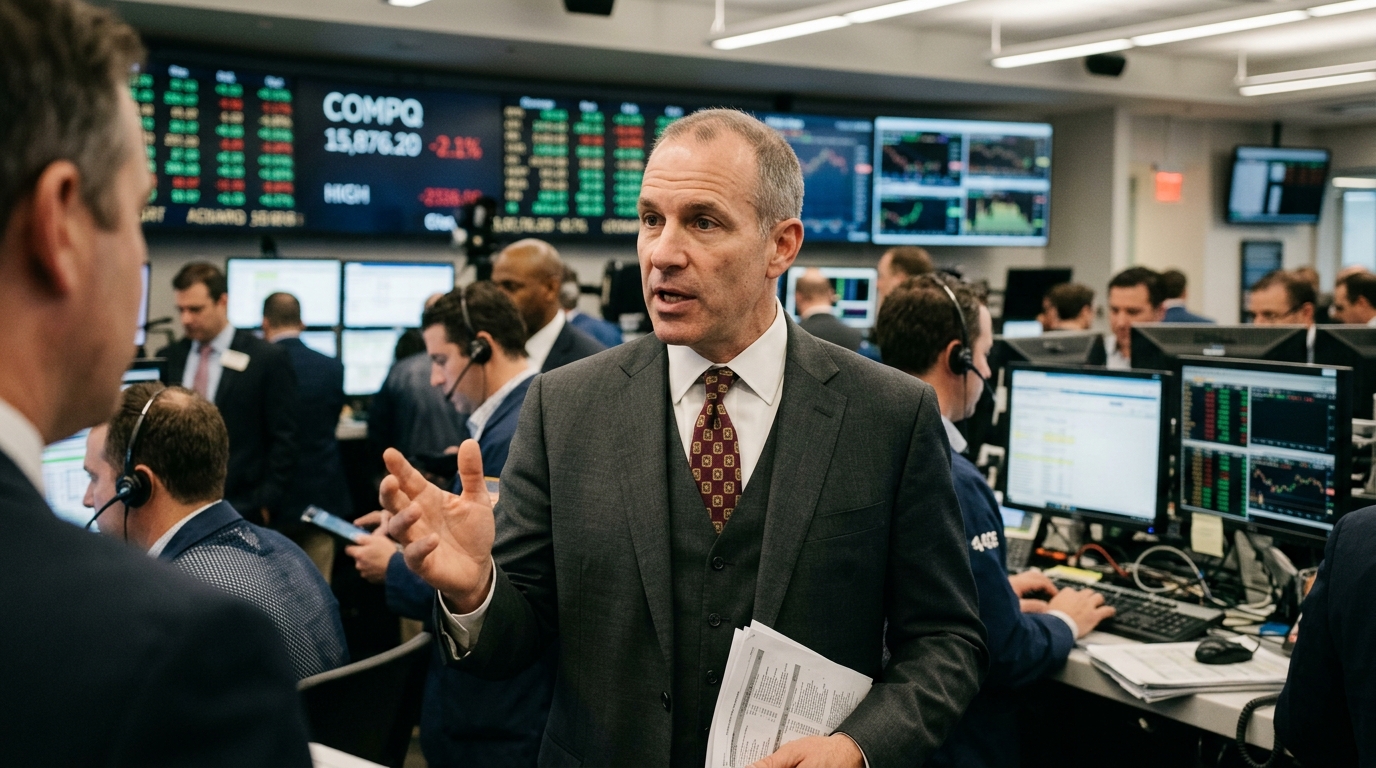
In a period where global markets seem to be reeling from uncertainty and valuation corrections, Scott Rubner, head of equity and equity derivatives strategy at Citadel Securities, offers a refreshingly optimistic perspective. Speaking with Bloomberg’s Dani Burger, Rubner argued that the recent sell-off in US megacap tech stocks is not the beginning of the end for the Artificial Intelligence (AI) revolution, but rather a golden buying opportunity for discerning investors.
The Disconnect Between Markets and Real Demand
Rubner’s core argument rests on the observation that there is a clear disconnect between the stock market behavior of these equities and the fundamental drivers of the AI market. Despite the recent dip in prices, tech giants—the well-known Megacap cohort—continue to pour billions of dollars into AI infrastructure. "We are not seeing any decline in spending or demand for AI technologies," Rubner noted. This suggests that the AI investment cycle is still in an expansionary phase, regardless of short-term fluctuations caused by monetary policy or geopolitical tensions.
Analysis from Citadel Securities, which plays a pivotal role as a market maker in global markets, indicates that liquidity remains robust. The drop in prices appears to be driven more by technical factors, such as portfolio rebalancing and deleveraging, rather than a structural shift in investor faith regarding the prospects of technology. For Rubner, this "gap" between price and value is precisely what creates the opportunity.
The Return of Retail Investors and the Power of Megacaps
A particularly interesting point in Rubner’s intervention was his reference to consumer trading activity. Despite pressures from inflation and the cost of living, individual investors remain active and bullish. This resilience in the retail market acts as a safety net, providing the necessary liquidity that allows markets to recover faster after corrections.
Megacap stocks, such as Microsoft, Nvidia, and Alphabet, are now viewed by many as the "new defensive havens." Unlike traditional defensive stocks, these companies combine massive cash reserves with exponential growth rates driven by AI. Rubner points out that the ability of these companies to self-fund their growth makes them less vulnerable to interest rate hikes compared to smaller tech firms.
- Demand for chips and data centers remains at record highs.
- Institutional investors are using corrections to increase their positions in leading companies.
- Retail investor sentiment remains positive, supporting valuations.
Strategic Analysis and Future Outlook
Looking toward the second half of 2026, Citadel’s strategy focuses on exploiting volatility. Rubner argues that investors who fear the current decline risk missing the next leg of the rally. History has shown that tech corrections during periods of structural change—such as the transition to cloud or now to AI—are typically short-lived and followed by new all-time highs.
"The market often punishes a lack of patience. In the case of AI, we are in the implementation phase, where real gains are beginning to be integrated into balance sheets," he stated.
In conclusion, Citadel Securities' position is clear: the sell-off is noise, while the growth of AI is the signal. For investors with the horizon and capital, the current juncture represents one of the most attractive moments in recent years to position themselves in the sector that will define the global economy for decades to come.





