

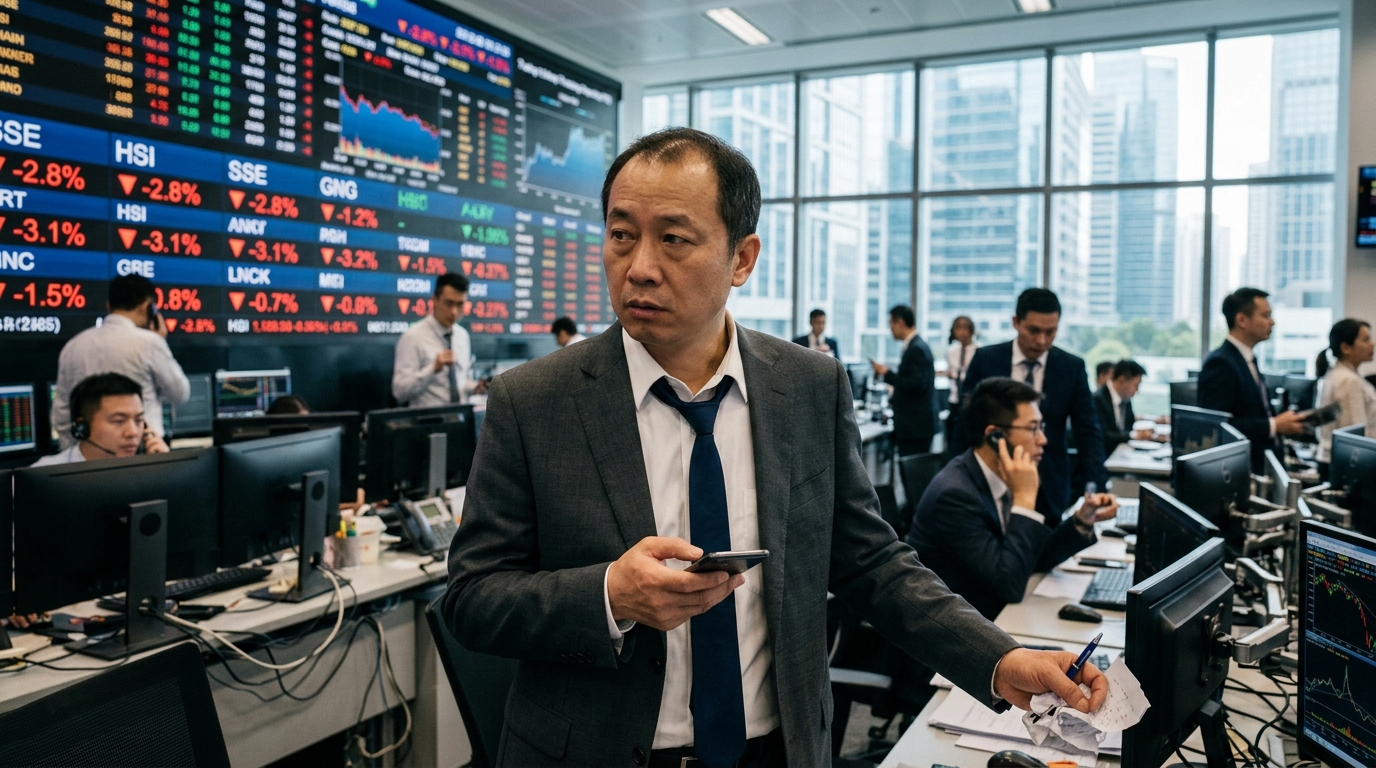
In the global economic landscape of 2026, Artificial Intelligence (AI) stands as the primary engine reshaping markets and driving valuations to unprecedented heights. Yet, one of the world's economic superpowers, China, appears to be trapped in a peculiar state of inertia. According to recent market data, Chinese tech stocks are trailing their global peers by the widest margin since 2001—the era marking the collapse of the dot-com bubble. The contrast is stark: while Nvidia and Microsoft propel U.S. indices to historic peaks, Chinese giants like Baidu, Alibaba, and Tencent are struggling to convince investors of the viability and scalability of their AI endeavors.
The Great Valuation Divergence
The current stock market divergence is not merely a temporary correction; it is a profound structural crisis of confidence. Analysts point out that the MSCI China Index has been underperforming the MSCI World Index at rates not seen in over two decades. The root cause is not a lack of talent or technical expertise—China continues to produce more AI researchers than any other nation—but rather the restrictive environment in which these entities operate. Economic uncertainty, coupled with a persistent real estate crisis and tepid consumer spending, has triggered a massive capital flight toward safer havens in the U.S., Japan, and even emerging markets in Southeast Asia.
"The market isn't just discounting Chinese technology; it is pricing in the systemic risk inherent in the country's geopolitical and regulatory framework," says a senior equity strategist based in Hong Kong.
The Chip War and Hardware Bottlenecks
Perhaps the most significant factor behind China's AI lag is the restricted access to critical hardware. U.S.-led export controls on advanced semiconductors, specifically high-end GPUs like Nvidia’s H100 and the newer Blackwell series, have created a "digital famine" in Beijing. Without the necessary compute power, training Large Language Models (LLMs) becomes exponentially slower and more expensive. While domestic firms like Huawei and Biren Technology are racing to develop indigenous alternatives, the performance gap remains significant. The lack of access to cutting-edge lithography from ASML further complicates the long-term roadmap for Chinese self-reliance in the semiconductor space.
- Stringent U.S. export bans on high-performance AI chips.
- Limited access to EUV and DUV lithography equipment.
- High energy and infrastructure costs for inefficient domestic hardware.
Regulatory Friction and the "Great Firewall" of Data
Beyond hardware, China faces a unique internal challenge: the absolute control of information. Beijing has implemented rigorous regulations for Generative AI, stipulating that chatbot outputs must align with "core socialist values." This creates an inherent friction with the creative and unpredictable nature of LLMs. Developers must implement heavy filtering layers, which can degrade the model's performance and utility compared to their Western counterparts. Furthermore, the memory of the 2021 regulatory crackdown on the platform economy still haunts the private sector, making entrepreneurs and venture capitalists hesitant to pursue the kind of disruptive innovation seen in Silicon Valley.
Investment Apathy and the Path Ahead
While Wall Street views AI as the "trade of the decade," the mood in Shanghai and Shenzhen remains somber. Foreign institutional investors have reduced their China exposure to multi-year lows, citing both geopolitical risks and the lack of a clear exit strategy. The hope that AI would serve as China's new growth engine—offsetting the decline in the property sector—has yet to materialize in the form of stock market gains. For the narrative to change, China will need more than just technical breakthroughs; it will require a fundamental shift in how the state interacts with private capital and a de-escalation of the technological cold war with the West.





