

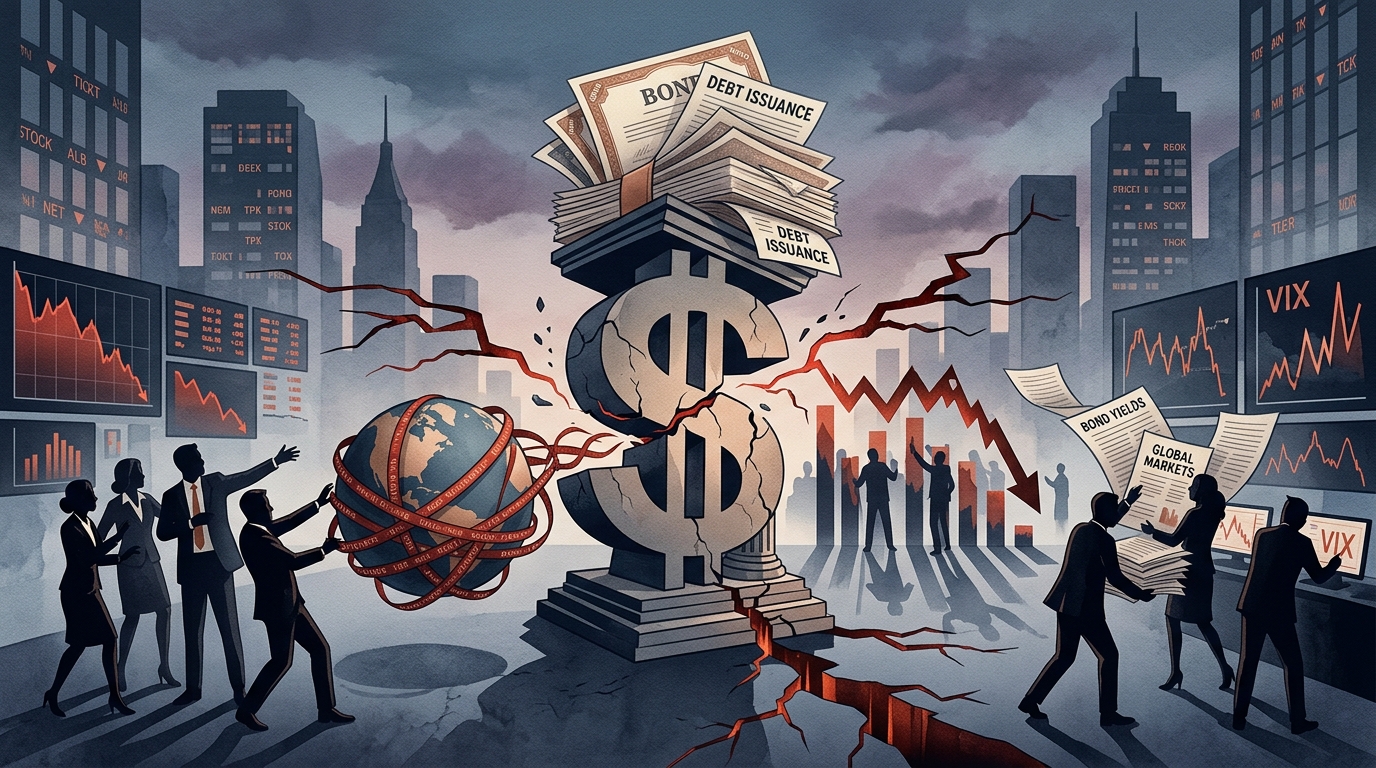
The global financial community is watching Washington with bated breath as the U.S. Treasury Department announced it must issue significantly more debt than initially projected. This development, coming at a time when federal government cash flows are showing a worrying decline, has sent shockwaves through international markets. As analysts put it, "the bond market is shouting," suggesting that confidence in the fiscal management of the superpower is beginning to waver.
Fiscal Gravity: The Widening Deficit Gap
The root of the problem lies in the disappointing performance of government revenues. Despite expectations for a dynamic recovery in tax receipts in 2026, data shows that corporate profits and individual income taxes have underperformed. Simultaneously, the cost of servicing existing debt has skyrocketed due to sustained high interest rates, creating a vicious cycle where the government must borrow more just to pay the interest on previous loans.
This situation is described by many as "fiscal dominance," a state where budget needs dictate monetary policy, limiting the Federal Reserve's room for maneuver. Markets are reacting with nervousness, as the oversupply of bonds pushes prices down and yields up, increasing borrowing costs for everyone from homebuyers to large corporations. The Treasury's quarterly refunding announcement has become a high-stakes event, rivaling Fed meetings in market impact.
A Historical Anomaly in Yield Dynamics
The most alarming element in the current crisis is the breakdown of the traditional relationship between central bank policy and long-term yields. Since 1990, there has been a clear correlation: when the Fed signaled a stabilization or decrease in rates, 10-year bond yields followed suit. Today, for the first time in decades, we are seeing yields rise even as the Fed attempts to maintain a more dovish or neutral stance.
This "disconnect" is interpreted as a clear statement from investors that they no longer believe in the government's ability to rein in the deficit. Fortune AI analysts point out that the market is now demanding a "term premium" to hold U.S. debt—something previously unthinkable for the dollar's "safe haven" status. The bond market is no longer a passive recipient of policy signals but an active judge of fiscal credibility. The "bond vigilantes," a term from the 1980s, seem to have returned with a vengeance.
The Crowding Out Effect and Private Capital
The consequences of this market outcry are not limited to traders' screens. The rise in bond yields translates directly into higher mortgage rates and credit card interests. At a time when inflation remains stubborn, the added pressure from borrowing costs threatens to stifle consumption, the engine of the American economy.
- Rising Housing Costs: 30-year fixed mortgage rates are approaching levels that make homeownership an impossible dream for the younger generation.
- Investment Constraints: Businesses are postponing expansion plans as financing becomes prohibitively expensive.
- Geopolitical Instability: U.S. reliance on foreign debt buyers (such as China and Japan) creates strategic vulnerabilities in an increasingly multipolar world.
Furthermore, the need for increased debt issuance could lead to the "crowding out" of the private sector from capital markets. When the state absorbs all available liquidity to fill its fiscal holes, fewer funds remain for innovation and growth, which in the long run reduces the country's productivity and competitive edge.
Policy Crossroads: Austerity or Inflation?
The issue is deeply political. With elections looming and the political climate polarized, the likelihood of serious fiscal consolidation seems slim. Neither party appears willing to propose the spending cuts or tax increases necessary to reassure the markets. Instead, rhetoric remains focused on benefits and subsidies, ignoring the distress signal emitted by the bond market.
In conclusion, the situation we are witnessing in May 2026 is a warning of the end of an era. The age of "easy money" and unlimited trust in U.S. debt has passed. The bond market isn't just shouting; it's warning that if there is no immediate change in course, the next economic crisis will not originate from the banks, but from the state itself. The ability of the U.S. to lead the global economy now depends on whether it can convince its creditors that it remains a reliable debtor in a world fraught with uncertainty. The fiscal trajectory is no longer just a domestic concern; it is a systemic risk to the global financial architecture.





