

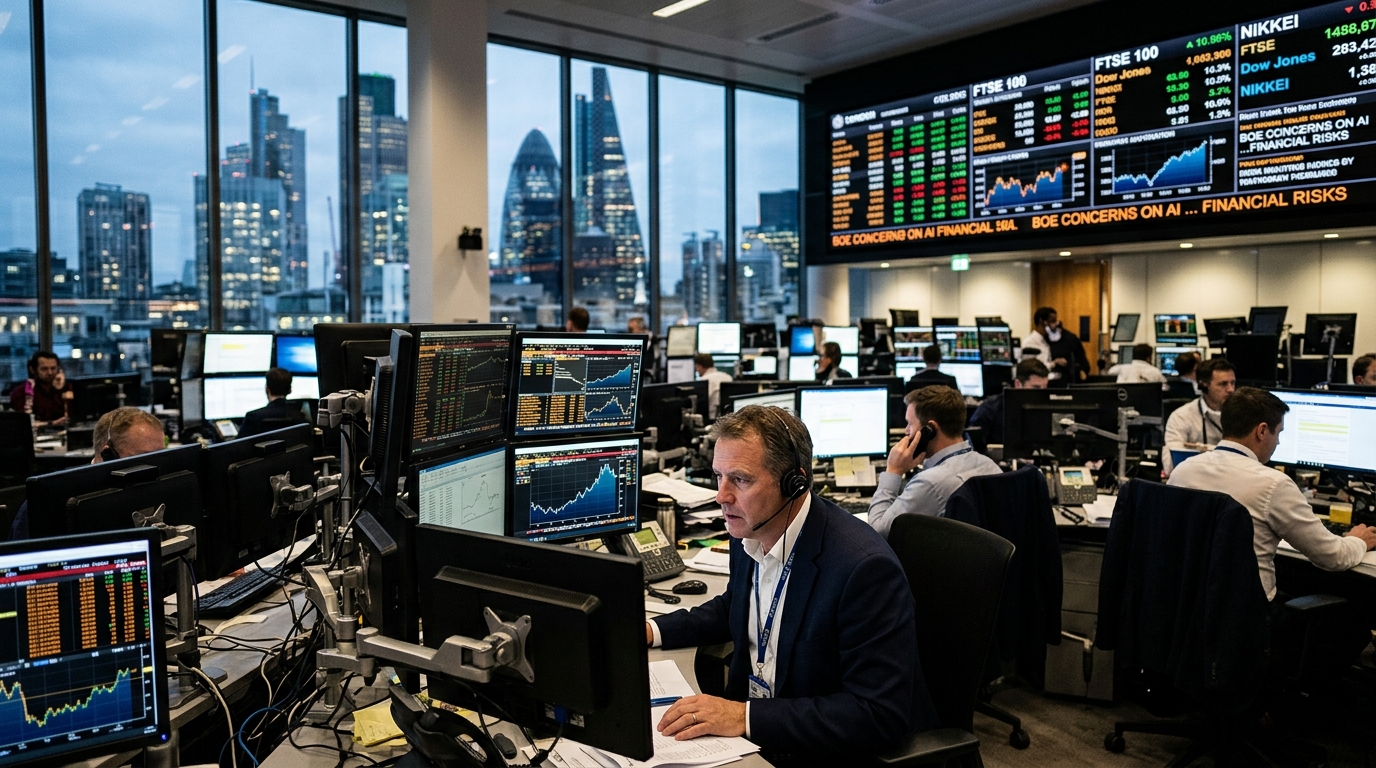
In the hallowed halls of Threadneedle Street, where centuries of tradition meet modern monetary policy, a new apprehension is taking shape. The Bank of England (BoE), one of the world’s oldest and most respected financial institutions, has issued a stark warning: Artificial Intelligence (AI) is no longer just a productivity tool, but a potential threat to global financial stability. The report from the Financial Policy Committee (FPC) emphasizes that the speed at which banks and hedge funds are adopting AI is outstripping the ability of regulators to monitor and control emerging risks.
The Herding Menace and Model Uniformity
One of the primary risks identified by the Bank of England is the phenomenon of "herding behavior." Historically, markets relied on the diversity of human decision-making. Different fund managers had varying strategies, instincts, and risk appetites. Today, however, if a large number of financial institutions use the same AI models—trained on the same datasets from the same tech giants—there is a risk they will all react in the same way to a market shock.
Imagine a scenario where thousands of algorithms simultaneously decide to dump a specific asset because they detected the same signal. This could lead to a "flash crash" of unprecedented proportions, where liquidity vanishes in a fraction of a second. The BoE is concerned that the lack of diversity in AI models could act as a crisis multiplier, turning a minor market correction into a systemic collapse. This algorithmic monoculture is the antithesis of the resilience that central banks strive to maintain.
The Black Box and the Transparency Gap
Another critical issue is the lack of explainability. Modern deep learning models often operate as "black boxes." Even their own developers sometimes struggle to explain exactly why a model made a specific decision. For regulators, this is a nightmare. How can you enforce rules or assign accountability when a multi-billion dollar investment decision was made by an opaque algorithm?
The Bank of England highlights that the reliance on third-party AI providers—such as Microsoft, Google, and OpenAI—creates a new form of systemic dependency. If one of these providers experiences a technical failure or a cyberattack, the ripple effects could immediately spread across the entire banking system. The concentration of power in a few tech firms that lie outside the direct purview of central banks is a challenge that demands urgent international cooperation and a rethink of jurisdictional boundaries.
Toward a New Regulatory Frontier
The BoE’s response is not a call for prohibition, but for more rigorous oversight. The central bank plans to conduct "stress tests" that specifically include AI failure scenarios. Furthermore, it is demanding that financial institutions maintain "human-in-the-loop" protocols and ensure they hold sufficient capital to buffer against potential losses from algorithmic errors.
In a world moving at the speed of light, stability requires foresight. The Bank of England's warning serves as a reminder that technological progress, however impressive, must never undermine the foundations of economic security. The challenge for the coming years will be balancing innovation with transparency, ensuring that AI remains a servant to the markets rather than their volatile master. As we integrate these powerful tools, the goal is to build a financial system that is robust enough to survive the very intelligence it created.
- AI model uniformity can trigger mass, simultaneous market sell-offs.
- The lack of transparency in algorithmic decisions hampers regulatory oversight.
- Dependency on a handful of Big Tech providers creates new systemic vulnerabilities.
- The Bank of England calls for more rigorous stress tests and mandatory human oversight.





