

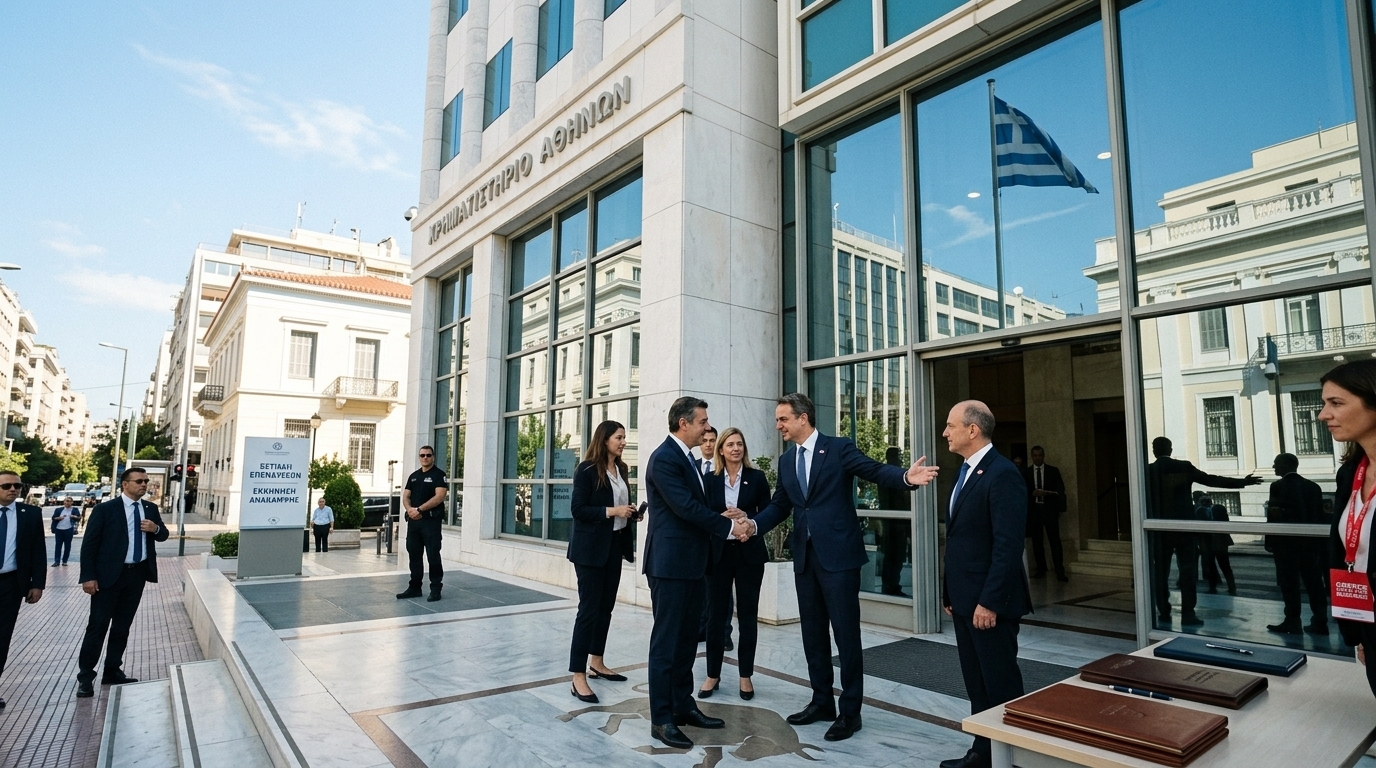
The Greek economy, after a decade of painful structural adjustments, has definitively turned a corner, transforming the Athens Stock Exchange (ASE) from a global market pariah into one of the most promising destinations for international capital. Recent activity and reports from giants such as Goldman Sachs, JP Morgan, and Morgan Stanley are not merely a vote of confidence, but a strategic repositioning toward a market offering rare opportunities in an environment of global uncertainty.
The Renaissance of the Banking Sector
The banking sector remains the locomotive of the Greek market. Following the successful cleanup of balance sheets from Non-Performing Loans (NPLs) and a return to profitability, Greek banks now display capital adequacy ratios that compare favorably with European averages. Morgan Stanley, in a recent analysis, highlights that the return of dividends—for the first time in 16 years—is the milestone institutional investors have been waiting for. Eurobank, National Bank of Greece, Piraeus Bank, and Alpha Bank are no longer viewed as distressed institutions but as cash-generating machines benefiting from high interest rates and credit expansion fueled by the Recovery and Resilience Facility (RRF).
- Goldman Sachs focuses on attractive valuations, noting that Greek banks trade at a significant discount compared to their Southern European peers.
- JP Morgan highlights the improved risk profile, as the Greek economy grows at rates significantly higher than the Eurozone average.
- Morgan Stanley emphasizes the stability of Net Interest Margins (NIMs), which remain resilient despite expectations for ECB rate cuts.
Macroeconomic Stability and Investment Grade Status
The recovery of investment grade status from major rating agencies (S&P, Fitch, Moody's) acted as the catalyst that unlocked "heavy" institutional capital, which by mandate could not invest in junk-rated assets. This development changed the composition of the investor base in Athens, attracting long-term players instead of speculative hedge funds. Political stability, combined with the fiscal discipline demonstrated by Athens, creates a predictable environment—a rarity in the current geopolitical climate.
Energy and Infrastructure: The New Protagonists
Beyond banks, the interest of foreign firms extends to sectors like energy and infrastructure. Companies such as Metlen (formerly Mytilineos), PPC (DEI), and TERNA Energy are under the analysts' microscope. The transition to green energy and Greece's role as an energy hub in Southeast Europe provide Greek listed companies with a premium that was previously mispriced. Goldman Sachs, for instance, has repeatedly stressed the importance of the international footprint of these groups, which now compete on a global scale.
The Challenges of a "Shallow" Market
Despite the optimism, foreign houses do not overlook the risks. The Athens Stock Exchange remains a relatively "shallow" market with limited liquidity in many mid- and small-cap stocks. This means that large inflows or outflows can trigger significant volatility. Furthermore, the Greek economy's dependence on tourism and consumption makes it vulnerable to external shocks, such as a new energy crisis or a sharp global slowdown. However, the prevailing view in the corridors of Wall Street is that the Greek recovery story still has a long way to run, with the ASE preparing for its official reclassification to "Developed Market" status by 2025.





