

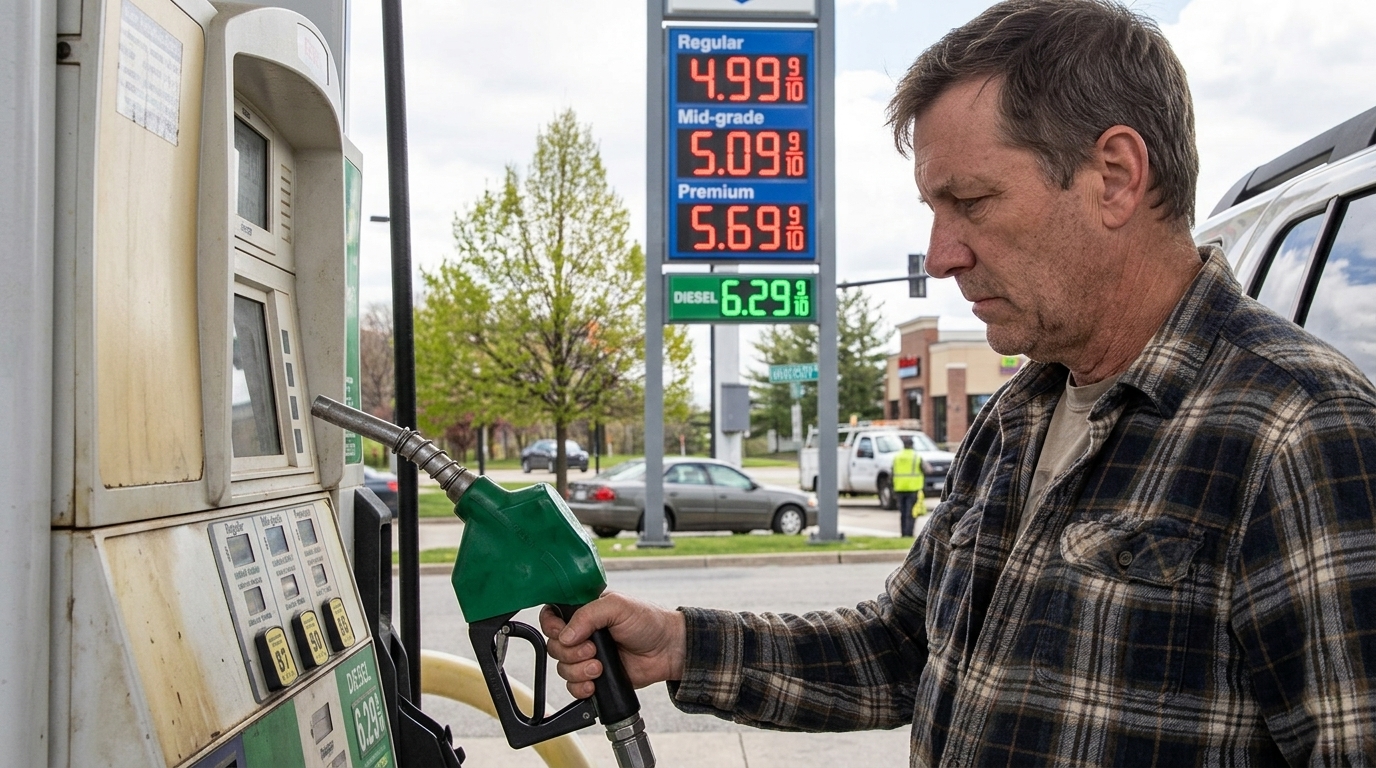
As we navigate May 2026, the chasm between Wall Street’s performance indicators and the lived reality of households has reached a dangerous breaking point. While analysts at major investment banks continue to characterize the current economic climate as a series of "transitory pressures" stemming from the ongoing crisis in the Strait of Hormuz, a startling new analysis reveals a much grimmer truth: the average American household has seen its "operating margin" collapse by 81%. This is not merely an inflation problem; it is a full-blown solvency crisis that the markets have yet to price in.
The Anatomy of Economic Suffocation
In the corporate world, profit margins are the ultimate metric of health. For a household, the equivalent margin is the surplus remaining after non-discretionary expenses—housing, energy, basic groceries, and essential transport—are deducted from net income. According to recent data, this safety buffer has all but evaporated. The spike in energy prices, ignited by geopolitical volatility in the Middle East, has acted as the final catalyst in a long-brewing storm.
The fundamental issue is that the prices of essential goods do not rise linearly with wages. Instead, energy costs permeate every layer of the supply chain. When the cost of moving and producing goods spikes exponentially, discretionary income is the first casualty. An 81% cut in household margin means that for the majority of families, an unexpected expense—be it a medical bill or a car repair—is no longer a manageable setback; it is a mathematical impossibility.
"We are not witnessing a standard inflationary cycle, but a structural restructuring of purchasing power. Wall Street looks at corporate revenues, but fails to see that the end consumer is now 'technically insolvent'," notes Katica Roy, the analyst who first highlighted the scale of the compression.
Wall Street’s Blind Spot and the Hormuz Factor
Why do the markets remain in a state of euphoric denial? The answer lies in the metrics of success. Indices like the S&P 500 are dominated by tech and energy giants that, in many cases, benefit from higher prices or possess massive cash reserves. However, the bedrock of the economy—consumption—is rotting from within. The crisis in the Strait of Hormuz, which has throttled global oil flows, is not a "black swan" event but the new operating reality.
- Surging fuel costs have driven food prices up by 22% in just six months.
- Credit card interest rates have hit historic highs, making debt refinancing nearly impossible for the average family.
- Pandemic-era savings have been completely depleted for approximately 65% of households.
Wall Street operates on the assumption that the Federal Reserve can engineer a "soft landing" by cutting rates if conditions deteriorate. However, lower interest rates cannot pump more oil or reopen contested sea lanes. The problem is one of supply, and households are paying the price for a geopolitical chess game in which they have no move to make.
The Global Domino Effect
While this analysis focuses on the United States, the implications for the global economy are profound. In the Eurozone, where energy dependency is traditionally higher, the compression of household margins may not have reached 81% yet, but the starting point was significantly lower. For the global consumer, the rise in energy and essential goods doesn't just mean fewer luxury purchases; it signals an impending wave of defaults on mortgages and public debt.
History teaches us that when the safety margin of the household disappears, social and political instability inevitably follow. Wall Street may be forced to revise its models abruptly as consumer spending—which accounts for 70% of US GDP—prepares for a violent correction. The "soft landing" narrative is increasingly looking like wishful thinking in a world running out of cheap energy and financial breathing room.





