

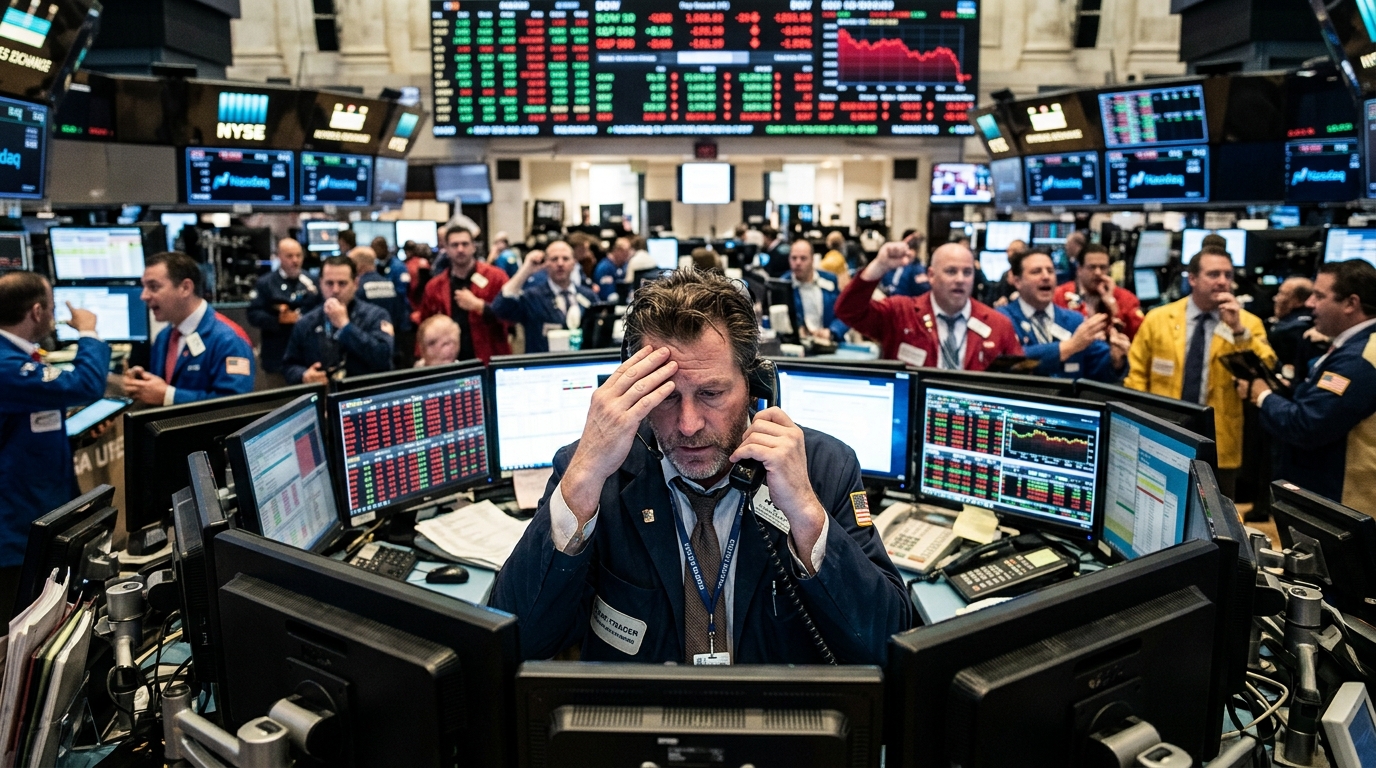
The stock market, historically prone to cycles of irrational exuberance and abrupt landings, is currently at a critical crossroads regarding the Artificial Intelligence (AI) sector. After nearly two years of uninterrupted growth, where companies like Nvidia, Microsoft, and Alphabet saw their valuations soar to unprecedented heights, recent trading sessions indicate a clear downward trend. The question looming over Wall Street and European exchanges is simple yet profoundly complex: Is this slump merely a case of "profit taking" by institutional investors, or are markets beginning to realize that the promises of AI have been overvalued relative to current profitability?
Market Psychology and the Ghost of the Dot-com Era
For many analysts, the current situation is strikingly reminiscent of the 1999-2000 period. Back then, the advent of the internet promised to change the world—which it eventually did—but stock valuations had outpaced actual economic performance by a decade. Today, AI is treated as the "fourth industrial revolution," yet investors are starting to demand tangible results. The recent decline in semiconductor stocks, which form the backbone of AI, suggests growing nervousness.
Investors are no longer suffering from FOMO (Fear Of Missing Out) but rather from the fear of being trapped in stocks with price-to-earnings (P/E) ratios that are not justified by growth rates. When a company like Nvidia drops 10% or 15% within a few days, it’s not just a fluctuation; it’s a signal that "smart money" is seeking safer havens, waiting to see if the massive capital expenditures (Capex) of Big Tech giants will soon translate into increased revenue from AI services.
The Capital Expenditure (Capex) Dilemma
One of the main points of friction is the sheer scale of investment required for AI infrastructure. Microsoft, Google, and Meta are spending tens of billions of dollars every quarter on chips and data centers. While this spending fuels the profits of Nvidia and other hardware manufacturers, the shareholders of these software companies are beginning to ask when they will see a return on investment (ROI).
- The rising energy consumption of data centers creates additional costs and environmental challenges.
- Competition in Large Language Models (LLMs) is leading to margin compression, as companies offer free or cheap services to gain market share.
- AI regulation from the EU and US adds a layer of uncertainty and potential legal costs.
These factors create a backdrop where "nervousness" outweighs "optimism." If investors become convinced that AI profitability is a matter for the next decade rather than the next quarter, the current slump may only be the beginning of a larger retreat.
Macroeconomic Environment and Liquidity
We must not overlook the broader economic context. With interest rates remaining at relatively high levels (despite expectations for cuts), the cost of capital is significant. Growth stocks, such as those in technology, are particularly sensitive to interest rate changes. If inflation proves more persistent than expected, the US Federal Reserve might delay rate cuts, making expensive AI stocks even less attractive compared to bonds.
"The market can remain irrational longer than you can remain solvent," John Maynard Keynes once said.
In the case of AI, the "irrationality" of the upside might be giving way to the "rationality" of a correction. Major investment banks, such as Goldman Sachs and Morgan Stanley, have issued warnings about the over-concentration of capital in a handful of tech stocks. This lack of market breadth is often a harbinger of volatility.
Conclusion: Healthy Correction or Systemic Risk?
In conclusion, the recent slump in AI stocks is likely a combination of both factors. Profit taking is inevitable after such rallies, but the nervousness is real and based on fundamental questions about the sustainability of the current AI business model. For the long-term investor, this period represents an opportunity to separate the wheat from the chaff—to identify which companies have a real competitive advantage and which are simply riding the wave of hype. Artificial Intelligence is here to stay, but the road to its universal adoption will be paved with stock market turbulence.





