

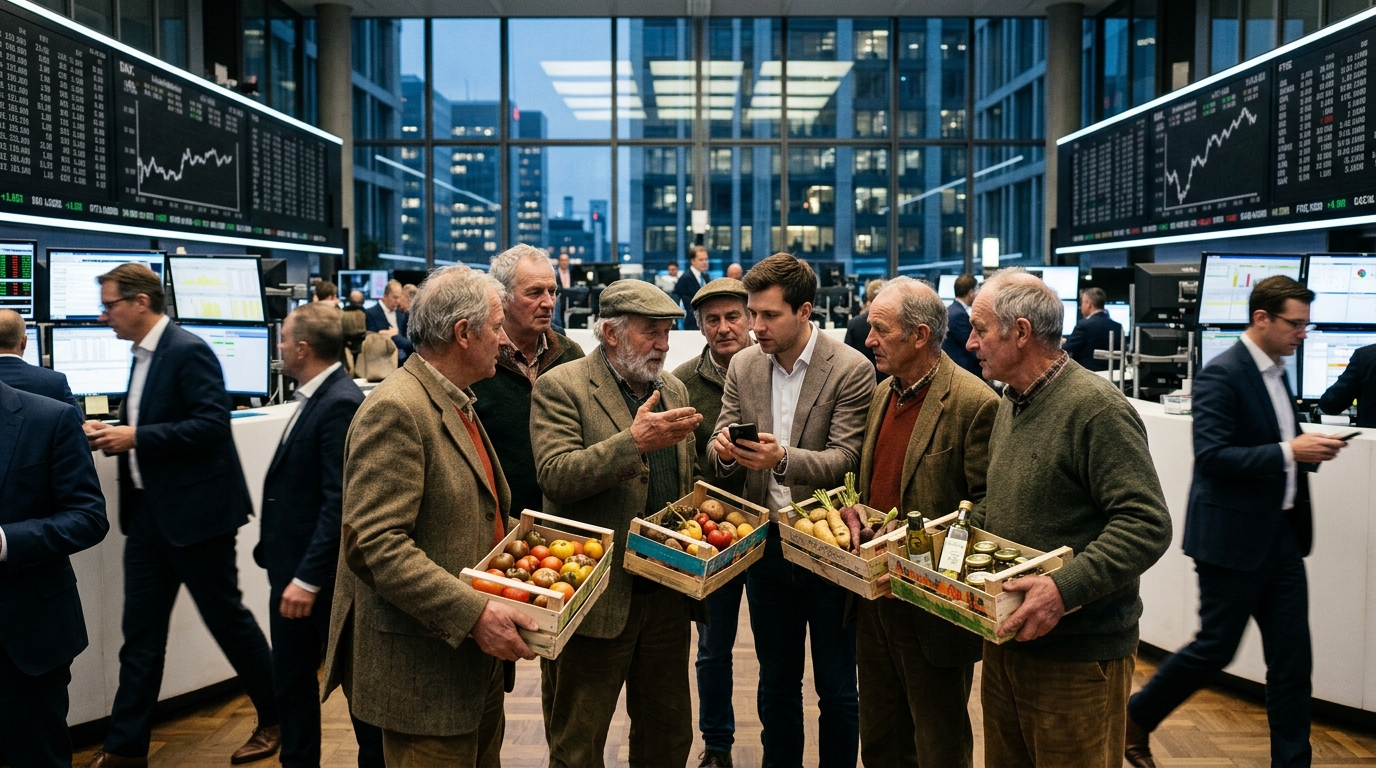
The European countryside, particularly in the Mediterranean, has been in a state of existential crisis for decades. Small landholdings, the traditional model of family farming, were long viewed as the weak link in a global market dominated by the industrial-scale operations of the US and Brazil. However, the emergence of Artificial Intelligence (AI) and Precision Agriculture promises to flip this narrative. This is not merely a technical upgrade; it is a fundamental re-evaluation of what agricultural production means in the 21st century.
Precision Agriculture as a Survival Tool
For a small-scale farmer in Greece, Italy, or Southern France, production costs are often prohibitive. AI steps in not as a distant automation tool, but as a digital consultant that optimizes every drop of water and every gram of fertilizer. Through IoT (Internet of Things) sensors and satellite data analysis, farmers can now understand the precise needs of every square meter of their land.
This granular approach drastically reduces overhead, allowing small plots to become economically viable without the need for massive expansion. AI can predict diseases before they are visible to the naked eye by analyzing weather patterns and soil moisture. Consequently, pesticide use is kept to a minimum, aligning perfectly with the strict requirements of the European Green Deal.
The 'Boutique' Model: Quality as a Competitive Edge
The true revolution, however, lies in AI’s ability to support a 'boutique' production model. In the global market, small landholdings cannot compete on the price of mass-market commodities. They can, however, dominate in high-value-added products. AI enables full traceability from farm to fork, creating a digital identity for every product.
- Digital Product Passports: A consumer in London or Tokyo can scan a QR code and see the exact origin, cultivation conditions, and environmental footprint of the olive oil or wine they are purchasing.
- Personalized Production: Data analytics allow producers to tailor their crops to the specific needs of niche markets, such as organic products or functional superfoods.
- Supply Chain Management: Demand forecasting algorithms help small producers connect directly with markets, bypassing intermediaries who often absorb the lion's share of the profits.
The Challenge of Digital Transition
Despite the promise, the path is not without obstacles. Adopting AI requires capital and, more importantly, digital skills that are often lacking in Europe’s aging farming population. This is where the role of cooperatives and state support becomes critical. Creating 'digital hubs' where small producers share the costs of technology and data is the only realistic solution.
"Technology is not coming to replace the farmer, but to give them the tools to become a high-tech manager while preserving the soul and tradition of their land," state agricultural economy analysts.
In conclusion, AI offers small landholdings a final opportunity to survive and thrive. By turning a lack of scale into an advantage of uniqueness, European agriculture can stop being a subsidized relic of the past and become the boutique of the global food map. Tradition is not ending; it is being transformed into a digital legacy that can command a premium price in international markets.





