

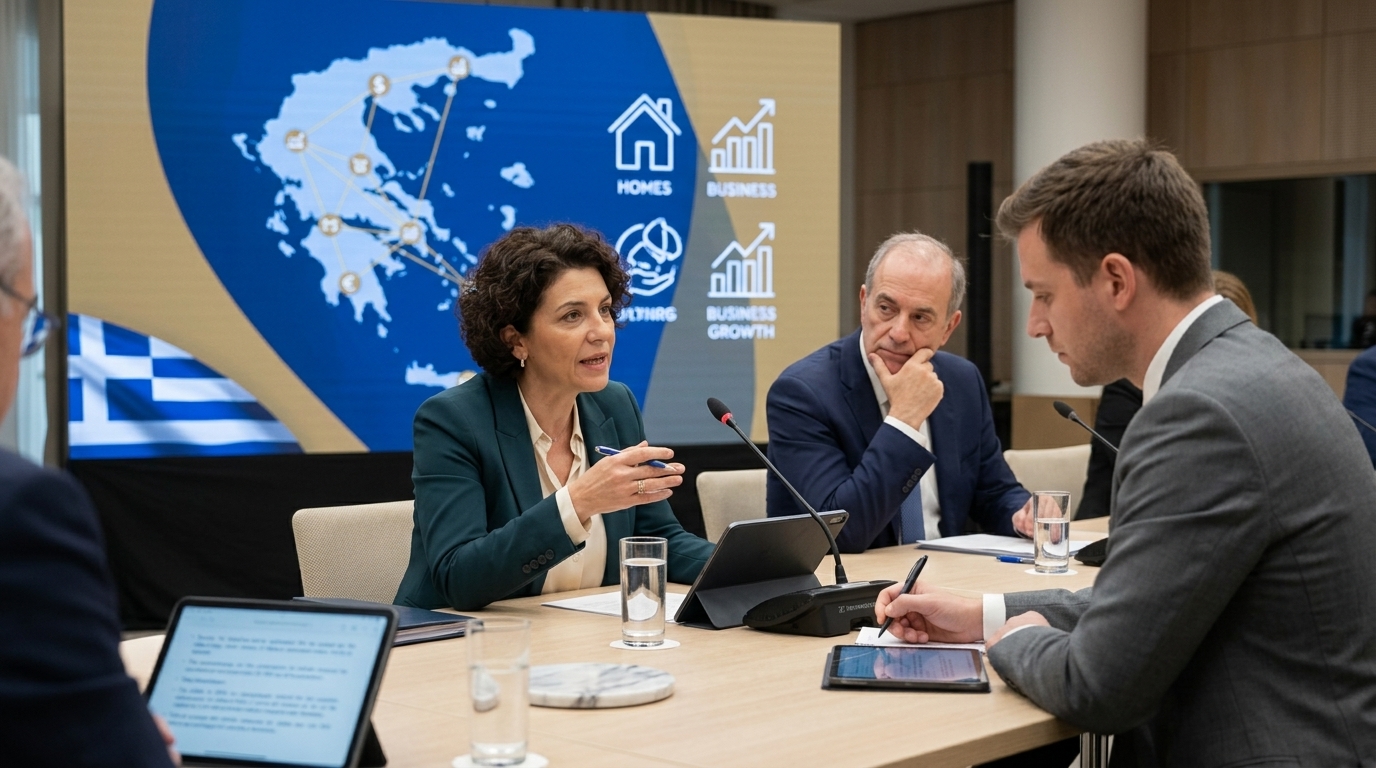
In a move designed to act as a catalyst for the structural transformation of the Greek economy, the government has unveiled a comprehensive package of financial tools totaling 19 billion euros. Alternate Finance Minister Nikos Papathanasis detailed the strategy extending to 2030, focusing on two critical pillars: enhancing the competitiveness of Small and Medium Enterprises (SMEs) and alleviating the housing crisis that particularly affects the younger generation.
The Low-Interest Revolution for SMEs
The centerpiece of the announcement is the utilization of Recovery and Resilience Facility (RRF) funds to provide loans with exceptionally low borrowing costs. With fixed interest rates set at 0.35% for micro and small enterprises, the government is attempting to bypass the hurdle of high market interest rates, which often make investments prohibitive for Greek firms.
These financial tools are not merely about survival but modernization. Subsidies, which in some cases reach 95%, are strategically directed toward digital transformation and the green transition. The logic is clear: for a Greek SME to survive international competition, it must reduce its energy footprint and integrate cutting-edge technologies. State intervention acts as a buffer and simultaneously an accelerator for investments that would otherwise be delayed for decades.
"We are not just offering liquidity; we are offering Greek businesses the chance to move up a league," Papathanasis emphasized, highlighting the importance of extroversion.
Housing Policy: Renovation and Affordable Living
The second major chapter of the package concerns housing, an issue that has evolved into a social "time bomb." The "Renovate - Rent" program, along with the new phases of "My Home," aims to mobilize the idle building stock. With subsidies reaching 95% for energy and functional upgrades, the state is calling on owners to open closed apartments and make them available for long-term rental.
Data analysis shows that the problem in Greece is not a lack of square footage, but the age and energy inefficiency of existing properties. By providing interest-free or low-interest loans for first-time home purchases, the government is attempting to broaden access to homeownership for individuals up to 50 years old, extending the age limits that applied in previous programs. This move is expected to relieve rental price pressure by increasing the supply of quality housing.
Implementation Challenges and Bureaucratic Hurdles
Despite the optimism generated by the figures, the path to absorbing the 19 billion euros is not without obstacles. The history of European programs in Greece has shown that bureaucracy and the banking system's difficulty in evaluating small investment projects are the main bottlenecks. For the program to succeed, a radical simplification of application and approval procedures is required.
Furthermore, there is the risk of construction material inflation. A massive shift toward renovations could push up the prices of materials and labor, absorbing part of the subsidy and reducing the final benefit for the citizen. The government must closely monitor the market to avoid speculative phenomena that would negate the social character of the measures.
Conclusion: A Historic Opportunity for Greece 2030
The 19 billion euro package is not just a budget; it is a vision for Greece in the next decade. If implementation meets the design, the country could see a new generation of entrepreneurs who do not fear innovation and a new generation of citizens who can dream of their own home without the stress of unbearable debt. The success of this venture will be judged on speed, transparency, and the ability of institutions to bring the money where it is truly needed: to the heart of society and the real economy.





