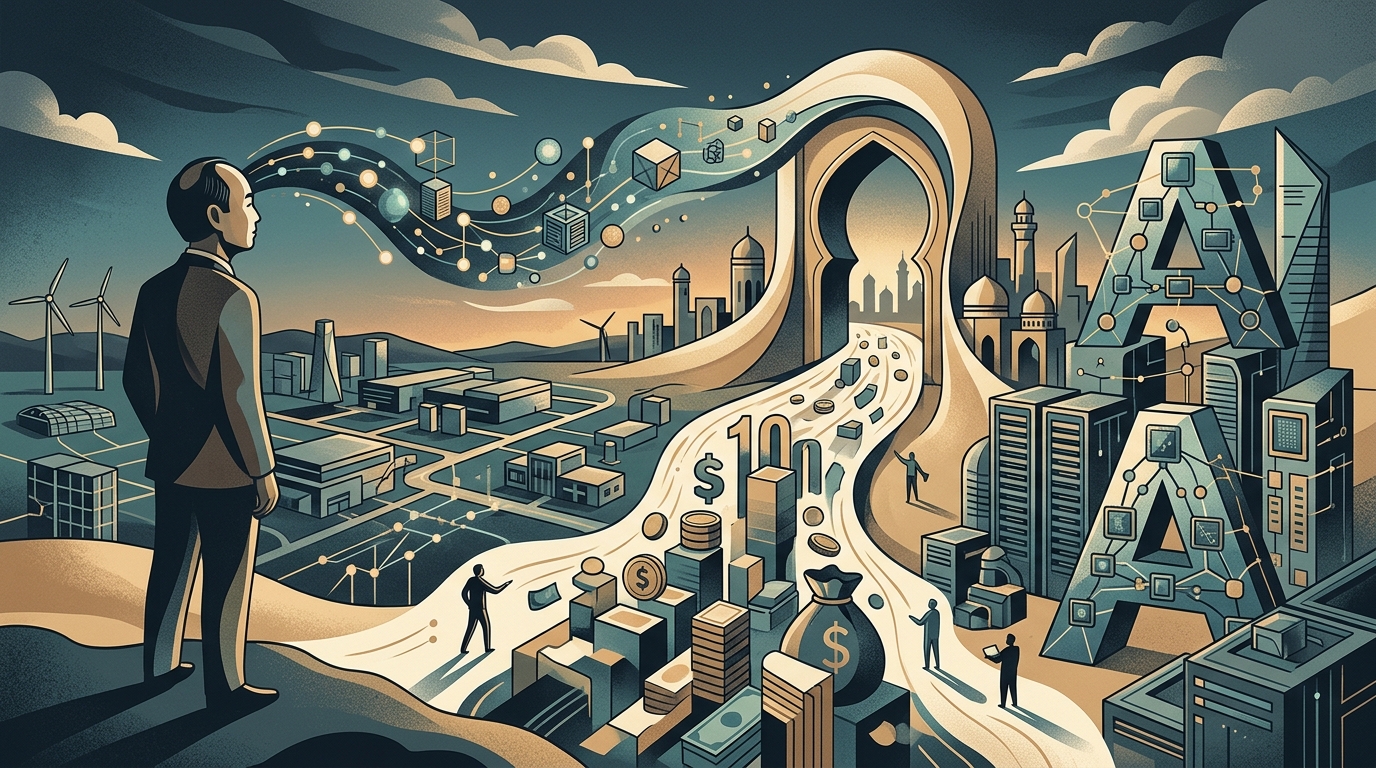
As we navigate the summer of 2026, the discourse surrounding Artificial Intelligence (AI) has shifted from the initial "bubble" anxieties to a profound, structural reorganization of the global economy. The era when AI was considered an experimental tool is long gone. Today, computational power is the new oil, and data is the currency of power. For investors, the question is no longer whether to gain exposure to the sector, but which companies possess the necessary "moat" to survive and dominate for decades to come.
A "buy and hold forever" strategy requires businesses that don't just offer a product, but an infrastructure upon which an entire civilization is built. Based on the current economic data and technological advancements of 2026, three giants stand out as the undisputed pillars of this new edifice.
NVIDIA: The Undisputed King of Infrastructure
Despite predictions by many analysts in 2024 that NVIDIA would hit a saturation point, Jensen Huang’s company has proven in 2026 that its dominance is deeper than we imagined. With the launch of the "Rubin" architecture and the full integration of Sovereign AI systems, NVIDIA has transformed from a semiconductor company into a provider of comprehensive data ecosystems.
- Dominance in Inference: While the focus in 2023-24 was on model training, in 2026, profitability stems from executing (inference) these models in real-time, where NVIDIA holds 90% of the market.
- The CUDA Ecosystem: CUDA software remains the biggest hurdle for competitors, as millions of developers are now "locked" into this environment.
- Robotics and Omniverse: NVIDIA no longer just sells chips for chatbots; it sells the "brain" for the next generation of humanoid robots and industrial digital twins.
Investing in NVIDIA in 2026 is not a bet on the future, but a participation in the profits of the very operation of the internet and industry itself.
Microsoft: The Empire of Software as Intelligence Service
Microsoft has achieved something few companies in history have: remaining relevant and dominant for five consecutive decades. In 2026, Microsoft Copilot is no longer a plug-in; it is the operating system itself. The integration of AI into every facet of Azure and Office 365 has created a revenue stream that is practically impossible to disrupt.
"Microsoft is no longer selling software; it is selling productivity at a scale that was unthinkable three years ago," Wall Street analysts report.
The strategic partnership with OpenAI (which has now reached AGI-light levels) and the development of its own silicon (Maia chips) allow Microsoft to control its costs, driving profit margins to record levels. For the long-term investor, Microsoft represents the safety of a bond combined with the growth of a startup.
Alphabet (Google): The Awakened Giant
After a period of uncertainty in 2024, Alphabet in 2026 has solidified its position as the ultimate force in data. The Gemini 3.0 model has been fully integrated into Search, YouTube, and Android, creating a closed ecosystem where AI learns from billions of users every second.
The reason Alphabet is a "forever" stock lies in its vertical integration. It is the only company, alongside Apple, that simultaneously controls software, data, and hardware (via its TPUs - Tensor Processing Units). Furthermore, Waymo (its autonomous driving subsidiary) has begun to contribute significantly to revenue in 2026, proving that Google’s AI has real-world applications beyond screens.
Why "Never Sell"?
The concept of "never selling" in an industry as volatile as tech might sound dangerous. However, AI is not a sector; it is a horizontal technology that affects everything. Companies that control the infrastructure (NVIDIA), the platform (Microsoft), and the data (Alphabet) act as the "toll booth operators" on the digital highway of the future. Their market capitalization, while appearing high, reflects their ability to extract value from every digital interaction on the planet.