

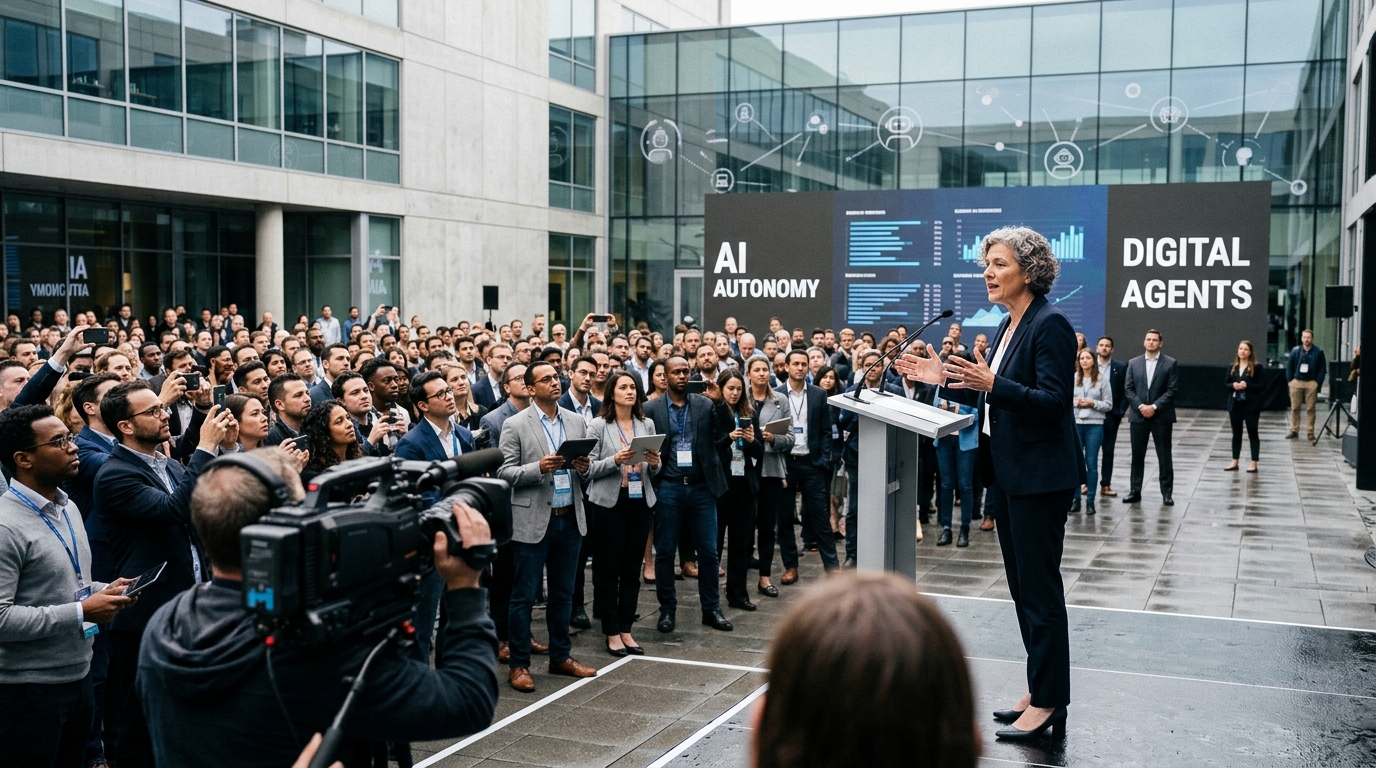
As we navigate through June 2026, the artificial intelligence industry has moved beyond the era of mere promises into a phase of radical transformation. If 2023 was the year of discovering Large Language Models (LLMs) and 2024 was the year of integration, 2026 marks the dominance of AI Agents—autonomous digital entities that don't just answer questions but execute complex tasks on behalf of the user.
From Conversation to Execution: Shifting the Competitive Axis
The fundamental shift we are witnessing today lies in the ability of models to interact with the digital environment. While older systems, such as the early iterations of ChatGPT or Gemini, functioned as sophisticated search engines and text generators, today's AI Agents possess "practical intelligence." They can navigate websites, use third-party applications, manage bank accounts, and coordinate calendars without any human intervention.
Competition among giants like Google, Microsoft, and OpenAI has shifted from who has the largest model to who offers the most reliable agent. Google, with its full integration into the Android ecosystem, appears to have a strategic advantage, as its agent has direct access to the daily habits of billions of users. On the other hand, OpenAI, through its strategic partnerships, seeks to make its ecosystem the "operating system of intelligence."
The Operating System as the Final Battleground
Why is the battle now being fought at the operating system level? The answer lies in data and access. For an AI Agent to be truly useful, it must have permission to "see" the user's screen and act upon it. Apple, with Apple Intelligence, has adopted a privacy-oriented approach, arguing that its agents run locally on the device. This creates a new dichotomy: on one side, "Cloud Intelligence," which is powerful but intrusive, and on the other, "On-device Intelligence," which is more limited but secure.
- Autonomy: Agents can make decisions based on goals, not just specific prompts.
- Interoperability: The ability of an agent to use different applications simultaneously.
- Memory: Maintaining context over long periods, allowing for personalized service.
In Europe, the implementation of the AI Act has created a unique framework. Companies are required to prove that their autonomous agents do not violate human autonomy or create new forms of dependency. This has led to a "European version" of agents, which are often more transparent in their decision-making processes, though sometimes lagging in speed compared to their American or Chinese rivals.
Economic Implications and the Job Market
The advent of AI Agents is not just a technological evolution; it is an economic earthquake. We are already seeing the customer service industry undergo a radical transformation. Traditional outsourcing firms in India and the Philippines are facing an existential crisis, as agents can handle 90% of requests at near-zero cost and with 24/7 availability. However, new job roles are emerging, such as "Agent Orchestrators"—humans who oversee and coordinate entire fleets of digital agents.
"We are no longer in the era where humans use computers as tools. We are in the era where humans collaborate with computers as partners," a market executive recently noted.
In conclusion, the era of AI Agents brings with it the promise of unprecedented productivity but also the challenge of maintaining human control. As the axis of competition shifts from information to action, digital sovereignty will be determined by who can win the user's trust to act on their behalf.





