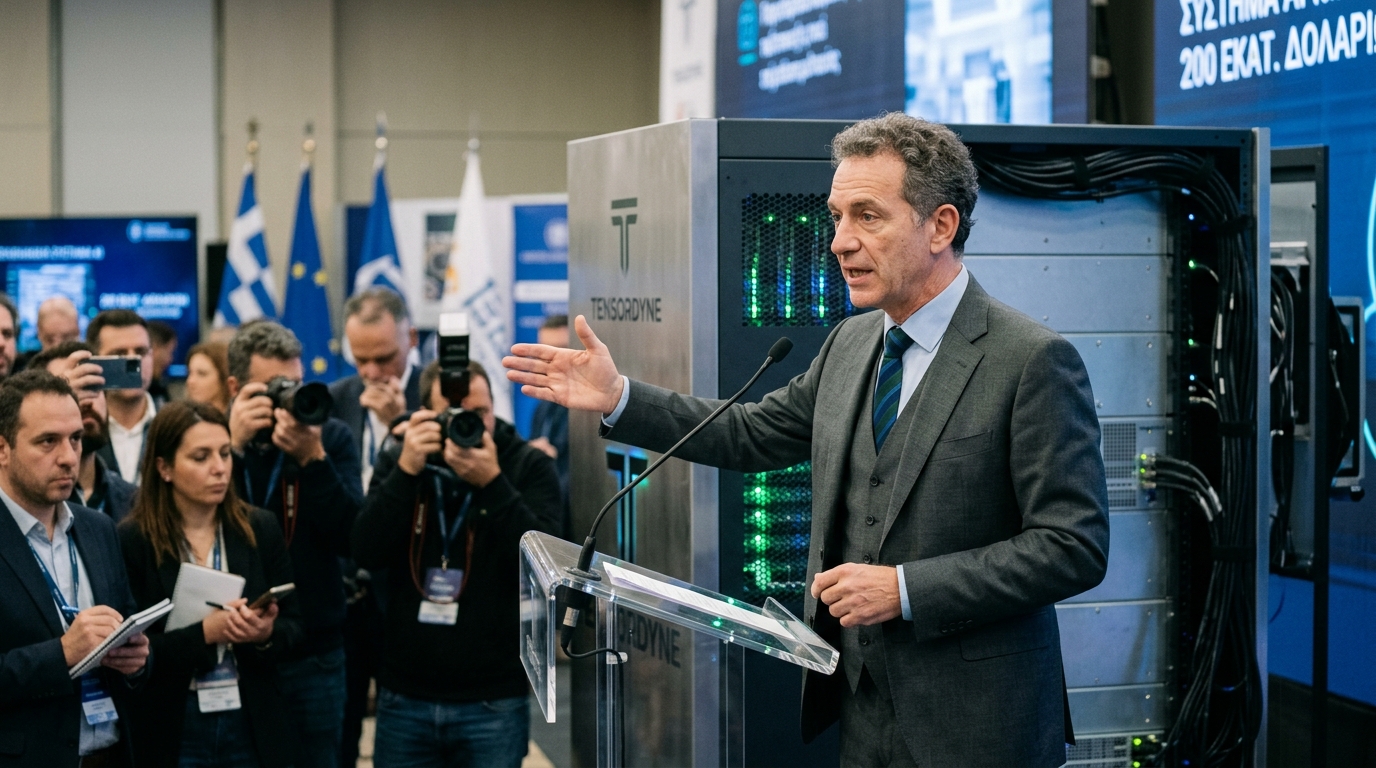
In the current AI landscape, where Nvidia commands nearly 80% of the specialized processor market, the emergence of a new player with significant financial backing and technological promise is front-page news. Tensordyne, a company that until recently operated under the radar of many, has announced that it expects orders totaling $200 million for its new AI system. This news, initially reported by Oikonomikos Tachydromos, is not just a business success; it is a sign that the Silicon Valley monopoly is beginning to show cracks.
The Architecture of Disruption
Tensordyne is not merely trying to replicate Nvidia’s Hopper or Blackwell architecture. Instead, its system is based on a radically different approach to memory management and power consumption. The major problem for modern data centers is not just processing speed, but energy costs and the heat generated. Tensordyne claims its unit offers up to 40% better performance-per-watt compared to current industry standards.
This energy efficiency is the "holy grail" for cloud computing giants like AWS, Google, and Microsoft, who spend billions on cooling their servers. If Tensordyne can prove its reliability at scale, these $200 million orders could be just the beginning of an avalanche that will reshape the global semiconductor supply chain.
The Software Hurdle and the CUDA Ecosystem
However, the road to the top is not paved with roses. Nvidia dominates not only because of its hardware but primarily because of its CUDA software. CUDA is the language that developers worldwide use to "talk" to Nvidia chips. Tensordyne must convince software engineers to adopt its own development framework or offer a perfectly compatible solution that does not sacrifice speed.
Analysts point out that many companies that tried to compete with Nvidia in the past failed because they could not offer a user-friendly software ecosystem. Tensordyne seems to be investing in compilers that allow for the automatic porting of code from CUDA to its own system—a high-risk but high-reward move.
Economic Implications and Geopolitics
The $200 million investment comes at a time when the global economy is desperately seeking alternatives to reduce its dependence on a single source. The chip shortages observed in previous years served as a lesson for governments and tech giants alike. The emergence of Tensordyne strengthens competition, which in turn leads to lower prices and accelerated innovation.
Furthermore, there is the dimension of strategic autonomy. In a world where access to computing power is equivalent to national power, having multiple AI hardware suppliers is a matter of national security for many countries. Tensordyne, with a headquarters location that allows it to maneuver in international markets, could be the "middle ground" for buyers wary of American protectionism or Chinese sanctions.
Conclusion: A New Era in Computing
In conclusion, Tensordyne is not just a startup with a large order. It is the symbol of a new phase in the artificial intelligence revolution—a phase where the emphasis shifts from raw power to efficiency, compatibility, and diversification. If the $200 million system meets expectations, 2026 will go down in history as the year Nvidia’s throne began to rattle, not from another giant, but from the ingenuity and boldness of a new challenger.