

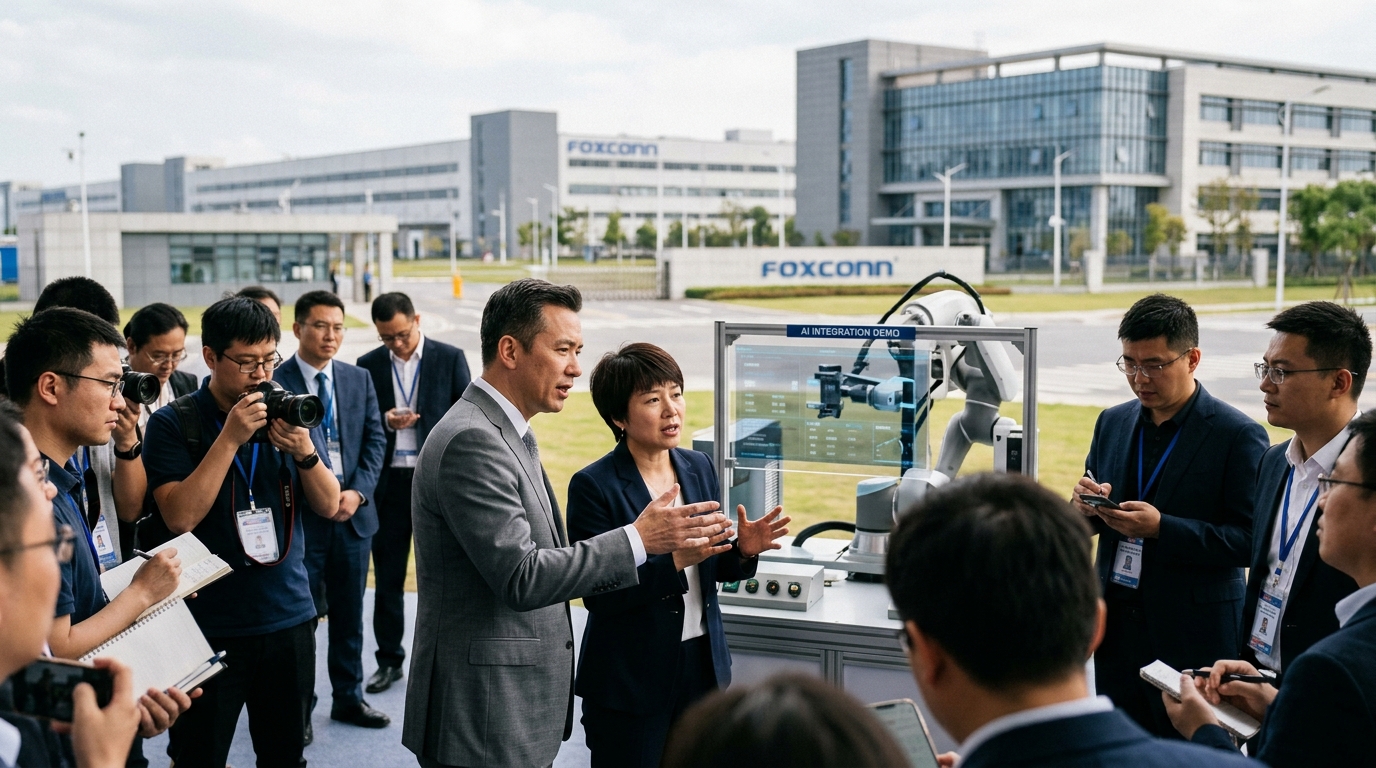
Hon Hai Precision Industry Co., globally known as Foxconn, is no longer just the "iPhone assembler." According to the latest financial data released in July 2026, the Taiwanese tech giant is undergoing one of the most radical transformations in its history, driven exclusively by the global market's insatiable hunger for Artificial Intelligence infrastructure. The company's revenue has surged to levels exceeding analyst expectations, proving that Foxconn has successfully positioned itself at the heart of AI's "golden age."
The Transition from Smartphones to AI Servers
For decades, Foxconn's fortunes were inextricably linked to the lifecycle of consumer electronics, primarily Apple's iPhone. However, as the smartphone market matures and shows signs of fatigue, Foxconn has found a new, far more profitable path. The demand for specialized servers capable of supporting Large Language Models (LLMs) and generative AI applications has created a multi-billion dollar market.
Foxconn now holds a dominant role in manufacturing the AI servers used in data centers for NVIDIA, Google, and Amazon. Its partnership with NVIDIA to produce systems based on the Blackwell architecture (and its 2026 successors) has made the company an indispensable link in the supply chain. Analysts note that the profit margins on these products are significantly higher than those in mobile phone assembly, a fact directly reflected in the company's bottom line.
Geopolitical Resilience and the "Silicon Shield"
Foxconn's rise through AI is not just a business success; it is a strategic move on the geopolitical chessboard. Taiwan, often described as the world's "Silicon Shield," is strengthening its position through companies like Foxconn and TSMC. Despite ongoing tensions in the Taiwan Strait, Foxconn has managed to diversify its production base, expanding operations to India, Mexico, and Vietnam, ensuring that AI server production remains uninterrupted.
The "China + 1" strategy seems to be paying off. While China remains a central hub, new high-tech production units outside China are focusing precisely on the AI products destined for Western markets. This flexibility allows Foxconn to avoid tariffs and trade restrictions while maintaining its leadership in the global supply chain.
The Future: Robotics and Electric Vehicles
Foxconn is not stopping at servers. Company Chairman Young Liu has repeatedly stated that the vision for 2026 and beyond includes integrating AI into every aspect of production. The company is investing heavily in "smart manufacturing," using AI-driven robots to automate its own production lines. Furthermore, AI is the missing link for Foxconn's entry into the Electric Vehicle (EV) market.
"We are not just building machines; we are building the brain of the future economy," a senior executive recently stated.
With its MIH platform for EVs and the development of AI-based autonomous driving systems, Foxconn aspires to become the "Android of EVs." Its ability to combine hardware with advanced AI software puts it at a distinct advantage over traditional automakers struggling to adapt to the digital age.
Conclusion: A New Growth Cycle
Foxconn's revenue surge in 2026 confirms that artificial intelligence is not a bubble but a structural shift in the global economy. The company has managed to break free from the image of low-cost labor and emerge as a technological leader defining future trends. For investors and market observers, Foxconn's trajectory is a mirror of the new industrial revolution, where power is no longer measured solely in production units but in teraflops and algorithmic efficiency.





