

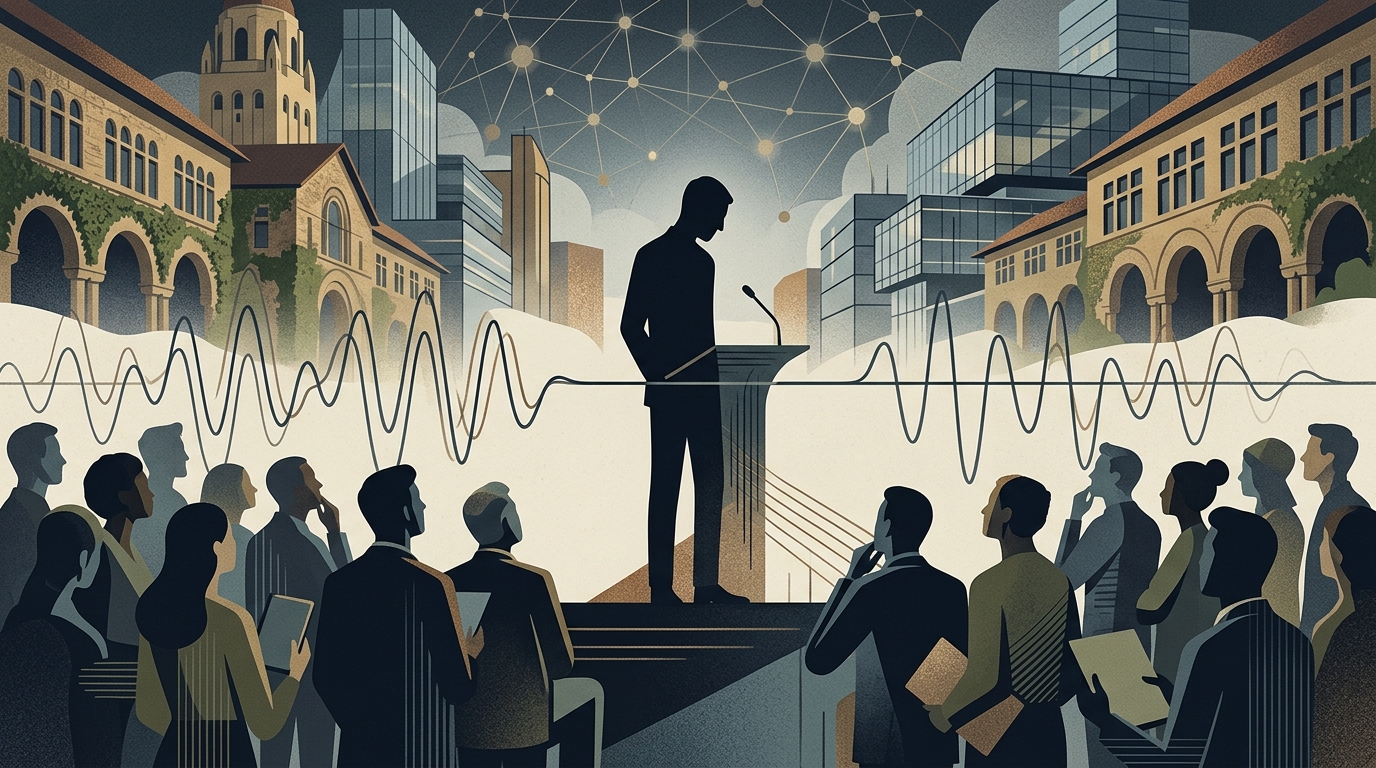
At Stanford, the university that birthed Google and served as the nursery for Silicon Valley’s digital revolution, Sundar Pichai’s appearance at the 2026 commencement podium was expected to be a manifesto for the future. In an era where Artificial Intelligence (AI) reshapes every aspect of human activity—from the labor market to the very structure of knowledge—the CEO of the tech giant made a choice that surprised many: he almost entirely avoided mentioning AI.
This move was not accidental. At a time when Google is under intense scrutiny for its dominance in search and the challenges posed by Gemini, Pichai’s silence on the 'holy grail' of technology is interpreted as a strategic pivot toward human-centricity. Instead of code and algorithms, Pichai offered graduates life lessons, focusing on patience, curiosity, and the ability to manage failure.
The Strategy of 'Low Profile'
Why would the man leading an 'AI-first' company choose not to speak about the product that defines his business's survival? One explanation lies in the current psychology of the job market. The Class of 2026 is entering a world where automation is no longer a distant threat but a daily reality. Mentioning AI by a man considered an architect of this shift could be perceived as tone-deaf or even provocative.
Pichai chose to speak about 'patience,' a virtue that seems anachronistic in the high-velocity world of Silicon Valley. He argued that great breakthroughs take time and that an obsession with immediate results can cloud judgment. This approach also serves as an indirect answer to critics who claim Google was 'late' to respond to OpenAI and Microsoft. It is an attempt to rebrand Google not as a player running in a panic, but as a wise giant moving with methodical precision.
Resilience as the New Hard Skill
In his speech, Pichai placed particular emphasis on resilience. 'The road to success is paved with failures that don’t show up on LinkedIn,' he noted. For Stanford graduates, who are often pressured by the pursuit of perfection, this message carried significant weight. Google's CEO used examples from his own journey—from his early years in India to the top of the corporate world—to show that technology is merely a tool, while character is the driving force.
- The importance of intellectual curiosity in a rapidly changing world.
- Accepting uncertainty as an integral part of innovation.
- The need for an ethical compass in developing new technologies, even if not explicitly stated regarding AI.
This shift toward 'soft skills' reflects a broader trend in Silicon Valley leadership. As machines become better at problem-solving, the human capacity for empathy, critical thinking, and strategic patience becomes more valuable. Pichai, with his characteristic calm, sought to reassure graduates, suggesting that human creativity remains irreplaceable.
Political and Social Context
We must not overlook the fact that commencement speeches are acts of public diplomacy. Google faces intense pressure from regulators in the US and the EU. A speech filled with technological triumphalism about AI could fuel the narrative of 'unchecked power.' Conversely, a speech about the human experience presents the company as a responsible social partner.
"Technology is not the destination; it is the means to reach a better world. But that world is built by people, not algorithms."
In conclusion, Sundar Pichai’s 'silence' on AI at Stanford was perhaps the loudest statement he could have made. It was an admission that, despite technological omnipotence, humanity remains at the center. For the graduates, it was a reminder that their careers will not be judged by how well they use today’s tools, but by how resilient they remain in the face of tomorrow’s challenges. Google may be an AI company, but Pichai reminded everyone that it is run by humans who understand deeper human needs.





