

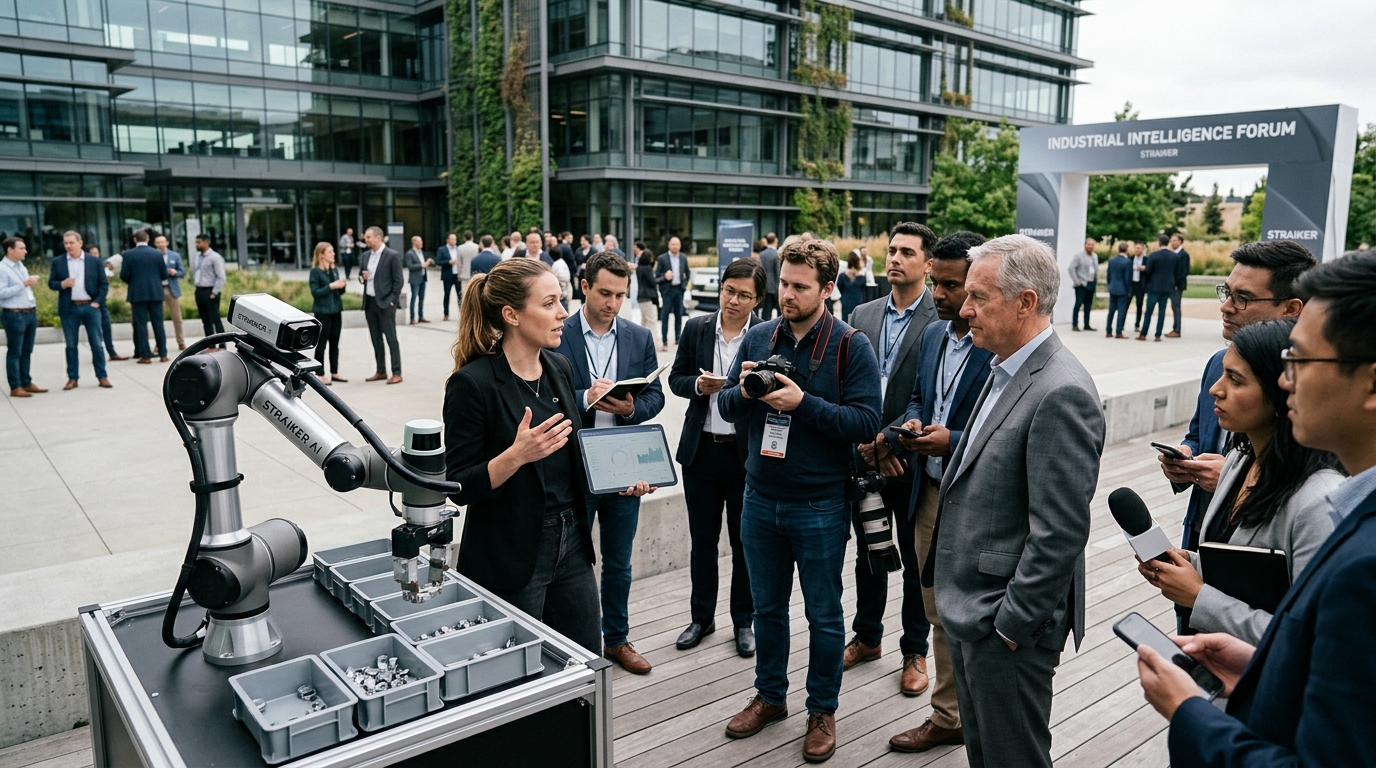
In an era where the global artificial intelligence market is maturing beyond the initial hype of large language models (LLMs), Straiker’s emergence as one of the 100 most innovative startups in the world by CB Insights for 2026 marks a significant milestone. The announcement, released via PR Newswire, is not merely a corporate achievement; it is a validation of the industry's pivot toward "Physical AI" and autonomous agentic systems.
The CB Insights AI 100 list has long been regarded as the "gold standard" for identifying companies poised to reshape the economic landscape. For 2026, Straiker’s inclusion highlights the company's ability to bridge the gap between digital code and physical execution, offering solutions that go far beyond simple text or image generation.
The Strategic Significance of Straiker in the 2026 Ecosystem
Straiker has managed to distinguish itself in a hyper-saturated environment by focusing its efforts on operational resilience and supply chain automation through advanced neural networks. While 2024 and 2025 were characterized by the dominance of chatbots, 2026 is the year of the "Action Agent." Straiker’s technology allows large organizations to automate complex decision-making processes in real-time, reducing operational costs by up to 40% in some sectors.
Market analysts suggest that Straiker’s success is rooted in its proprietary architecture, which enables few-shot learning in industrial environments. This means its systems do not require massive amounts of data to adapt to a new production line or warehouse layout, making high-end AI accessible even to mid-sized enterprises that lack the infrastructure of tech giants.
The CB Insights Methodology and the Future of Investment
Inclusion in this list is no accident. CB Insights utilizes its "Mosaic" algorithm, which evaluates a company’s health based on funding, investor quality, commercial momentum, and talent acquisition. Straiker scored exceptionally high in "market momentum," suggesting that its solutions fill a real and urgent void in the global market.
- Architectural Innovation: Use of hybrid models combining symbolic logic and deep learning.
- Scalability: Applicability across multiple sectors, from automotive to energy.
- Sustainability: A focus on resource optimization, contributing to clients' ESG goals.
The fact that Straiker secured a spot among thousands of candidates speaks to the confidence of the investment community. With the global economy facing inflationary pressures and labor shortages, technologies that offer genuine productivity gains are the ones that will survive and dominate the next decade.
Challenges and Ethical Dilemmas
Despite the accolades, the rise of Straiker and similar entities brings serious questions to the fore. Automation at this depth threatens traditional roles in management and supervision. Straiker argues that its technology "augments" humans rather than replacing them, but the history of industrial revolutions shows that these transitions are rarely painless.
"Innovation is not measured solely by lines of code, but by the impact it has on the social fabric. Straiker is at the heart of this conversation," notes Clio, lead analyst at The AI Chronicle.
In conclusion, Straiker’s recognition by CB Insights in 2026 confirms that Artificial Intelligence is entering its "mature" phase. It is no longer an experiment in Silicon Valley labs but the engine of global industry. The question that remains is whether regulators and society can keep pace with the velocity dictated by these 100 most innovative companies.





