

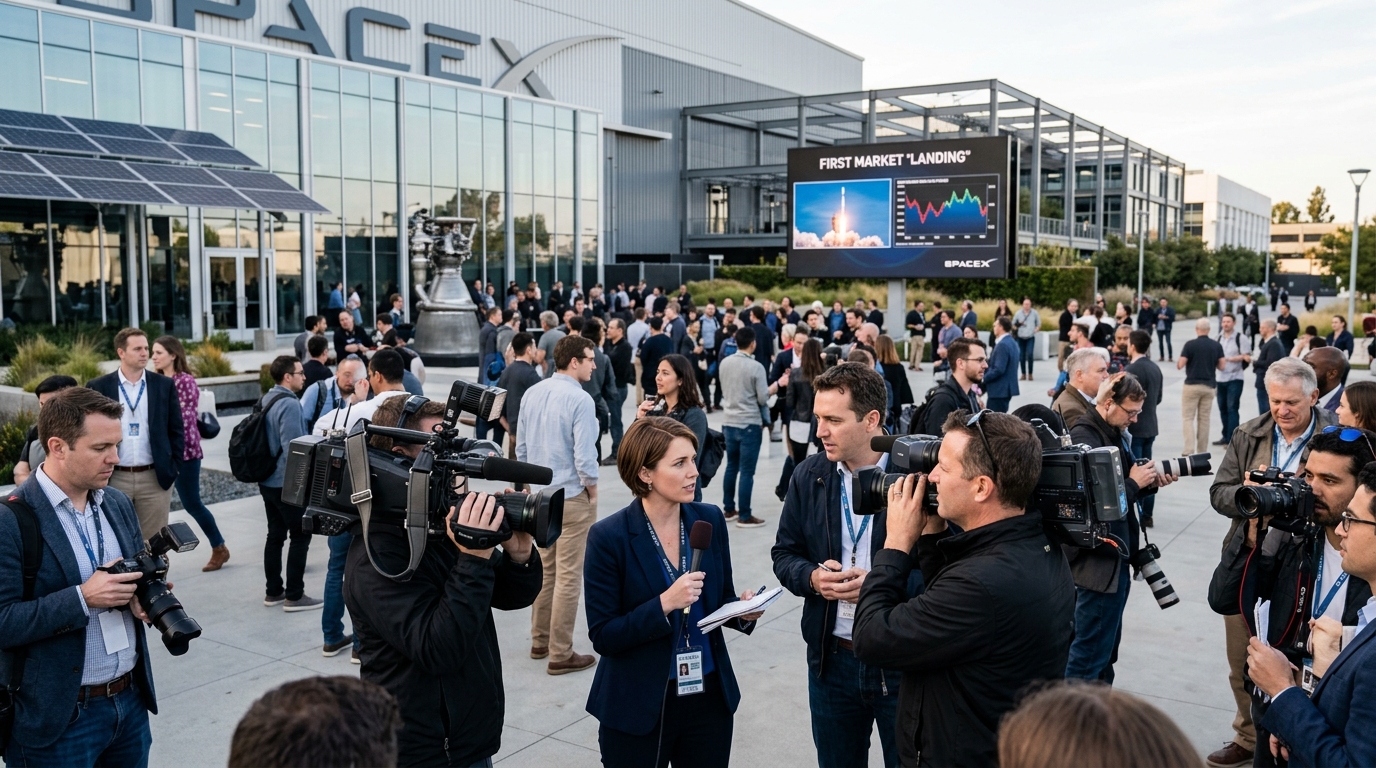
June 18, 2026, marks a pivotal moment in market history: the day SpaceX’s perceived immunity to economic gravity was first tested. Following a week that began with celebrations over the largest initial public offering (IPO) in aerospace history, Elon Musk’s company saw its first significant share price decline, triggering a wave of nervousness across Wall Street. This fluctuation is more than just a statistical correction; it is SpaceX’s first encounter with the raw reality of quarterly expectations and public accountability.
The Transition from Private Vision to Public Reality
For over two decades, SpaceX operated under a veil of relative privacy, allowing Elon Musk to pour billions into visionary projects like Starship without the relentless pressure of shareholders demanding immediate profitability. The IPO, completed earlier this month at a valuation that defied expectations, has fundamentally changed the rules of the game. The current dip in share price reflects a critical question: Can a company planning the colonization of Mars satisfy analysts focused on next quarter’s profit margins?
Market analysts point out that the initial overvaluation was expected, driven by the "Musk Premium"—the tendency of investors to pay a premium for access to the billionaire’s ventures. However, as the post-IPO dust settles, institutional investors are beginning to scrutinize the fundamentals with greater rigor. SpaceX is no longer a promise; it is a tradable asset that must prove its value on a daily basis.
Starlink: The Revenue Engine
Despite the stock’s volatility, many believe the true value of SpaceX lies not in its Falcon 9 rockets, but in the Starlink constellation. With over 15 million global subscribers by mid-2026, the satellite internet service provides the company’s primary source of recurring revenue. The recent share decline is partly linked to concerns over market saturation in certain regions and growing competition from state-subsidized programs in China and the European Union.
- Dependence on NASA and Pentagon government contracts remains a double-edged sword.
- Starship development costs continue to consume vast amounts of capital.
- Geopolitical instability is impacting supply chains for critical satellite components.
Furthermore, the market is anxiously awaiting the next Starship test flight. Any delay in the timeline for NASA’s Artemis missions now translates directly into a loss of market capitalization—a pressure Musk did not have to face with such intensity during the company's private years.
The Governance Challenge and the Musk Factor
A primary point of friction for investors remains Elon Musk’s multi-faceted focus. With Tesla facing its own set of challenges and the X platform (formerly Twitter) continuing its controversial trajectory, SpaceX shareholders are wary of CEO distraction. This week’s stock dip is attributed by some to the lack of a clear succession plan or a more traditional corporate governance structure expected of a company of this magnitude.
"SpaceX is not just a tech company; it is an infrastructure provider for the future of humanity. The stock market, however, does not always have the patience to wait for that future," notes a senior analyst at Morgan Stanley.
In conclusion, SpaceX’s first share price retreat serves as a reminder that even the most ambitious enterprises are subject to the laws of supply and demand. The company’s ability to rebound will depend on the success of upcoming launches and the stability of Starlink’s revenue streams. For long-term investors, this volatility may represent an entry point, but for the company itself, it marks the end of an era of "innocence" away from the prying eyes of Wall Street.





