

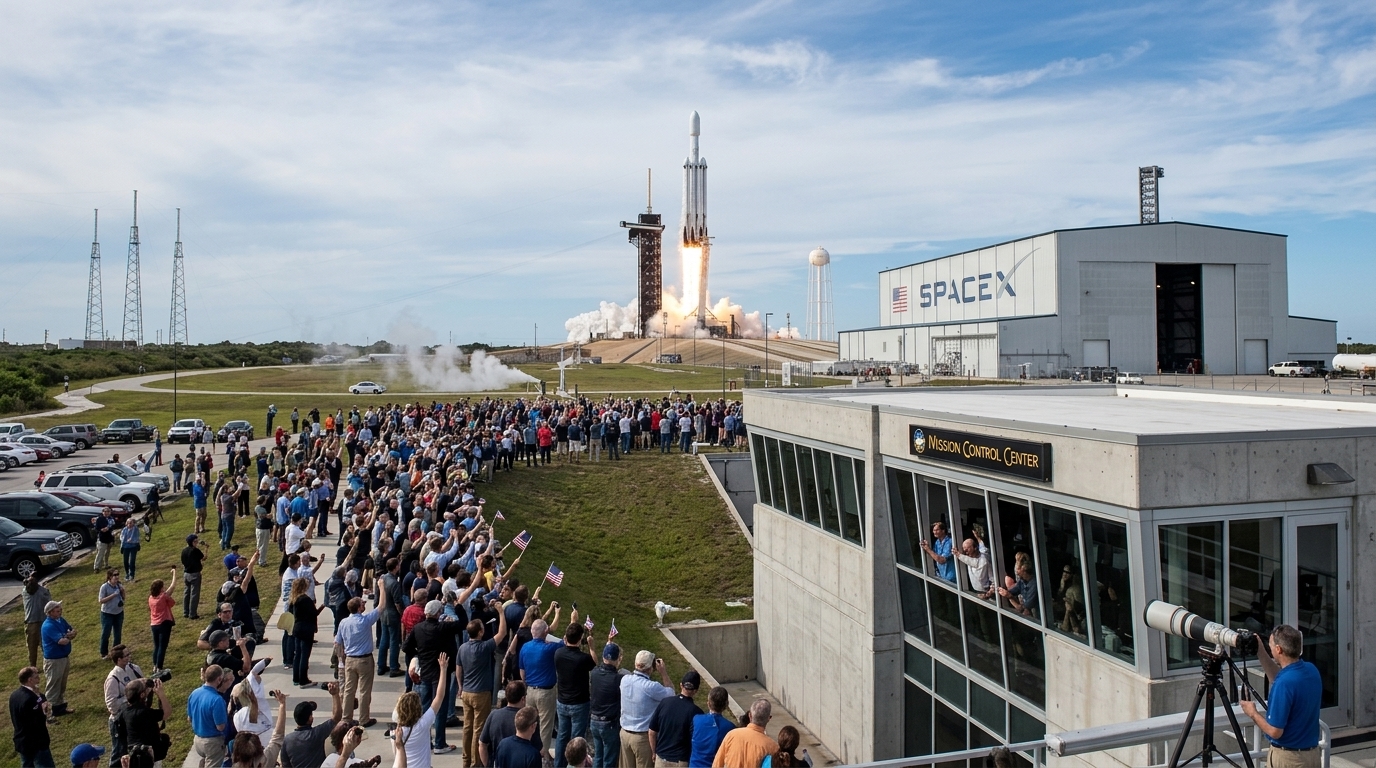
In a move set to reverberate through global financial markets, SpaceX, the aerospace giant founded by Elon Musk, is reportedly preparing for its long-awaited initial public offering (IPO). According to reports from Fortune AI, the company plans to file formal paperwork with the Securities and Exchange Commission (SEC) as early as this Wednesday, aiming for a market debut under the ticker symbol "SPCX" by mid-June.
This decision marks a significant pivot for Musk, who has long maintained that SpaceX would remain private until his vision of making humanity multi-planetary was well underway. However, the explosive growth of the Starlink satellite constellation and the capital-intensive development of the Starship rocket system appear to have necessitated a shift toward public equity markets.
Starlink: The Engine of Valuation
The primary driver behind this IPO is undoubtedly Starlink. What began as an ambitious project to provide global satellite internet has evolved into a formidable revenue engine with millions of active subscribers. Unlike the traditional rocket launch business, which is subject to lumpy government contracts and high operational risks, Starlink offers the recurring revenue model that Wall Street craves.
Analysts estimate that SpaceX’s valuation could soar past $250 billion, placing it among the most valuable companies globally from its first day of trading. The influx of public capital will provide Musk with the necessary dry powder to fund the ambitious Mars colonization program while offering a liquidity event for long-term employees and early-stage venture capital backers.
The Role of AI and Automation
While SpaceX is fundamentally a hardware and logistics company, its reliance on Artificial Intelligence is profound. AI algorithms are responsible for the autonomous precision landings of Falcon 9 boosters on drone ships—a feat once thought impossible. Furthermore, the Starlink constellation utilizes sophisticated AI to manage orbital paths, avoid debris, and optimize data routing across thousands of satellites in real-time.
"SpaceX is no longer just a rocket company; it is a data infrastructure powerhouse that happens to own its own transportation system," noted a senior analyst at Morgan Stanley.
The market expects SpaceX to use the IPO proceeds to further integrate AI capabilities, potentially through deeper collaboration with Musk’s xAI venture, to automate deep-space navigation and habitat management on future lunar and Martian bases.
The IPO Timeline and Market Expectations
The leaked timeline suggests an aggressive push to capitalize on current market sentiment:
- May 20: Expected filing of the S-1 registration statement with the SEC.
- June 4: Commencement of the formal marketing roadshow for institutional investors.
- June 11: Final pricing of the IPO.
- June 12: Official listing and start of trading on the NYSE or Nasdaq.
Such a rapid schedule is characteristic of Musk’s companies but brings inherent risks. Public status will subject SpaceX to unprecedented regulatory scrutiny and the pressure of quarterly earnings reports. For a company that famously embraces a "fail fast, learn fast" philosophy—often involving spectacular rocket explosions—the transition to a corporate structure that demands predictability will be a delicate balancing act.
Geopolitical Stakes and the Space Race
The SpaceX IPO occurs against a backdrop of intensifying global competition. Jeff Bezos’s Blue Origin and China’s state-backed space programs are racing to challenge SpaceX’s dominance. A publicly-funded SpaceX will have the financial leverage to maintain its lead through massive economies of scale. However, the company’s dual role as a commercial entity and a critical defense contractor for the U.S. government adds a layer of complexity to its public status.
As SpaceX transitions from a private visionary project to a public corporate titan, it faces the challenge of maintaining its innovative edge while satisfying the demands of retail and institutional investors. If successful, the June 12 listing will not only be a milestone for the Musk empire but a defining moment for the entire commercial space industry, proving that the final frontier is open for business.





