

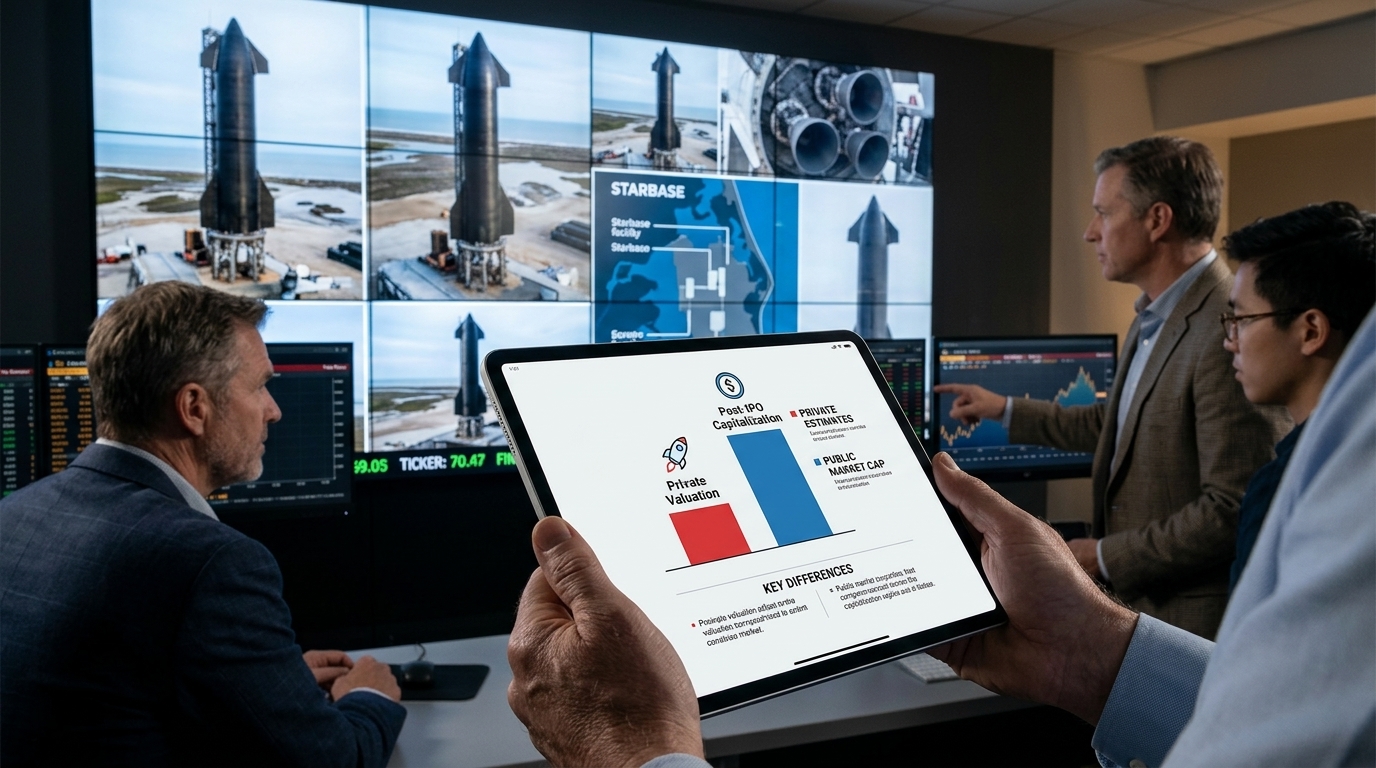
The public listing of SpaceX a few weeks ago was undoubtedly the financial event of the decade. With a valuation soaring past the $2 trillion mark, Elon Musk’s company didn’t just enter Wall Street; it redefined it. However, the initial euphoria has given way to deep-seated skepticism. Investors are now grappling with a fundamental question: Is SpaceX a profitable telecommunications utility via Starlink, or a colossal space exploration experiment destined to consume capital for decades to come?
The Valuation Dichotomy: Starlink vs. Starship
The primary point of contention in analyzing SpaceX is its internal structure. On one hand, Starlink is already functioning as a cash-generating machine. With millions of subscribers globally and strategic national security contracts, the satellite internet service offers the predictability that institutional investors crave. Goldman Sachs analysts estimate that Starlink alone could justify 60% of the current valuation, given its dominance in the LEO (Low Earth Orbit) market.
On the other hand, the Starship program remains a massive variable. Despite successful tests and the recent historic recovery of the Super Heavy booster, development costs remain astronomical. SpaceX is investing billions into infrastructure in Texas and Florida, with the return on investment (ROI) projected into the distant future. For conservative investors, the lack of a clear timeline for the commercialization of Mars missions is a significant red flag.
The Elon Musk Factor and Corporate Governance
The IPO has also highlighted the challenges of corporate governance. As a private entity, SpaceX operated under Musk’s absolute vision. Now, under SEC oversight and the burden of quarterly earnings calls, the culture clash is palpable. Musk’s tendency to make major announcements via social media and his involvement in complex geopolitics—such as the deployment of Starlink in conflict zones—adds a layer of risk that many fund managers find difficult to price.
- Geopolitical Risk: The Pentagon’s reliance on SpaceX creates a defensive moat for the company, but also makes it a lightning rod for international pressure.
- Competition: Jeff Bezos’s Blue Origin and Amazon’s Project Kuiper are finally beginning to close the gap, threatening SpaceX’s monopoly on launches.
- Volatility: The stock has become a favorite among retail investors, leading to swings that do not always align with the fundamental data of a mega-cap company.
The Future of the Space Economy
Despite the criticisms, it is impossible to ignore that SpaceX has birthed an entire industry. The reduction in the cost per kilogram to orbit has enabled thousands of other businesses to flourish. If the company can stabilize Starlink revenues while simultaneously reducing the Starship burn rate, the $2 trillion valuation might one day look like a bargain. However, for now, the market is in a 'wait and see' mode, torn between the fear of missing out (FOMO) and the fear of a space-sized bubble.
"SpaceX isn't just a stock; it's a wager on whether humanity can become a multi-planetary species under free-market terms," noted a senior Morgan Stanley executive.
In conclusion, SpaceX’s trajectory on the public markets in 2026 will serve as the ultimate barometer for investor appetite for high-stakes innovation. In a world plagued by inflationary pressures and geopolitical instability, the promise of the stars remains alluring, but the price of admission is, for many, still too steep.





