

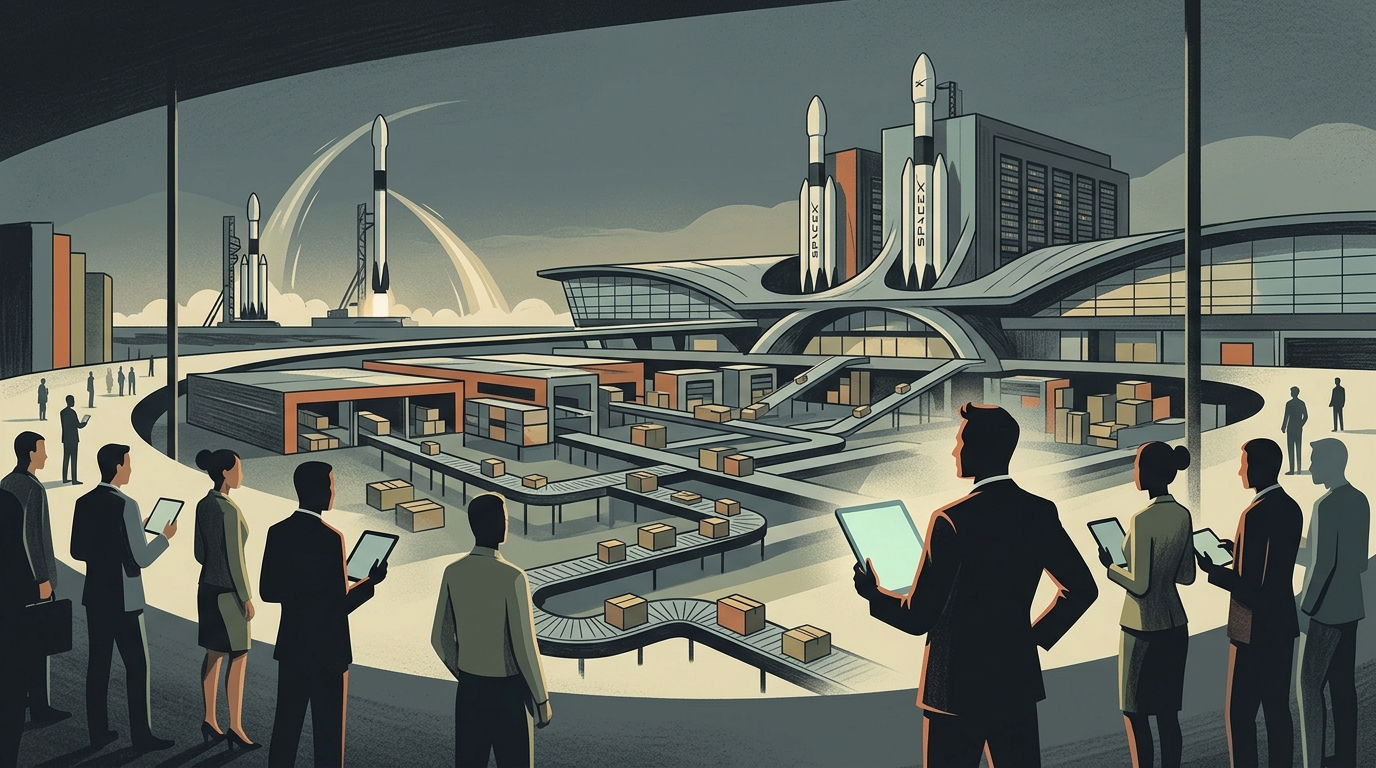
The news that SpaceX has funneled a staggering $60 billion into Artificial Intelligence (AI) is more than a corporate pivot; it is a declaration of intent to reshape the global economy. While the public still largely associates Elon Musk with rocket launches and Martian colonies, Wall Street analysts are beginning to see a familiar yet formidable pattern: the emergence of a new Amazon, but one operating from the high ground of Earth's orbit.
The Convergence of Space and Intelligence
SpaceX is no longer just an aerospace company. Through Starlink, it has established a network providing connectivity to every corner of the planet. However, the true value of this network lies not just in data transmission, but in data processing. The $60 billion AI investment is aimed at automating satellite navigation, optimizing bandwidth distribution, and, most importantly, creating a cloud infrastructure in space.
Just as Amazon leveraged its e-commerce platform to fund Amazon Web Services (AWS), SpaceX appears to be using its launch capabilities as a vehicle to dominate AI infrastructure. The ability to process massive amounts of data in real-time, directly from orbit, offers a latency and security advantage that terrestrial firms struggle to match. SpaceX’s AI is not merely about software; it is about managing a global nervous system.
The Amazon Playbook and Vertical Integration
The comparison to Amazon is deliberate. Jeff Bezos’s strategy was built on vertical integration: controlling the warehouse, the delivery network, and the tech platform. Musk is applying this model on an exponential scale. SpaceX builds the rockets (Starship), the satellites (Starlink), and now the 'brain' that orchestrates them (AI).
- Autonomy: AI enables Starship rockets to land with centimeter-level precision, drastically slashing costs.
- Edge Computing: Processing data in space reduces latency for critical AI applications on Earth, from autonomous vehicles to financial trading.
- Synergies: Integration with xAI (Musk’s specialized AI firm) creates an ecosystem where SpaceX hardware powers cutting-edge software.
"SpaceX isn't just building rockets; it's building the fabric upon which the future global economy will run," market analysts suggest.
Geopolitical and Economic Implications
This massive capital deployment raises profound questions about the concentration of power. If SpaceX succeeds in becoming the primary provider of AI infrastructure via space, it will wield influence that transcends national borders. Amazon revolutionized retail and the cloud; SpaceX aims to revolutionize how humanity accesses information and computational power.
Competitors, from Blue Origin to Europe’s Arianespace, find themselves chasing a target moving at hypersonic speeds. The $60 billion figure exceeds the GDP of many nations, highlighting the sheer economic dominance Musk is pursuing. The transition from a transportation company to a data and intelligence powerhouse is now a reality, and its ripples will be felt for decades to come.





