

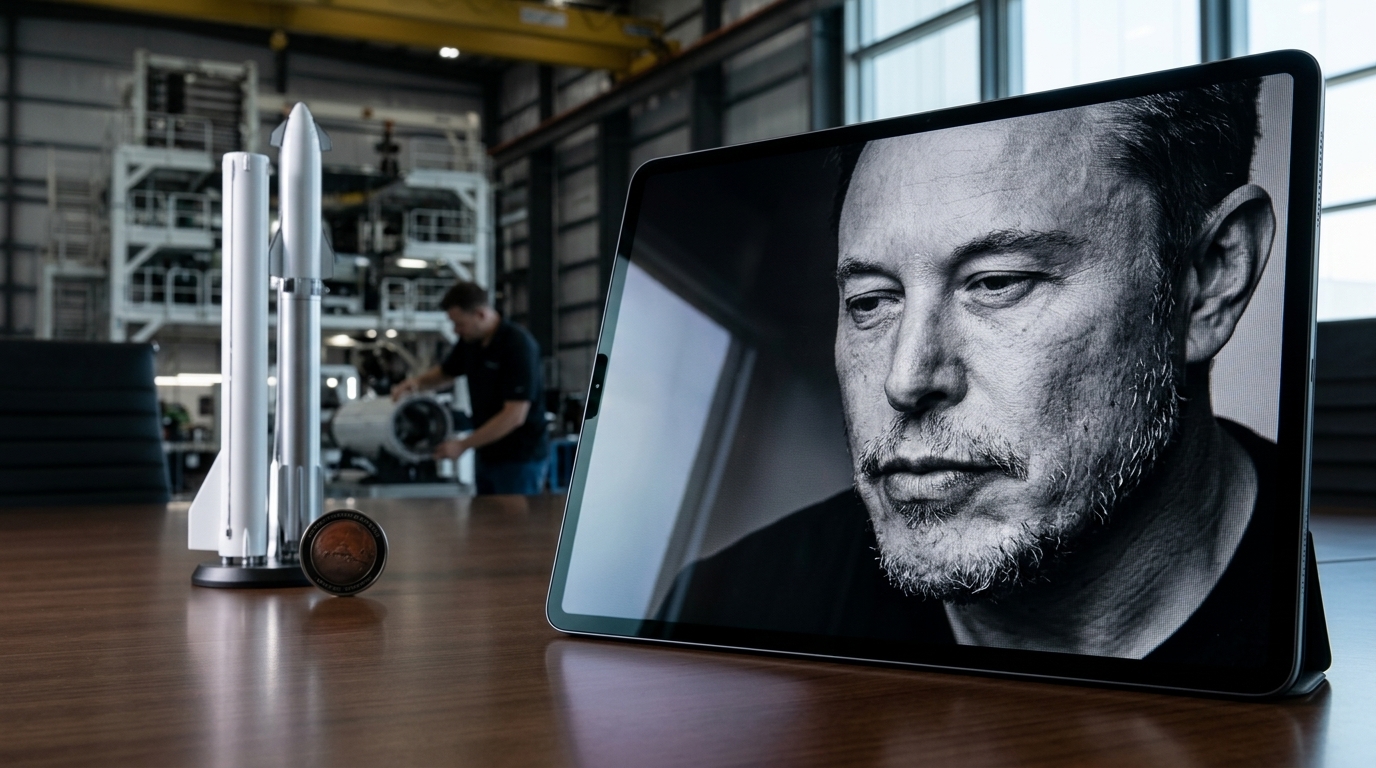
The news that Elon Musk’s SpaceX is now approaching a valuation of $1.78 trillion did more than just create a buzz in financial circles; it sent shockwaves through the global economy. In a world where Silicon Valley tech giants are fighting for every percentage point in the AI market, SpaceX seems to be playing on a solitary field: space. But the question remains urgent: Is it possible for a rocket company to be worth as much as Google or Amazon? Or are investors buying a ticket to a future that might never arrive?
The Starlink Empire: The Cash Cow
To understand SpaceX’s astronomical valuation, we must look away from the spectacular Falcon 9 rockets and focus on their smaller, but more profitable sibling: Starlink. By June 2026, Starlink is no longer an experiment; it is a global telecommunications titan. With over 12,000 satellites in low Earth orbit (LEO), the service now provides broadband internet to every corner of the planet, from the depths of the Amazon to ships in the middle of the Pacific.
Starlink’s profitability is the key. Unlike traditional space missions that rely on government contracts, Starlink has millions of subscribers paying monthly fees. Analysts estimate that Starlink’s revenue could exceed $40 billion annually by the end of the decade. This steady stream of cash is what allows SpaceX to fund its most ambitious—and risky—missions. Without Starlink, SpaceX would simply be a successful aerospace company. With it, it is an infrastructure company controlling the flow of information globally.
Starship: The Holy Grail of Reusability
If Starlink is the cash register, Starship is the future. The massive rocket, which has now completed dozens of successful orbital tests and cargo deliveries, promises to reduce the cost of access to space by 100-fold. The full and rapid reusability of Starship changes the rules of the game. When a rocket can take off, land, and fly again within hours, space ceases to be a destination for the elite and becomes a new economic zone.
SpaceX has achieved something that its competitors—Jeff Bezos’s Blue Origin, Boeing, and Europe’s Arianespace—are still struggling to grasp: vertical integration and the speed of innovation. While NASA takes ten years to develop a new system, SpaceX tests, fails, and iterates in weeks. This velocity is what terrifies competitors and thrills investors. The $1.78 trillion valuation reflects the belief that SpaceX will hold a monopoly on transportation to the Moon and, eventually, Mars.
Geopolitics and the "Musk Premium"
We cannot ignore the political factor. SpaceX has become an integral part of U.S. national security. The Starshield program, the military version of Starlink, is already being used for surveillance and communications in conflict zones, offering Washington an advantage that no other power possesses. This close relationship with the American state provides a security "guarantee" for investors. SpaceX is now considered "too big to fail."
However, the reliance on Elon Musk’s personality remains the biggest risk. His controversial statements, involvement in politics, and management of other companies like X (formerly Twitter) and Tesla create an atmosphere of instability. Many wonder if SpaceX’s valuation includes a "Musk premium"—a surplus value based more on a cult of personality than on economic fundamentals. If Musk leaves or if his attention becomes too fragmented, can SpaceX maintain its momentum?
Conclusion: Investing in Infinity
The $1.78 trillion valuation is a bet on the future of humanity as a multi-planetary species. If SpaceX manages to establish a sustainable colony on Mars or if it turns Earth's orbit into an industrial hub, then $1.78 trillion will look like pocket change in a few decades. But if the costs and technical difficulties prove insurmountable, the fall will be as spectacular as its launches. For now, SpaceX isn't just selling rockets; it's selling a monopoly on the next great economic frontier. And in the history of capitalism, a monopoly always comes with a high price tag.





