

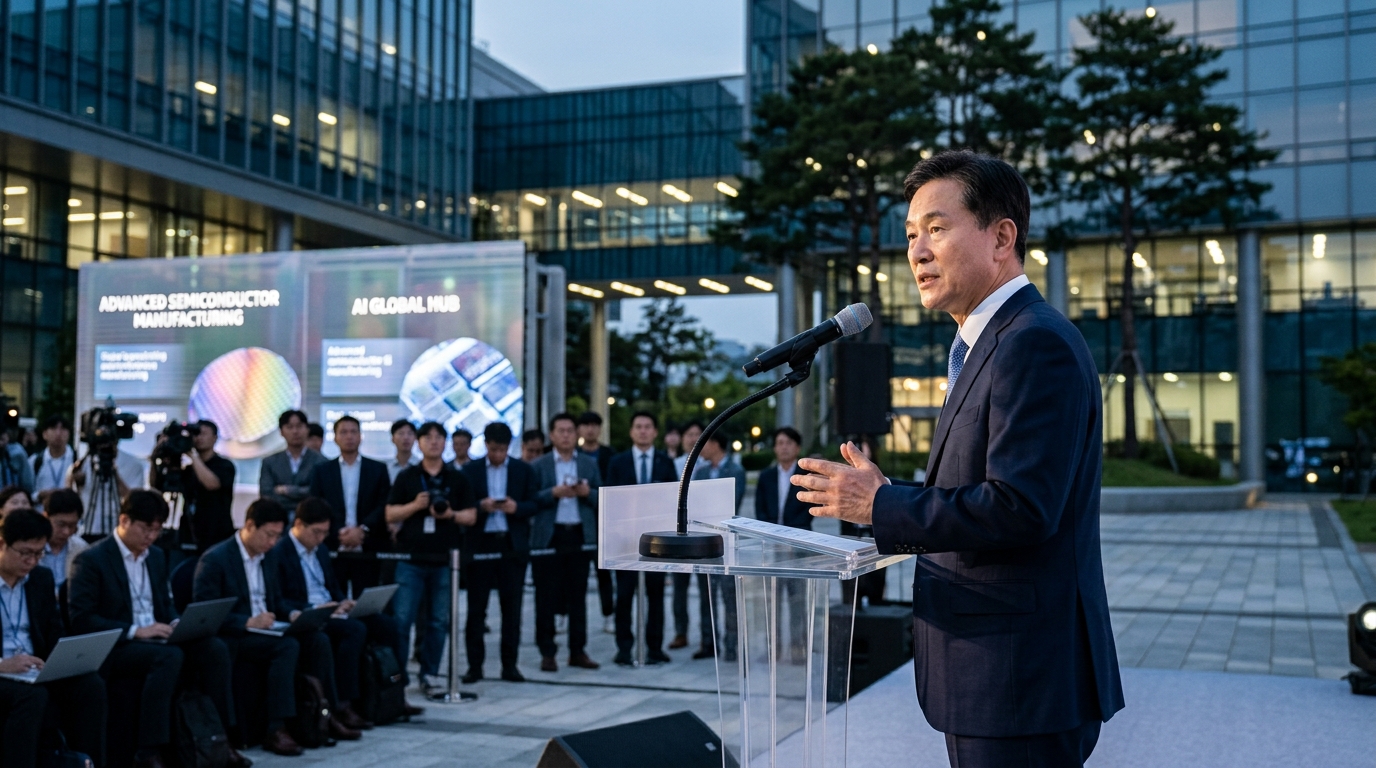
In an era where geopolitical power is measured in nanometers and economic survival hinges on data processing capabilities, South Korea has decided to play the most expensive card in its history. In an orchestrated move reminiscent of the "Miracle on the Han River," the Seoul government has announced a colossal investment plan of at least $880 billion, placing Samsung Electronics and SK Hynix at the forefront of a global war for AI supremacy.
This move is not merely a business expansion; it is an existential necessity. As demand for AI chips skyrockets, South Korea is attempting to transform itself from a traditional memory manufacturer into an integrated semiconductor hub that controls the entire value chain, from design to cutting-edge production.
The Yongin Mega Cluster: A Silicon Fortress
At the heart of this strategy lies the creation of the world's largest semiconductor cluster in the Yongin region, near Seoul. This "Mega Cluster" is not just an industrial zone; it is a technological ecosystem that will host dozens of new fabrication plants (fabs) and hundreds of suppliers. Samsung Electronics has committed to investing the lion's share of these funds to develop 2nm and 1.4nm production nodes, directly targeting the dominance of Taiwan's TSMC in the foundry sector.
President Yoon Suk Yeol's administration has made it clear that state support will be unwavering. From tax breaks reaching up to 25% for strategic technologies to guaranteed supplies of electricity and water—two critical resources that often hinder such projects—Seoul is acting as the ultimate orchestrator. The "K-Semiconductor Belt" strategy aims to create 3.4 million jobs by 2047, highlighting the long-term horizon of this planning.
SK Hynix and the HBM Memory Battle
While Samsung fights on the foundry front, SK Hynix has emerged as the undisputed protagonist of High Bandwidth Memory (HBM), essential for Nvidia's AI processors. SK Hynix, which saw its market capitalization soar due to its close partnership with Silicon Valley giants, plans to invest billions in new HBM4 production lines, the next generation of memory that will power the AI models of 2027 and beyond.
The challenge for SK Hynix is to maintain its technological lead over Samsung and the American Micron. The $880 billion investment includes the creation of specialized R&D centers focusing on the convergence of memory and processing power (Processing-in-Memory), an innovation that could drastically reduce energy consumption in data centers worldwide.
Geopolitical Chess and the China Threat
This investment is taking place in an extremely fragile international environment. South Korea finds itself caught between the United States, which demands restrictions on technology exports to Beijing, and China, which remains one of its largest trading partners. Seoul realizes that the only way out is "unrivaled technological superiority." If South Korea becomes irreplaceable to the global AI supply chain, it gains a geopolitical shield that no diplomatic agreement can offer.
However, the risks are real. China is also investing billions to develop its own semiconductor industry, while Washington is pushing for domestic production through the CHIPS Act. The success of the South Korean plan depends on the speed of implementation and the ability of Samsung and SK Hynix to innovate faster than their competitors, in a market where "second place" often means "obsolescence."
Conclusion: A Bet on the Future
The $880 billion plan is the largest industrial experiment of the 21st century. If it succeeds, South Korea will establish itself as the undisputed capital of AI hardware. If it fails, the economic cost and loss of influence could downgrade the country to a secondary player on the technological stage. What is certain is that Samsung and SK Hynix are no longer just companies; they are the pillars upon which South Korea is building its future in the digital empire.





