

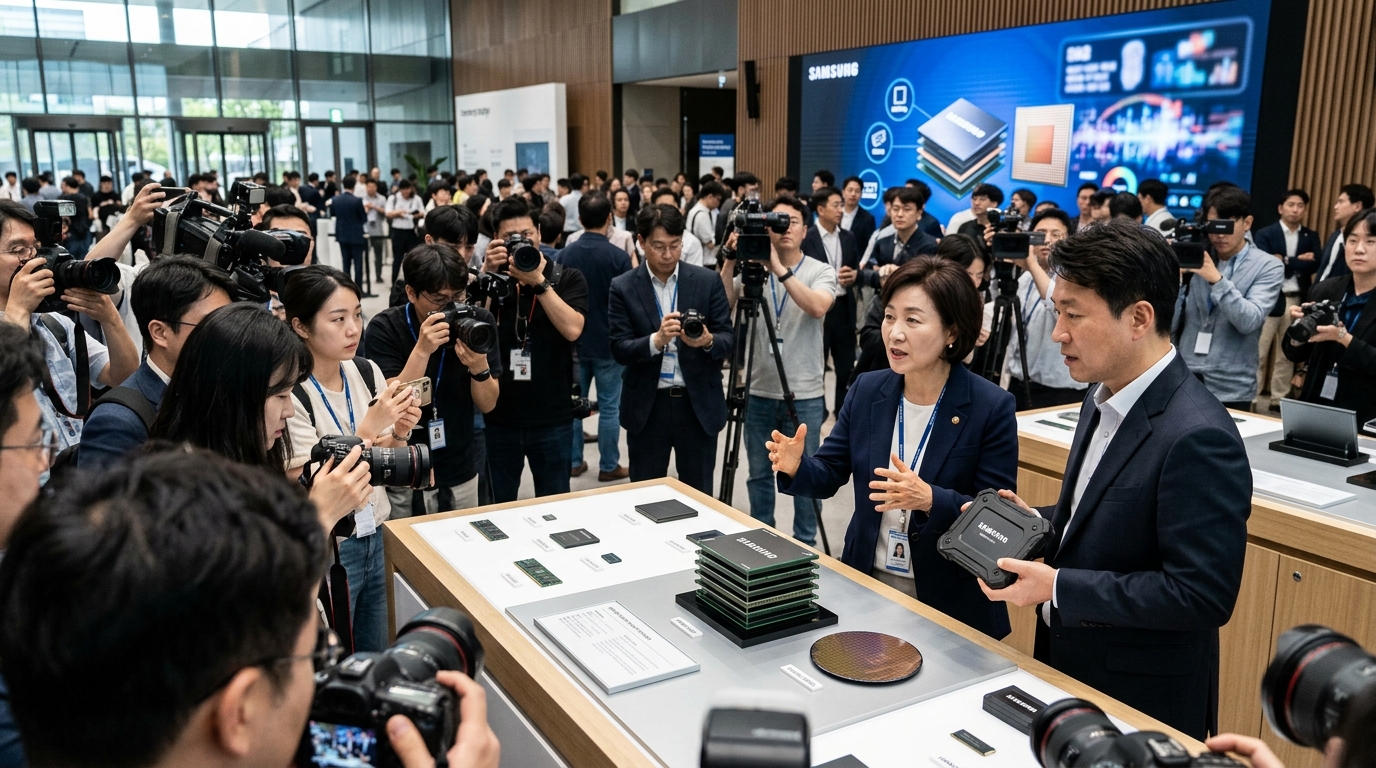
The global semiconductor market is witnessing one of the most dramatic turnarounds in its history, with Samsung Electronics at the epicenter of this seismic shift. After a challenging two-year period marked by oversupply and plummeting prices, the South Korean giant is expected to report a staggering increase in its second-quarter operating profit for 2024, which according to Reuters analysts, could reach an 18-fold jump year-on-year.
The Golden Age of HBM Memory
The key behind this financial renaissance is none other than High Bandwidth Memory (HBM). As tech titans like Nvidia, Microsoft, and Google race to build increasingly powerful artificial intelligence models, the need for specialized memory chips that can process vast amounts of data in minimal time has skyrocketed. Samsung, although initially found trailing its domestic rival SK Hynix in the HBM race, now appears to be regaining lost ground.
Analysts point out that the price of DRAM chips, widely used in AI servers, has seen a surge exceeding 15% in just a few months. Samsung, as the world's largest memory chip manufacturer, is the primary beneficiary of this trend. "This is not just a cyclical recovery," the report notes. "It is the transformation of an entire industry that now moves to the beat of artificial intelligence."
NAND Recovery and Data Center Strategy
Beyond HBM, Samsung is seeing significant improvement in its NAND flash chip division, used for data storage. Demand for high-capacity Solid State Drives (SSDs) from companies managing data centers has driven prices up by approximately 20%. This double-hit—surging demand in both DRAM and NAND—creates a perfect environment for the company's profitability.
"Samsung is leveraging its manufacturing scale to fill the void left by the global shortage of specialized semiconductors, turning the crisis of 2023 into a triumph for 2024," Seoul-based financial analysts observed.
Challenges: Labor Unions and the Geopolitical Chessboard
Despite the triumphant financial figures, the road ahead for Samsung is not without obstacles. The company is facing serious labor unrest for the first time in its history, with the National Samsung Electronics Union (NSEU) threatening strikes that could disrupt production lines. Workers are demanding better working conditions and transparency in bonus systems, at a time when the company is recording mammoth profits.
Furthermore, geopolitical tensions between the US and China continue to cast a shadow over the semiconductor industry. Export restrictions on advanced technology to China force Samsung to walk a tightrope, trying to maintain sales in the world's largest market while complying with Washington's supply chain security requirements.
The Future of AI at Samsung
Looking forward, Samsung is investing billions in developing the next generation of chips, HBM3E, aiming to become a primary supplier for Nvidia. Success in this area will determine whether the current profit surge is a transient burst or the beginning of a new, long-term era of dominance. The company's ability to innovate faster than competitors in the age of Generative AI will be the ultimate metric of its success.
In conclusion, Samsung Electronics is not just recovering. It is redefining its role as the indispensable pillar of global digital infrastructure. With operating profits expected to reach 8.8 trillion won (approximately $6.4 billion), the message to the markets is clear: the giant has awakened, and AI is its fuel.





