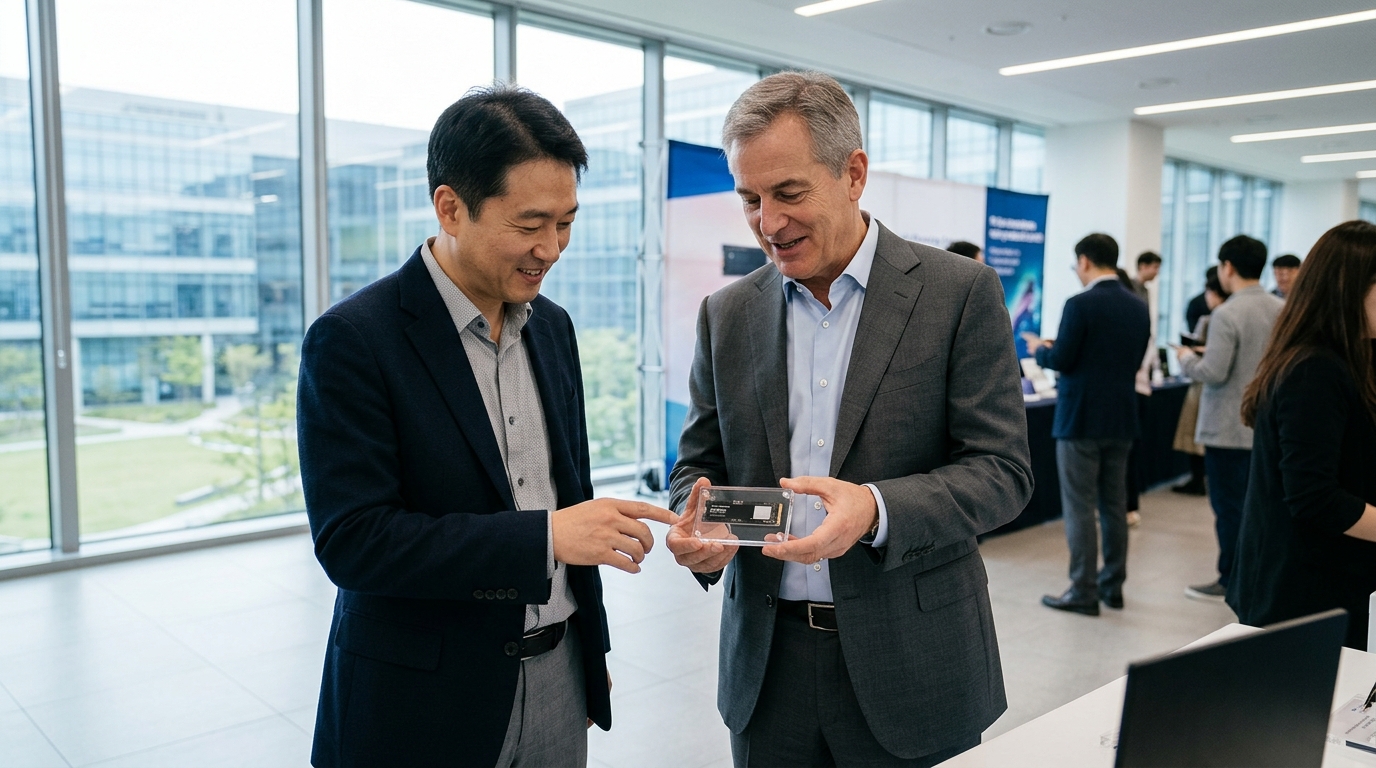
In a move that underscores the acceleration of the global AI arms race, Samsung Electronics Co. has announced the commencement of mass production for its newest solid-state drives (SSDs) specifically engineered for Nvidia’s next-generation hardware, the Vera Rubin platform. This development marks a critical turning point in the AI supply chain, as the industry shifts its focus from raw processing power to the urgent need for high-speed management of massive data volumes.
The Vera Rubin Architecture and the Need for Speed
Nvidia’s Vera Rubin platform, expected to hit the market in 2026, serves as the successor to the Blackwell architecture. While Blackwell laid the groundwork for training large-scale models, Vera Rubin promises an exponential leap in performance. However, the raw compute power of GPUs (Graphics Processing Units) is effectively bottlenecked if data cannot be fed into them at matching speeds. This is precisely where Samsung steps in.
Samsung’s new storage units, likely leveraging the PCIe Gen6 standard, offer read and write speeds that were virtually unimaginable just a few years ago. According to industry insiders, these drives are designed to minimize latency and maximize throughput, allowing Nvidia’s chips to operate at 100% capacity without idling while waiting for memory retrieval. In the world of AI, where every millisecond of compute time costs thousands of dollars, this efficiency is paramount.
Samsung’s Strategic Counter-Offensive
For Samsung, this agreement represents a significant strategic victory. Over the past two years, the South Korean giant found itself in an uncharacteristically defensive position as rival SK Hynix Inc. managed to seize the lead in supplying High Bandwidth Memory (HBM) to Nvidia. By securing the mass production contract for Vera Rubin’s SSDs, Samsung is proving that it remains an indispensable titan in the semiconductor ecosystem.
Samsung’s investment in ninth-generation V-NAND technology is clearly paying dividends. These drives are not only fast but also exceptionally power-efficient—a crucial factor for modern data centers grappling with soaring energy costs and sustainability mandates. The company’s ability to manufacture these components at an unprecedented scale is what makes it the preferred partner for Nvidia, which requires millions of units to satisfy global infrastructure demand.
Economic and Geopolitical Implications
The collaboration between American-based Nvidia and South Korean Samsung strengthens a technological axis that navigates around geopolitical tensions with China. As Washington continues to tighten export controls on advanced chips to Beijing, bolstering production capacity in South Korea ensures that the Western AI market remains well-supplied and resilient.
Furthermore, this move is expected to significantly bolster Samsung’s financial results for the latter half of 2026. Following a slump in the consumer electronics market, the pivot toward AI infrastructure offers profit margins that traditional laptop SSDs could never achieve. The enterprise SSD market is projected to grow at an annual rate exceeding 20%, with Samsung now positioned to capture the lion's share of high-end orders.
Conclusion: The Infrastructure of Intelligence
We often focus on the "brains" of artificial intelligence—the processors—but we frequently overlook the "nervous system" and the "memory banks." Nvidia’s Vera Rubin could not achieve its world-altering potential without the support of hardware partners like Samsung. As we head toward 2027, the battle for AI supremacy will be fought not only in software laboratories but also in the silicon foundries of Seoul and Taiwan. The mass production starting today is the fuel for tomorrow’s cognitive revolution.