

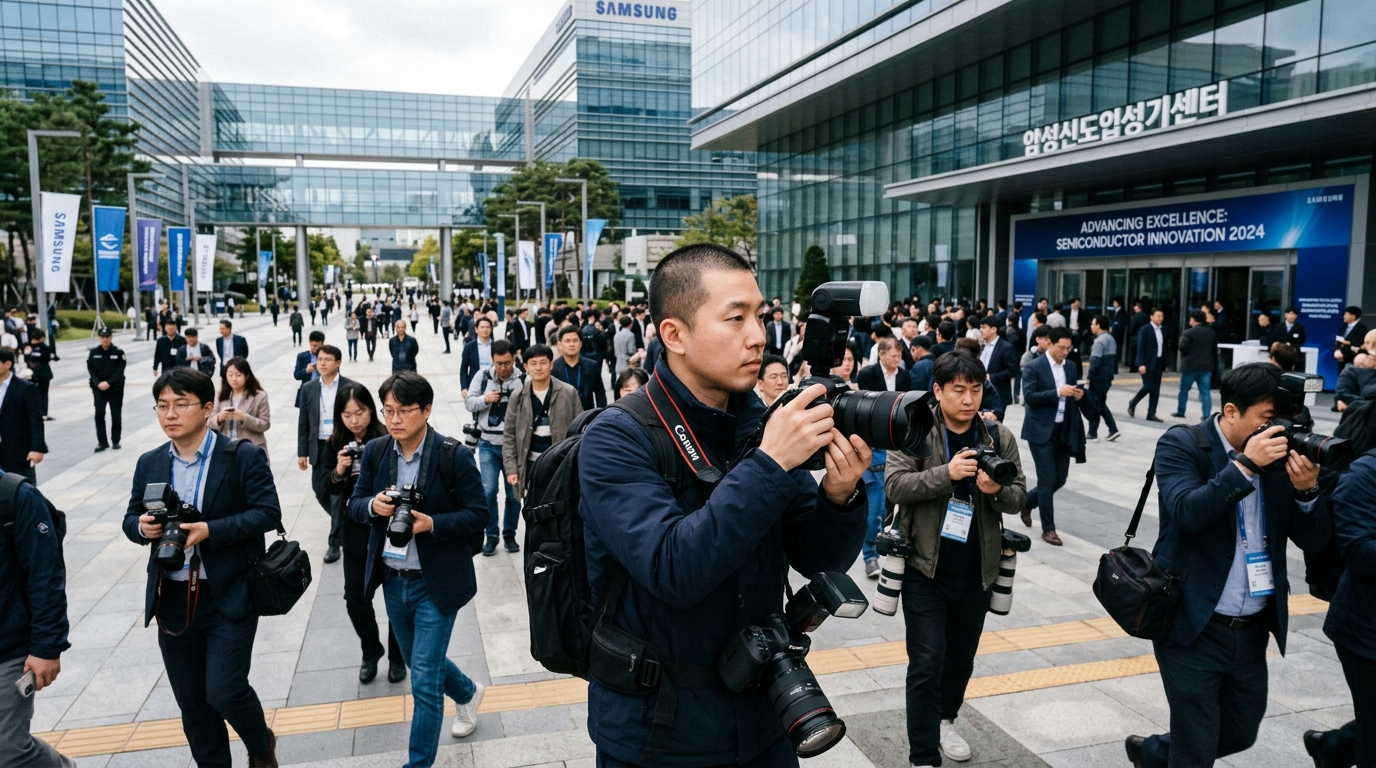
In the high-stakes world of technology, the term "success" is often relative. For Samsung Electronics, the titan that forms the backbone of the South Korean economy, the recent financial results of July 2026 should normally be a cause for celebration. The company announced a staggering jump in operating profit, far outperforming the previous year's figures, driven by a recovery in memory prices and an insatiable hunger for Artificial Intelligence (AI) infrastructure. However, the stock market reacted with the twitchiness of a passenger on a roller coaster, reminding everyone that in the AI era, "good" is often the enemy of "perfect."
The Paradox of Expectations and HBM Dominance
The central issue plaguing Samsung is not a lack of profitability, but the speed at which it adapts to the requirements of Nvidia and other AI heavyweights. High Bandwidth Memory (HBM) has become the "holy grail" of the semiconductor industry. While Samsung remains the world's largest memory maker, it has found itself in the unusual position of playing catch-up to its smaller rival, SK Hynix, regarding the supply of the most advanced HBM3E chips.
Investors are watching with bated breath for every announcement regarding Samsung's qualification tests by Nvidia. Every rumor of a delay translates into billions of dollars in lost market capitalization, while every positive sign triggers euphoria. This duality reflects a deeper shift in the investment landscape: shareholders are no longer interested in traditional chip sales for smartphones or laptops; they are looking exclusively for confirmation that Samsung can dominate the data center ecosystem powering large language models.
Strategic Counteroffensive and the Foundry Struggle
Beyond memory, Samsung is fighting an equally critical battle on the contract manufacturing front (Foundry). Here, the adversary is the Taiwanese giant, TSMC. Despite massive investments in 2nm and 3nm technology, Samsung is struggling to convince major chip designers like Apple and Qualcomm to shift their production to its facilities. The latest earnings report showed improvement in yields, but the gap with TSMC remains significant.
Samsung's management, under pressure from shareholders, has promised an aggressive reallocation of resources. The focus is shifting from quantity to quality, with the company investing billions in new production lines optimized for AI needs. However, this process is time-consuming and expensive. Analysts point out that Samsung is at a critical crossroads: it must maintain its dominance in traditional markets while simultaneously reinventing itself as a leader of the AI era.
Geopolitics and Internal Challenges
One cannot ignore the broader geopolitical context. Samsung sits at the center of the technological "Cold War" between the US and China. Restrictions on semiconductor equipment exports and pressure to move production to US soil complicate the supply chain. Simultaneously, within South Korea, the company faces growing labor demands, with unions seeking a larger share of the AI explosion's profits.
The "roller coaster ride" for investors is not expected to end anytime soon. The stock's volatility is the price paid by a company that is "too big to fail" but perhaps "too slow to lead" in a market moving at light speed. Samsung's ability to bridge the gap in HBM memory and improve its Foundry performance will determine not only its own future but the balance of power in the entire global tech industry.
Conclusion: The New Normal of Uncertainty
In conclusion, Samsung's case is a lesson in the current state of the global economy. Financial metrics, no matter how impressive, are no longer a guarantee of stability. The market demands vision, execution, and, above all, adaptability. For Samsung, the challenge is to prove that it can remain the architect of the digital future rather than just the supplier of its raw materials. The coming months will be decisive, as the testing of its new products will determine whether its stock will exit the roller coaster and enter a trajectory of steady growth.





