

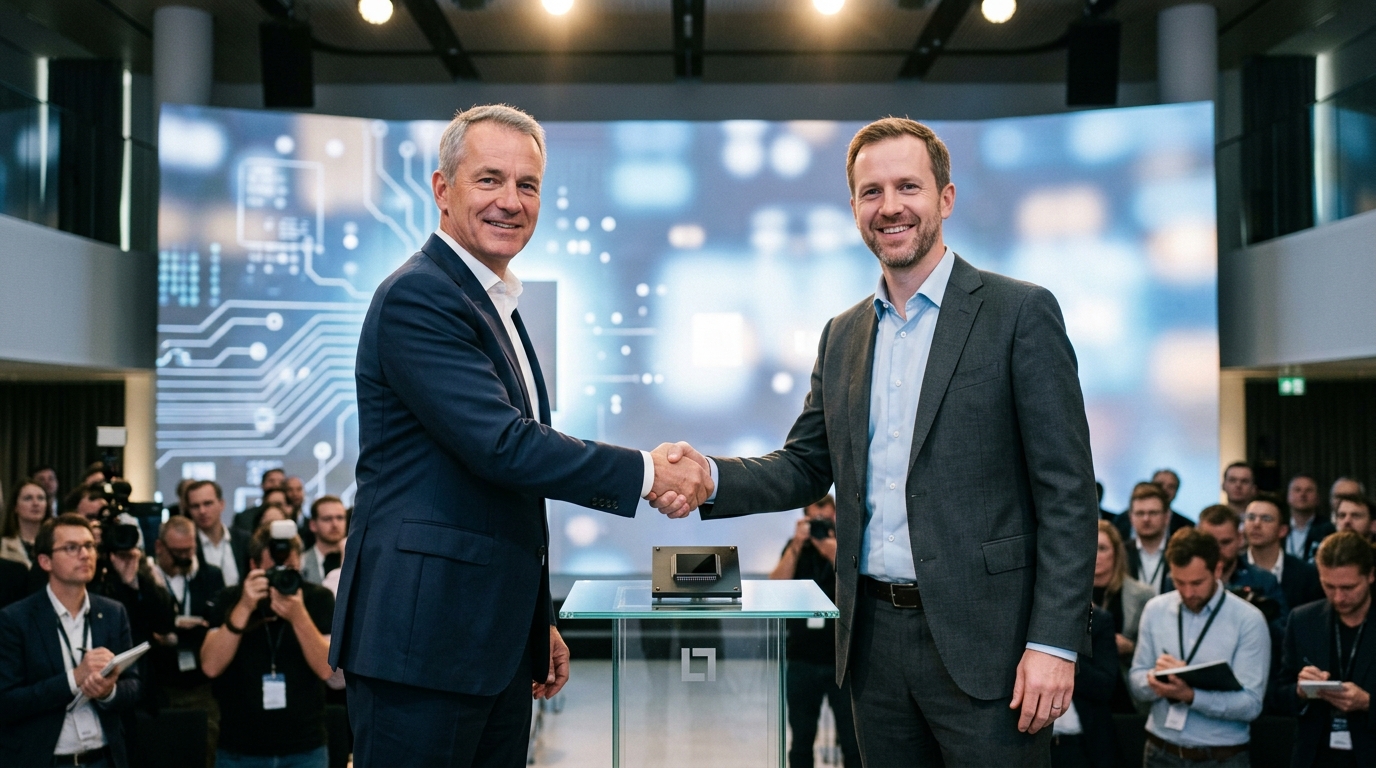
In the ever-evolving landscape of high technology, a new partnership is reportedly emerging, poised to rearrange the power dynamics of the Artificial Intelligence sector. According to reports from the Korea Economic Daily, Samsung Electronics is in advanced talks with Anthropic—the company behind Claude and a primary rival to OpenAI—to design and manufacture custom AI semiconductors. This move is not merely a commercial transaction; it is a strategic declaration of independence from Nvidia’s monopoly and a vote of confidence in the South Korean giant's technological prowess.
The Imperative for Custom Silicon (ASIC)
To date, the AI industry has relied almost exclusively on Nvidia’s Graphics Processing Units (GPUs), such as the H100 and the forthcoming Blackwell architecture. However, as Large Language Models (LLMs) grow increasingly complex, the need for energy efficiency and specialized computational power is making general-purpose GPUs less attractive. Anthropic, backed by titans like Amazon and Google, is seeking ways to slash operational costs and optimize the inference performance of its models.
Custom chips, known as ASICs (Application-Specific Integrated Circuits), offer exactly that: hardware designed from the ground up to execute AI algorithms with maximum speed and minimal power consumption. For Anthropic, developing its own silicon in collaboration with Samsung means it can tailor the hardware to its specific software architecture, gaining a significant competitive edge over OpenAI and Meta.
Samsung’s Strategic Edge: GAA Technology
For Samsung, this deal represents a golden opportunity to close the gap with TSMC (Taiwan Semiconductor Manufacturing Company), the world’s dominant foundry force. Samsung is betting heavily on its pioneering Gate-All-Around (GAA) technology at the 3nm and soon 2nm nodes. The GAA architecture allows for more precise control over current flow, reducing power leakage and increasing performance compared to the traditional FinFET technology used by its competitors.
"The battle for AI supremacy will not be fought solely in software labs, but on the silicon floor. Whoever controls the hardware production controls the pace of innovation," industry analysts in Seoul suggest.
Furthermore, Samsung possesses a unique advantage: it is the only company in the world capable of offering a "one-stop shop" solution. It can design the chip, manufacture it on its own production lines, and provide the essential High Bandwidth Memory (HBM3E) required for AI data processing. This vertical integration reduces lead times and supply chain costs, making it an attractive partner for AI startups looking for agility.
Geopolitical and Economic Implications
The potential Samsung-Anthropic alliance also mirrors a broader geopolitical trend. American AI firms are increasingly looking to diversify their supply chains to mitigate risks associated with Taiwan and the escalating US-China tensions. South Korea, a key US ally and a technological leader, serves as the ideal alternative. The South Korean government has already announced multi-billion dollar support packages for the domestic semiconductor industry, aiming to transform the nation into a global AI hardware hub.
However, challenges remain. Transitioning from design to mass production is an arduous process with high failure rates in early batches (yield rates). Samsung must prove that its 2nm/3nm processes are mature enough to handle the massive demands of a company like Anthropic. If successful, it will shatter TSMC’s perceived invincibility and redefine Samsung's role in the global economy.
Conclusion: The Future of AI Infrastructure
Anthropic’s move to seek proprietary chips via Samsung indicates that the AI market is maturing. It is no longer enough to possess the best model; one must also have the most efficient hardware to run it. As the demand for compute increases exponentially, the collaboration between the "brains" of software and the "hands" of production will become the standard. For consumers, this could translate to faster and cheaper AI services, but for tech giants, it is a race for survival in which Samsung has just made a very powerful move.





