

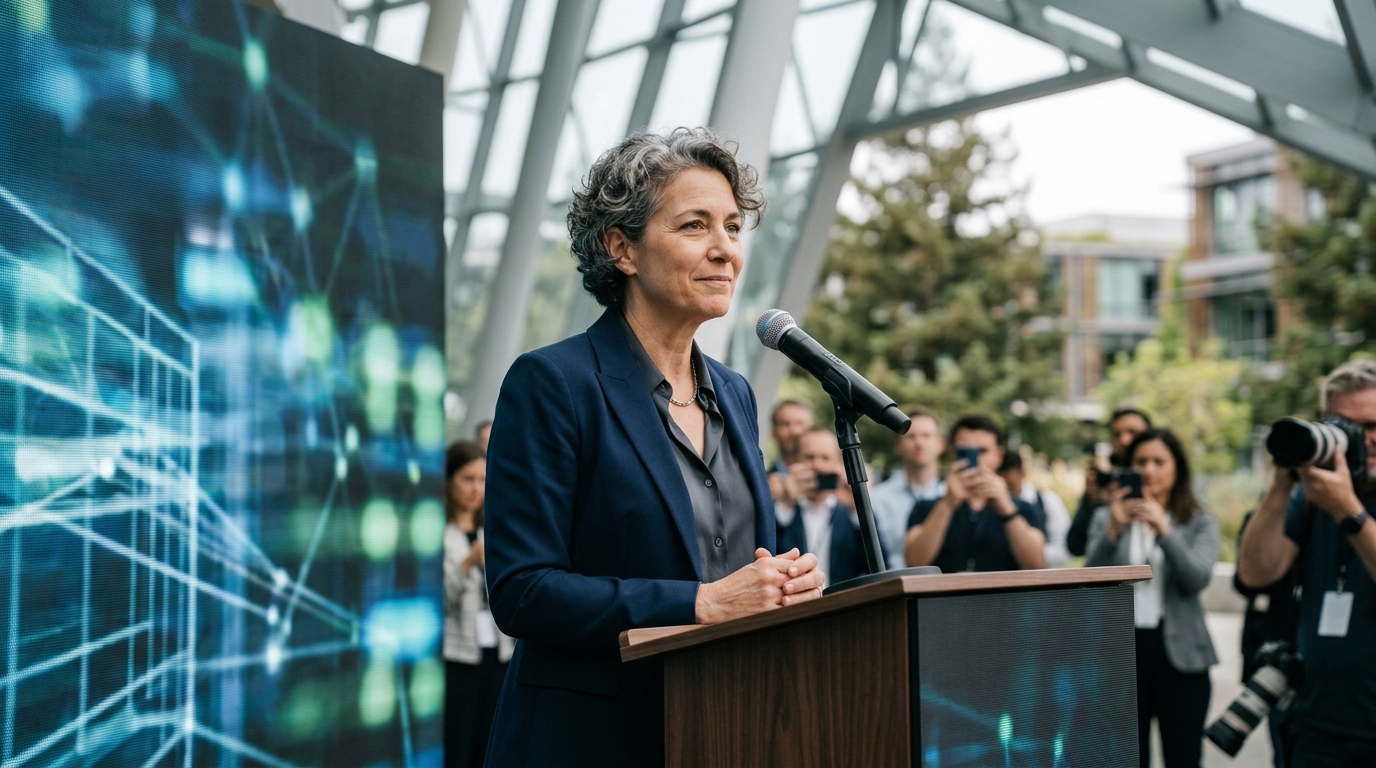
In a revelation that underscores the unprecedented financial scale of the Artificial Intelligence race, OpenAI Chief Financial Officer Sarah Friar stated that the ChatGPT maker may need to raise even more capital. Despite the company recently completing what has been described as the largest private fundraising round in history, the hunger for computing power—simply known as "compute"—is evolving into a financial black hole, absorbing billions at rates never before seen in the tech industry.
Speaking at a Bloomberg event, Friar made it clear that OpenAI’s strategy is no longer just about crafting clever algorithms; it is about securing the physical infrastructure required to train them. "The demand is immense, and the supply of compute remains our primary constraint," she noted, signaling a new reality where capital is directly converted into raw processing power to maintain a competitive edge.
The Geopolitics of Compute
Friar’s comments come at a pivotal moment for OpenAI. The transition from a non-profit-controlled entity to a structure more palatable to traditional investors is nearly complete—a move deemed necessary to attract the massive capital outlays required. The cost of training next-generation models, such as the anticipated GPT-5, is estimated to far exceed $100 million, with some projections suggesting costs in the billions for a single frontier model.
This "compute crunch" is not merely a technical bottleneck; it is a macroeconomic challenge. OpenAI is not just competing with Google or Anthropic; it is competing against the physical realities of the semiconductor supply chain. Its reliance on Nvidia for H100 and Blackwell processors means OpenAI must maintain massive cash reserves to pre-pay for multi-year orders, ensuring its place at the front of the line.
"We aren't just building software. We are building the foundation of a new industrial revolution, and that requires capital levels that resemble national programs more than Silicon Valley startups," noted market analysts.
Energy Infrastructure and the Scaling Laws
Beyond chips, the next great hurdle is energy. Friar hinted that a portion of future capital could be earmarked for securing energy resources. OpenAI has already expressed interest in partnering with nuclear power providers and developing massive data centers that will require power loads equivalent to entire cities. This shift toward heavy infrastructure fundamentally changes the company’s profile: from a pure-play software firm to an industrial infrastructure giant.
This strategy carries significant risks. Concentrating such vast amounts of capital within a single entity raises questions about market competition and systemic risk. If OpenAI becomes "too big to fail," the implications of a potential financial misstep could vibrate through the entire tech ecosystem. However, for Friar and CEO Sam Altman, the risk of falling behind in the race toward AGI (Artificial General Intelligence) far outweighs the risks of over-leverage or equity dilution.
Investor Appetite vs. Burn Rate
Despite the staggering requirements, investor appetite remains voracious. The company’s recent valuation, hovering around $150 billion, indicates that the market buys into OpenAI's vision. Investors no longer view AI as a speculative experiment but as the world's next foundational operating system. Friar, with her seasoned background at Square and Nextdoor, provides a level of financial gravitas that reassures Wall Street, even as the numbers being discussed reach dizzying heights.
Ultimately, OpenAI is in a race against time and resources. The signal for further fundraising is an admission that the summit of the AI mountain is much further—and more expensive—than initially projected. In this high-stakes gamble, the winner may not be the one with the most elegant code, but the one with the highest tolerance for capital burn and the deepest pockets to fund the infrastructure of tomorrow.





