

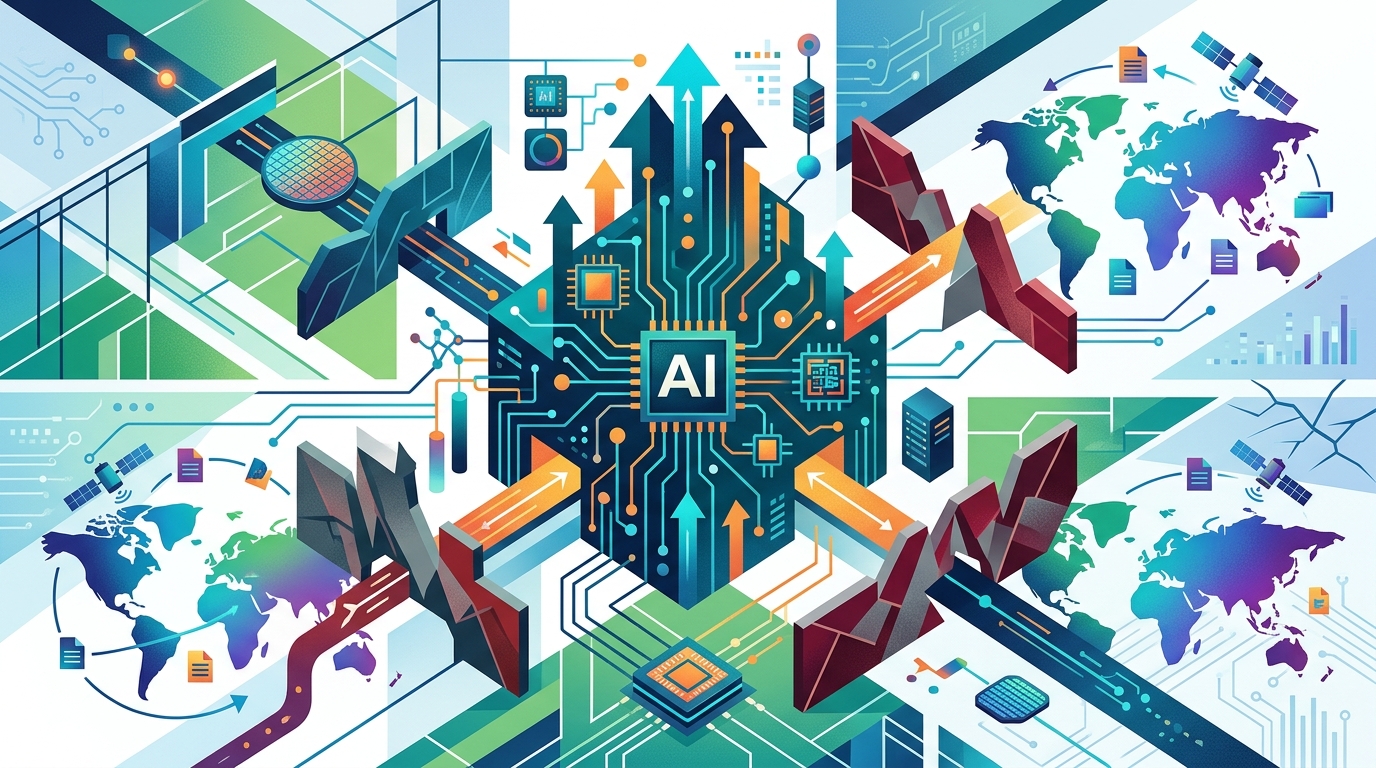
The news rippled through the corridors of Silicon Valley and the boardrooms of Wall Street like a seismic shift: Jensen Huang, the visionary leader of Nvidia and the face of the Artificial Intelligence revolution, is notably absent from the official business delegation accompanying President Donald Trump to Beijing this week. In an era where semiconductors are hailed as the 'new oil,' the exclusion of the industry’s most powerful player from high-level negotiations with China is no mere administrative oversight; it is a calculated political signal.
The Politics of Loyalty and the Semiconductor Dilemma
According to sources close to the White House, the selection of participants for this summit was not based solely on market capitalization or technological prowess, but on the degree of alignment with the 'America First' national strategy. Nvidia, which controls approximately 80% of the AI accelerator market, has long found itself in a precarious position. On one hand, China accounts for roughly 20-25% of its total revenue, and Huang has repeatedly warned that stringent US export controls could inflict 'irreparable damage' on the American tech industry.
On the other hand, the Trump administration appears to view Nvidia with a measure of skepticism. The company’s efforts to design 'lite' versions of its chips specifically for the Chinese market—intended to comply with regulations while maintaining sales—have been interpreted by some in Washington as an attempt to circumvent national security priorities. Huang’s absence from Air Force One suggests that personal charisma and market dominance are no longer enough to secure a seat at the table if they are not accompanied by absolute geopolitical fealty.
Competition and the Delegation's 'Winners'
While Huang remains behind in Santa Clara, other tech titans seem to be gaining favor. Reports indicate that the delegation includes top executives from Intel and Qualcomm—companies that have leaned heavily into domestic manufacturing via the CHIPS Act and maintained a more cautious public stance regarding Chinese trade relations. Their presence in Beijing underscores Trump’s intent to promote an agenda that prioritizes 'Made in America' production over the globalized design-and-distribute model that Nvidia represents.
- Intel appears to be successfully leveraging its status as a 'national champion' in semiconductor fabrication.
- Qualcomm maintains deep ties with the Chinese smartphone market but with a less volatile political footprint than high-end AI.
- Emerging semiconductor startups promising complete independence from Chinese supply chains are increasingly finding favor with Trump’s inner circle.
This move is expected to heighten pressure on Nvidia’s stock, as investors fear the company is losing its access to the decision-making centers that will dictate the future of Eastern trade. Without the White House’s explicit backing, Nvidia risks being caught in a pincer movement between Beijing’s push for technological self-reliance and Washington’s demand for technological containment.
The Strategy of Silence and the Future of AI
Nvidia has declined to comment officially on Huang’s exclusion, issuing only a brief statement regarding the company’s 'ongoing commitment to complying with US regulations.' However, analysts suggest that Huang may be opting for a strategy of strategic silence, betting that the indispensable nature of his hardware will eventually force the administration back to the negotiating table. 'You cannot run the future without Nvidia,' is the common refrain in the market.
'Technology is the new diplomacy, but in the Trump era, personal loyalty remains the strongest currency. Jensen Huang may be a king in the tech world, but in Washington, he is just another CEO who must prove his value to the national agenda.'
The question remains whether this isolation will drive Nvidia to accelerate its market diversification or if it will be forced to make painful concessions to regain presidential favor. Either way, the Beijing summit without Huang marks the end of an era where Silicon Valley could dictate its own foreign policy terms.





