

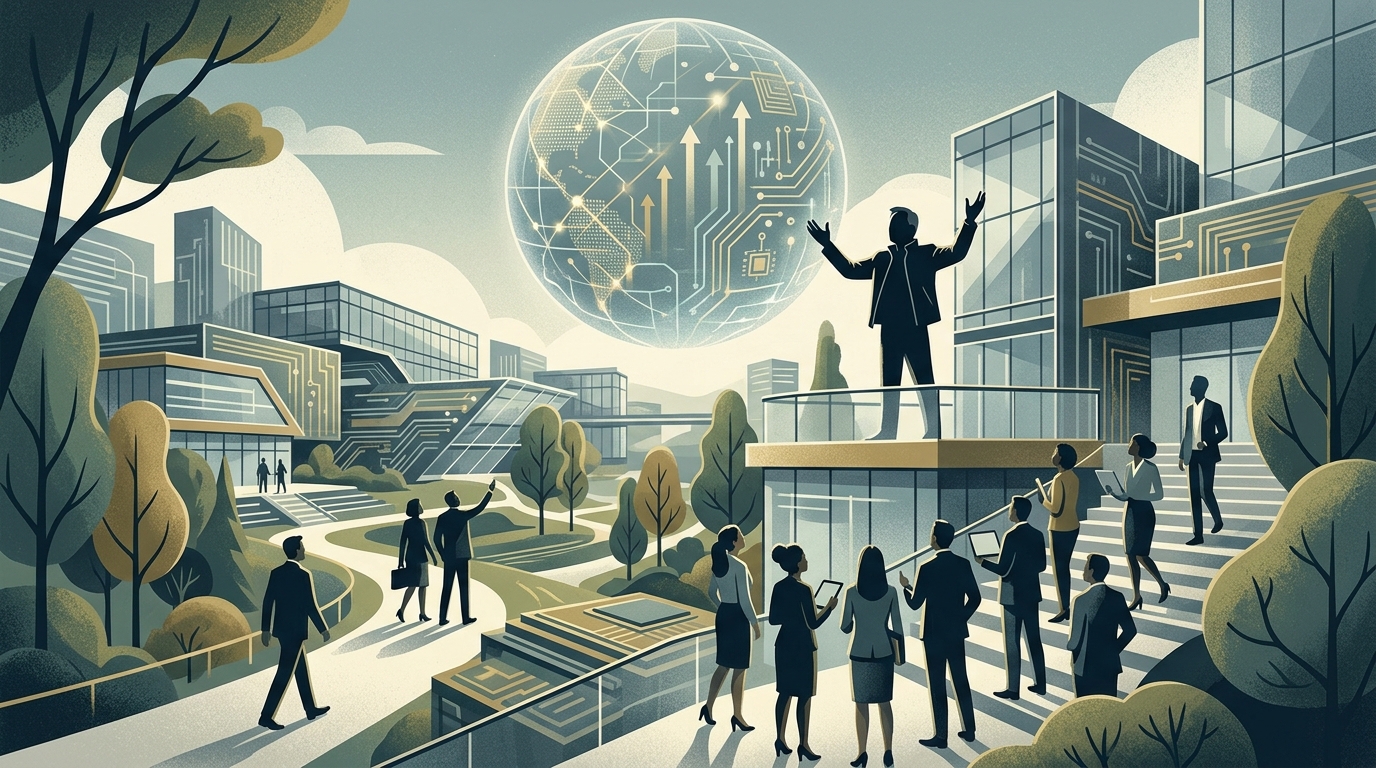
In an era where the global economy is desperately seeking its next major wave of productivity, Jensen Huang, the man who propelled Nvidia to the peak of the global market hierarchy, is sending a powerful message to the new generation. During his recent addresses, Huang moved beyond technical jargon to focus on the existential and professional significance of the current moment. For him, this is not merely a technological evolution; it is a "new industrial revolution" where knowledge and creativity are granted unprecedented tools of expression.
The Democratization of Programming
One of Huang’s most debated stances is his conviction that traditional coding, as we have known it, is fading, making way for something far more accessible. According to the Nvidia CEO, artificial intelligence has successfully turned human language into the most powerful programming language in the world. This means the gap between an idea and its realization has been effectively closed. “Everyone is a programmer now,” he frequently asserts, implying that the ability to guide an AI model (prompt engineering) is now more critical than memorizing the syntax of C++ or Python.
This paradigm shift creates a massive opportunity for those from non-technical backgrounds. Artists, biologists, economists, and sociologists can now leverage the power of Nvidia’s GPUs and Large Language Models to solve problems that previously required entire teams of software engineers. The "golden age" Huang refers to is exactly this: the era where human intent becomes the only limit to innovation.
The Strategy of Sovereign AI
Beyond the individual level, Huang sees a massive labor market emerging from the need for nations to develop their own "Sovereign AI." As governments realize that their data is a national asset, the demand for scientists who can train localized models—tailored to each country's specific culture and language—is skyrocketing. This creates a new career ecosystem that is not confined to Silicon Valley but extends from Athens and Paris to Tokyo and Riyadh.
- Development of national supercomputing infrastructures.
- Specialization in AI ethics and data security.
- Integration of AI into the public sector and healthcare.
Huang argues that young professionals should view AI not as a threat to their jobs, but as a "co-pilot" that will enable them to perform tasks once considered impossible. His advice is clear: “Run toward AI, don’t walk.” The speed of adopting these tools will be the defining factor separating tomorrow’s leaders from mere spectators.
The Importance of Adaptability and Continuous Learning
In this new landscape, a university degree is not the finish line, but the starting point. The Nvidia CEO emphasizes that curiosity is the most important asset. Technology is changing at such a pace that knowledge acquired two years ago may already be obsolete. However, understanding the fundamental principles of machine learning and system architecture remains a constant value. Nvidia, through its Deep Learning Institute, is investing billions in training millions of users, recognizing that its own success depends on how many people can effectively use its chips.
“We are at the starting line of a new era, similar to the discovery of electricity. Just as every factory then had to be electrified, every business and every career today must be augmented by artificial intelligence.”
In conclusion, Huang reminds us that success in the age of AI requires a combination of technical intuition and deep empathy. The ability to understand human needs and translate them into digital solutions is something no machine can fully replace. For this reason, the "golden age" belongs to those who manage to marry technology with humanistic values.





