

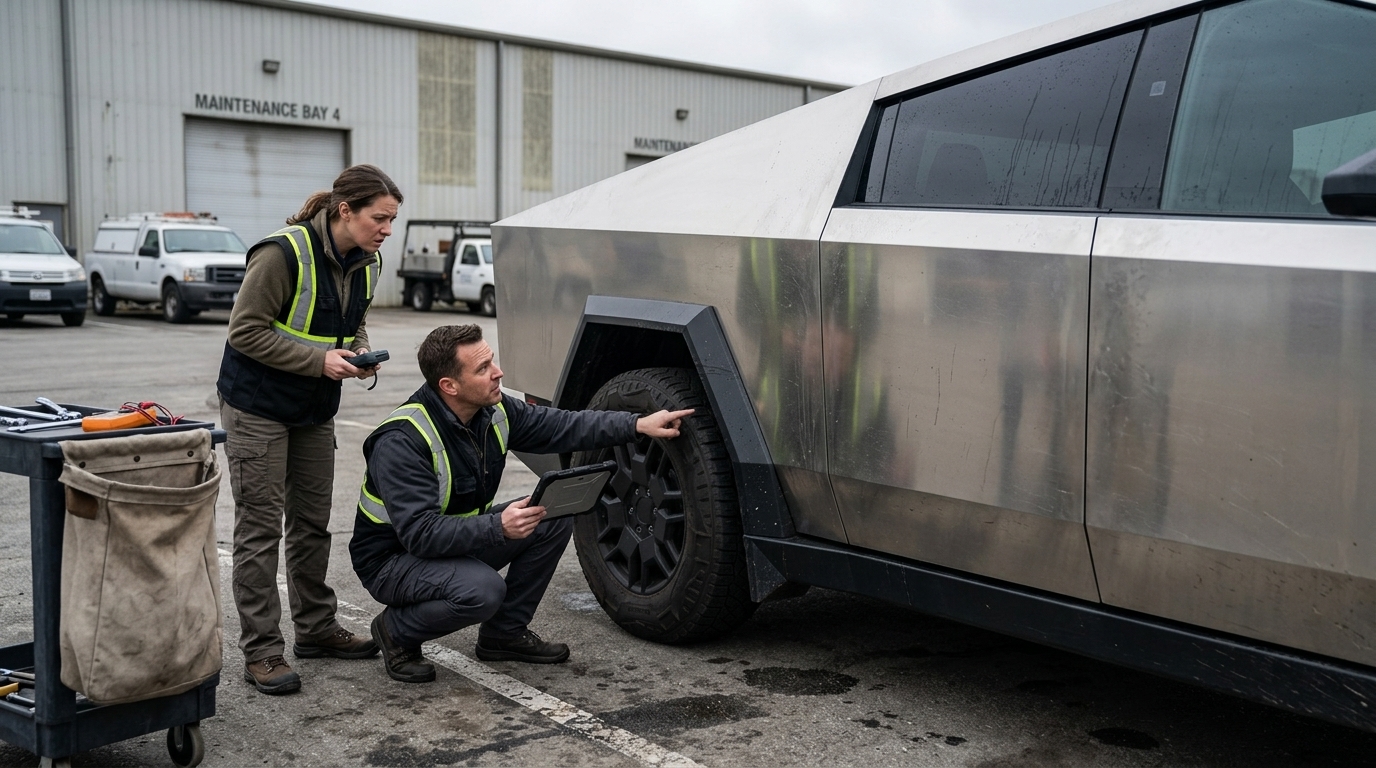
The story of the Tesla Cybertruck continues to resemble a voyage into uncharted waters rather than a standard automotive launch. The latest chapter in this turbulent journey is marked by a new, concerning recall. According to reports, a critical technical issue within the brake disc assembly could, under specific conditions, lead to the complete detachment of wheels while the vehicle is in motion. For a vehicle marketed as "bulletproof" and "apocalypse-ready," the prospect of losing a wheel on a highway is an irony that cannot be ignored.
The Technical Roots of the Failure
The specific problem lies in the interface between the wheel hub assembly and the brake discs. Tesla engineers and safety regulators have reportedly identified failures in materials or fastening processes that could cause excessive metal fatigue. Unlike previous recalls that primarily involved software and were resolved via over-the-air (OTA) updates, this case requires physical intervention at the company’s service centers. This adds a significant logistical and financial burden to Tesla, as the inspection and replacement process is labor-intensive.
This is not the first time the Cybertruck has faced issues affecting core road safety. From accelerator pedals getting stuck due to a faulty cover, to windshield wipers failing and body panels showing signs of oxidation, the vehicle seems to be paying the price for its unconventional design. The use of stainless steel and the rejection of traditional manufacturing methods have created challenges that the automotive industry had solved decades ago.
The 'Move Fast and Break Things' Culture in Automotive
Elon Musk has successfully ported the Silicon Valley philosophy into the production of heavy machinery. The "move fast and fix later" strategy works exceptionally well for social media apps or software, but in the case of three-ton vehicles, the consequences can be fatal. The U.S. National Highway Traffic Safety Administration (NHTSA) is closely monitoring Tesla, with recalls accumulating at a rate that would have crippled any other traditional automaker. However, Tesla maintains a unique ability to manage crises through direct communication and a fiercely loyal fan base.
"Safety cannot be an afterthought corrected by updates. When discussing the structural integrity of a vehicle, innovation must yield to the certainty of proven engineering."
This new recall affects thousands of recently delivered vehicles, causing frustration among a customer base that paid six-figure sums to own a piece of the future. While Tesla claims no accidents or injuries have been directly linked to this issue yet, the proactive nature of the recall underscores the severity of the situation. Owners are being urged to schedule service appointments immediately, while production lines at Giga Texas may face further modifications to integrate the corrected parts.
Reputational and Market Implications
For analysts, the Cybertruck remains a double-edged sword. On one hand, it is a phenomenal marketing tool that reaffirms Tesla's dominance in technological vanguardism. On the other, the constant stream of recalls bolsters the argument of critics who claim the company struggles to maintain mass-production quality standards. At a time when competition from China and traditional powers (Ford, Rivian) is intensifying, Tesla cannot afford to be perceived as unreliable.
In conclusion, the Cybertruck wheel recall is a stark reminder that physics does not bend for hype. Tesla is now challenged to prove it can mature as a manufacturer, maintaining its revolutionary spirit while simultaneously safeguarding the lives of its drivers. Whether the Cybertruck will go down in history as a technological marvel or a costly eccentricity will depend on how quickly the company can plug these holes in its manufacturing quality.





