

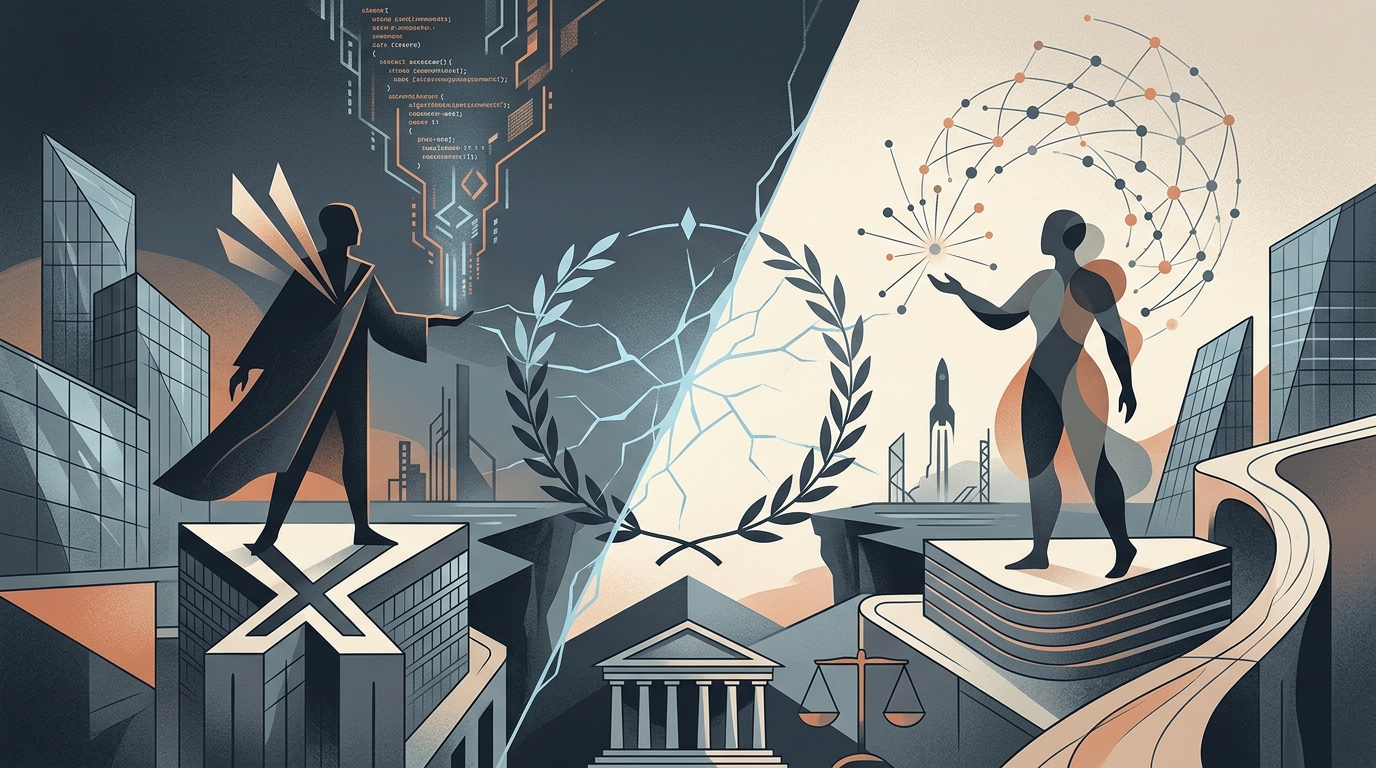
In the heart of San Francisco, a courtroom has become the theater for a battle that will define the future of global technological governance. The trial between Elon Musk and OpenAI, the organization he helped co-found, has officially commenced with jury selection. This marks the climax of a multi-year feud that transcends mere business litigation, touching upon the very philosophy and ethics of scientific progress.
Musk, who stepped down from OpenAI’s board in 2018, alleges that Sam Altman and Greg Brockman betrayed the organization’s foundational mission. According to the lawsuit, OpenAI was established as a non-profit dedicated to developing Artificial General Intelligence (AGI) for the benefit of humanity, insulated from commercial pressures. Today, Musk claims the company has devolved into a de facto “closed-source subsidiary” of Microsoft, prioritizing profit maximization over safety and transparency.
A Conflict of Visions: From Altruism to Equity
Musk’s legal argument hinges on what he terms the “Founding Agreement.” While OpenAI maintains that no formal written contract exists binding the company to a permanent non-profit status, Musk’s attorneys are presenting a trail of emails and internal communications dating back to 2015. In these exchanges, Altman appears to endorse the idea of an open structure designed to prevent the concentration of immense power in a few corporate hands.
OpenAI’s defense, conversely, characterizes the lawsuit as an attempt by Musk to hijack the success of a company he didn't believe in enough to sustain. They argue that the transition to a “capped-profit” model was a pragmatic necessity to attract the billions of dollars required for the massive compute power needed to train models like GPT-5. “Elon asked us to merge with Tesla or give him full control,” a source close to the company stated, “and now that we’ve succeeded without him, he’s attempting to sabotage the mission.”
Market Implications and the IPO Shadow
The timing of the trial could not be more sensitive for OpenAI. With the company’s valuation soaring past $100 billion, rumors of an impending Initial Public Offering (IPO) in late 2026 have been circulating widely. However, as Bloomberg Opinion columnist Dave Lee notes, the legal uncertainty could freeze investor appetite. If the court finds that OpenAI must return to its non-profit roots or open-source its proprietary technology, its commercial business model could evaporate overnight.
Furthermore, the discovery process is expected to unearth sensitive internal documents regarding “Project Q*” and other classified breakthroughs that OpenAI views as milestones toward AGI. Exposing such intellectual property could provide a strategic advantage to rivals like Google and Meta, while simultaneously fueling concerns among US and EU regulators regarding the safety and oversight of these autonomous systems.
What’s at Stake for Humanity?
Beyond the balance sheets, the Musk-Altman showdown asks a fundamental question: Who should hold the keys to intelligence? Musk argues that AGI is far too dangerous to be controlled by a private corporation driven by quarterly earnings. OpenAI counters that only through the scale and resources of the free market can the technology be developed safely and competitively. The jury’s decision in San Francisco will not just decide the fate of one company; it will set the precedent for how civilization manages its most potent creation.
- Musk’s legal team seeks to void the exclusive licensing agreement with Microsoft.
- OpenAI alleges Musk is suffering from “founder’s regret” and competitive jealousy.
- Key witnesses are expected to include the elite of Silicon Valley’s venture capital world.
- The verdict could redefine fiduciary duties for hybrid non-profit/for-profit entities.
As testimonies begin, the tech industry watches with bated breath. It is a clash between two former allies who once shared a vision of saving the world, now locked in a zero-sum struggle where the winner takes the future.





