

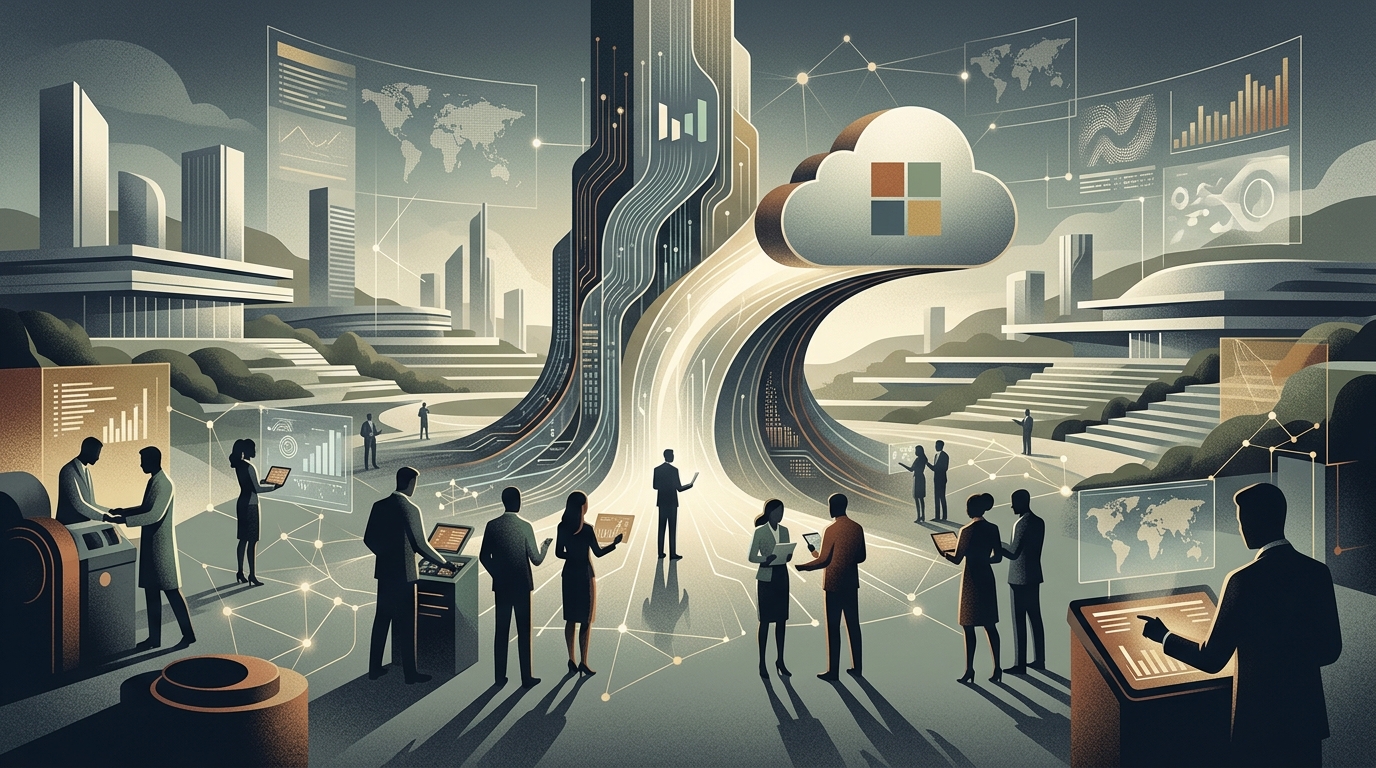
In the fluid and often contradictory landscape of global technology, few stories resonate as strongly as the revelation that ByteDance, the Chinese parent company of TikTok, has committed to spending over $1 billion annually on cloud services from Microsoft. This news, confirmed by industry sources and market analysis in mid-June 2026, highlights a profound irony: while Washington and Beijing remain on a collision course over AI supremacy and data security, the commercial ties between their corporate giants remain not only intact but exceptionally lucrative.
The deal primarily concerns ByteDance’s access to OpenAI’s models through Microsoft’s Azure platform. Despite ByteDance developing its own sophisticated large language models (LLMs), such as Doubao, the necessity for global scaling and the perceived superiority of GPT models for specific international applications have led them to Redmond’s doorstep. This move is not merely a procurement of services; it is a strategic choice for survival and growth in a hyper-competitive environment.
The Geopolitical Chessboard and Tech Dependency
The timing of this commitment is particularly charged. With TikTok facing relentless pressure to divest or face a ban in the United States due to national security concerns, its reliance on Microsoft’s infrastructure creates a paradoxical web of protection and risk. On one hand, utilizing American servers and AI services could be viewed as a step toward compliance with Western transparency standards. On the other, the fact that a Chinese entity is funneling billions of dollars into an American titan complicates the narrative of "decoupling" championed by many political circles.
Microsoft, for its part, is demonstrating a remarkable ability to navigate these turbulent waters. As the primary provider of OpenAI’s models, Azure has become the de facto infrastructure for the "AI revolution." The agreement with ByteDance underscores that Microsoft is not just a software company; it is the "arms dealer" of the modern digital age, providing essential tools even to those considered strategic adversaries of the United States.
Financial Impact: Cloud, AI, and Dividends
For Microsoft (MSFT) investors, ByteDance’s commitment is a clear signal of dominance. The $1 billion annual figure represents a significant portion of Azure's AI-related revenue, bolstering margins at a time when the company’s capital expenditures (CapEx) for data centers are at historic highs. The market has reacted positively, seeing this deal as confirmation that demand for AI services is inelastic, even amidst geopolitical uncertainty.
- Market Dominance: Microsoft is solidifying its position against Amazon (AWS) and Google Cloud by attracting clients with massive computational needs.
- Revenue Model: The shift from traditional SaaS (Software as a Service) to AIaaS (AI as a Service) is proving to be highly profitable.
- OpenAI Strategy: The exclusive partnership with OpenAI continues to bear fruit, making Azure the gateway for the world's leading AI technology.
Challenges and Future Outlook
However, the deal is not without risks. Regulatory scrutiny is expected to intensify. The U.S. Department of Commerce is closely monitoring tech exports and the provision of cloud services to Chinese firms. If restrictions tighten further, Microsoft may find itself in the difficult position of having to sever a highly profitable partnership. Furthermore, ByteDance is not standing still. It is investing billions in developing its own AI chips and domestic infrastructure in China, aiming for long-term independence from Western providers.
In conclusion, ByteDance’s commitment to Azure AI serves as a reminder that in the digital economy, borders are often more porous than political rhetoric suggests. Artificial intelligence requires such scale and resources that even the world’s largest players are forced to collaborate with their rivals. For Microsoft, it is a victory of both prestige and substance. For ByteDance, it is the price of remaining at the pinnacle of the global technological pyramid.
"In the age of AI, power is measured not just by the ownership of data, but by access to the compute power that makes it actionable."
As we move deeper into 2026, the evolution of this relationship will serve as a barometer for the future shape of the global web. Will technology manage to bridge the gap between superpowers, or will it become the very tool of their final rupture? The answer lies within the code and the data centers powering our daily lives.





